Icebergs

I was dealing with an iceberg yesterday. The iceberg in this instance was a story twist; I could see the tip but not the vast majority of it.

That’s what causes writing to be fun and challenging for me. I like seeing the tip of teh story and the concept and then imagining and writing to find the hidden depths.

people and then imagining what’s unseen underneath, discovering bravery and cowardice, honesty and betrayal under that tip.

The same is true with those characters. I often see and begin with the tip. Writing the story reveals the rest of the character’s iceberg. While I begin with a general idea of the character’s traits and their role, more becomes revealed as the story’s icebergs are explored.

Walking yesterday, and watching drivers making errors, I thought about how much we as people are ice bergs. I saw drivers making bone-headed errors in judgement. I had to remind myself that that was just the tip, and it wasn’t a matter of awareness, intelligence, or ignorance, that broad labels that I often misapply. I don’t know what mental, physical, and emotional issues are attacking them, what problems that they’re dealing with through meds, thought, or by fleeing. They might be driving, but we don’t know what’s happening in their brains and bodies.

Most of us are the same kind of icebergs on the outside, a typical bi-ped. Despite commonalities between us, like a body, two eyes and ears, and a head, things are different inside. Inside that head is a brain, and in that body are organs. Lots of chemicals are being produced and are being employed via neurons and neuro-transmitters and receivers.

It all doesn’t work the same, right? Have you seen any of the studies about the right amygdala and its size and activity in people who tend toward being conservative in their political views? Their right amygdala is larger and often more active. They tend to be more fearful, and tend to dislike change.

That doesn’t mean they’re cowards. Being fearful and being a coward aren’t the same.

The study also found that the amygdala’s activity could be shifted, and that shift affected people’s outlook. It all began with the observation that the United States became more politically conservative after the attacks of 9/11. A Business Insider article by Hilary Brueck best states it:

“The hypothesis social scientists developed about this effect is perhaps best summed up in a 2003 review of research on the subject: “People embrace political conservatism (at least in part) because it serves to reduce fear, anxiety, and uncertainty; to avoid change, disruption, and ambiguity; and to explain, order, and justify inequality among groups and individuals,” it said.”

A Yale psychologist, John Bargh, wrote about it in a new book, Before We Know It: The Unconscious Reasons We Do What We Do. Bargh explores how our brain’s responses affect our political views, and how that can be changed. For example, in one experiment, after a baseline about political views was established, an exercise was conducted. In the exercise, everyone was told to imagine they were like Superman. Bullets bounced off them. Fire couldn’t hurt them. They’d survive falls off a cliff without injury, and they could fly.

That exercise caused a dramatic change among conservatives and their responses, but no change among liberals. The exercise enabled conservatives to feel safer and less fearful, which triggered more compassionate and optimistic responses in their political views. They became more open to change, and more hopeful.

It’s something that we should keep in mind as we drive around and encounter one another. It’s not always about facts and logic, intelligence and awareness. We’re all icebergs, and what we see is only the tip.

It’s also something to keep in mind as we write about our characters and their motivations and actions.

Time to write like crazy and explore my icebergs, at least one more time.
Choice of Direction

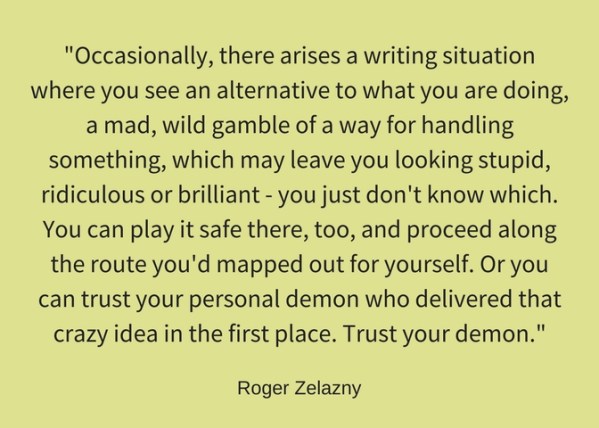
As I take up the next chapter, I’m faced with sudden choices. I thought the path was clearly defined when the chapter was begun, yet, when I wrote it, it took unexpected twists and ended up somewhere else. Once there, I saw two new options — and then a third, and a fourth. That forces the writing phase that I call “sitting at a computer with a cup of coffee and staring out a window thinking.”

I know I won’t be able to decide in this session. In a way, it’s like a chess match, where multiple future moves are considered. No, I’ll probably finish the coffee and get up without writing another word, and then I’ll go walk for a while and continue to think. I probably won’t decide while I’m walking, either. I’ll continue to think about the options and moves until I return to write like crazy tomorrow. Then, without making a conscious choice, I’ll begin writing, and let it take me.

That’s the process: realize, and think, letting it brew and simmer, and then write by letting the words take me. When I’m in these moments, I’m reminded of the scenes in Stranger than Fiction when Emma Thompson, as the author, Karen Eiffel, smokes cigarettes and wanders around, considering ways to kill her main character.

I so enjoy those scenes.

The Winding Road

As the current sub-plot and story line of my work in progress winds along like a leisurely country drive, I curb impatience to be done. If I had to describe myself, impatient is a word I’d consistently employ. I’m continuously monitoring and struggling with my impatient urges to be done, to move on, to get there, to get finished, etc.

Today, motoring through the scenes I planned to write, I realized that I wasn’t as close to being finished with the work in progress that I’d hoped and believed. I’m enjoying writing it. It’s weird to say that it’s a leisurely write, because I write several thousand words a day (knock on wood – don’t want to scare off the muses), and edit it every day. Yes, I’m a writer that edits as I go, because my writing is an organic garden in progress, and requires constant attention. I usually edit the volume in progress (number four), but sometimes jump back and edit the others. They’re all beta, and will require more work when they’re done before they’re finished.

I want this series done so I can go on to other books that I’ve begun or planned. One is from a story idea a fan sent me. “What can you do with this concept?” she asked. Answering her, I ended up writing about forty pages. I stumbled across it last night, and enjoyed what I read, and remembered what else was planned, and I feel like I owe her to finish it.

The second project that I want to continue is the third novel in my Life Lessons mystery series. Readers of the first two books have asked several times, “When is the third one coming out?” Soon, I promise, as soon as I finish this work in progress. I’d written five chapters of it before getting distracted by the current concept, and read some of that last night, and remembered, “Oh, yes, there’s so much to write here.” I had several more sequels planned in the series and had a broad outline of that developed. And, as I write this fourth volume of the current WIP, a fifth volume keeps tugging on my sleeve.

Not enough time, you know? Those are just a few of the dozen items in the writing bucket. But, c’est le vie, this is the writing life.

Now time to write like crazy, at least one more time.

The Midnight Writer

Have you ever been about to shut down the laptop for the day and go to bed when a sudden insight into a scene overtakes you, so you think with excitement, well, I’ll just sit down and add that part or make that change, it’ll just take a minute, and then you get into the work in progress, and look up to discover, holy hell, it’s ninety minutes later?

Yes, it’s at once irritating, satisfying, annoying, and exhausting. That damn muse has no sense of time.

Speaking of time, time to write like crazy, at least one more time.

E Cubed

Energy, exploring, and expectations.

The more I write fiction, the greater I understand that much of my writing is about exploring what I’m thinking and understand (and then trying to explain and share it by putting it in a story), and managing expectations about writing.

Some days, about one in fifty, I think, I don’t want to write. It’s mostly because I weary of my routine and want a time out. This typically happens when multiple energy levels – creative, physical, intellectual, mental, and emotional, let’s say – simultaneously drop to low levels. That puts me in a black place. That’s when I must dig deepest and longest to sit down and start typing those first words. If I can make it through a paragraph, I’ll persist and write several pages.

I know this. That’s when managing expectations enter my personal equation. Like everything else, my writing efforts reside on a spectrum. I know there are days when the words leap effortlessly through mind and onto media (and I love those days, and thank the Universe for the experience). On the spectrum’s opposite end on those weary, turgid days. Not only do I not want to write, but I’m also pretty much a much larger asshole than I am on other days. My tolerance, patience, and bonhomie seem completely drained on those days.

I also know that regardless of my approach and expectations to writing (and editing, and the rest of the writing process) on those days, I can rarely tell the difference in the end product. I edit, revise and polish too much. I tend to write the bones down in a flurry, and then more leisurely add details, bridges, and expansion. For instance, the first line of a new chapter begun the other day ended up being the first line of the sixth paragraph by the time I finished the chapter. That line was the part of the scene I first saw, but then the light grew wider and brighter, and I saw more of the scene, and entered the characters and their expectations and participation more deeply.

I know all of these things because I’ve explored myself and my approach to writing, and what I like and dislike about my processes. And then I write and post about it because that helps me clarify my understanding. Sometimes, other writers respond, and let me know, “Hey, me, too,” and that helps, too, because I see that I’m just another normal, fucked up writer. I might even be human.

Time to write like crazy, at least one more time.

The Intersection

I dreamed about my work in progress last night, specifically about the story-line now being addressed. My mind, being what it is, inserted me sometimes, so that I was part of the story. My mind, being what it is, would see that I was dreaming about my writing and including myself as a character, and then try to untangle me from the fiction being written. “I’m the writer. I’m not supposed to be in this story.” That would lead to dream-confusion among the dream participants (dreampants?) about what was going on. It was really…interesting.

Which, after awakening to think about it, demonstrates an intriguing intersection between who I am and how much I put of myself in my writing. Even when I deliberately decide to have a character do or speak in ways that I wouldn’t, that choice is based on what I’d be doing. My characters are composites of other people, but I’m essentially imagining how those folks would respond. I don’t know, though. I don’t have a secret window into their lives. I guess at what they’d do, twisting their responses into madness and lies, and courage and hypocrisy, betrayal and honor, all based on what I think I’ve heard them say and do, and the character’s arc. You all know how unreliable we are as witnesses. We color it all.

But in there, in the intersection between my dreams and imagination, and my choices and decisions, is where my writing takes place. Sometimes it’s a large intersection – or even a roundabout, with too many cars traveling too fast, all trying to change lanes and enter and exit at the same time – and other times, it’s two small animal paths meeting in a quiet field. Whichever intersection it is, I sort it and write.

Time to write like crazy, at least one more time.

Good Feeling

Isn’t it a good feeling when the writing energy is boiling up in you like a volcano about to lose it, and you finally sit down to write and let it all pour out?

No, it’s not a good feeling, it’s fantastic.

Time to write like crazy, at least one more time.

My Five Writing Rules

I have simple writing rules. It’s a complicated world, so why burden myself with greater complications?

  1. Write every day. Writing every day helps me maintain story continuity, and making progress is tangibly reassuring. I also like the practice and discipline, but as an amendment to this rule, I stay flexible and adapt. I don’t sweat it if I can’t write every day. Okay, I confess, I sweat it, but I endure with the promise to myself, “I will write again.” 
  2. Write like crazy. Yep, put it down, one word after another, and let it flow like lava escaping an erupting volcano. Then, edit, polish, edit, polish, revise, re-write, and edit and polish. It’s a rare sentence that is not changed in some manner between first thought and final edit. After grudgingly accepting that re-writing, polishing, and editing are necessary, I now enjoy this process. Writing like crazy is a fast and intense process, but the polishing, etc., is loving, and let me feel the novel and see how it breathes.
  3. Don’t overthink it and don’t write for anyone else. Man, I get angst about what I’m writing. I worry that it’s crap, and I suffer the imposter syndrome. Even as I write and enjoy what I write, I worry that others won’t like it, that it won’t measure up as professional, meaningful, entertaining, or original. I fear the moment when someone stands up, points a finger at me, and shouts, “J’accuse! You are not a writer.” However, I’m also ready to respond, “Fuck you, jack.” Of course, that won’t prevent me from brooding about it.
  4. Create and maintain a support structure. Like anything that you consider imperative, such as eating properly, exercising, or family time, it was critical for me to let others know that it’s writing time is important. In return, I set a schedule for it, and adhere to it, so that they know when I’ll be writing. Telling others – coming out of the writing closet, if you will – was a huge step. People respect the effort. Telling my wife, and her support of my writing efforts, were tremendous boosts to my ability to go off and write every day. Writing is already a solitary and lonely business, but her support reduces the struggle by an immeasurable chunk.
  5. Don’t talk to others about the novel(s) in progress. People will ask, and I do want to share. But it’s so easy to let that writing excitement overpower the moment. I end up going on and on, regaling them about the characters, concept, plot and complications, even as I understand that it’s in beta, or first draft, or whatever, and subject to change. Just answer politely in vaguely sensible terms, change the subject, and let them escape for being a good friend and inquiring.

Any rules that work for you that you want to suggest? No pressure.

Time to write like crazy, at least one more time.

Six Days, Seven Nights

I’m feeling so much better today. The cold seemed to have taken a cruise of my body for six days and seven nights. They really seemed to party in my eyes, for that was the worse day and lasted almost two days. The cold briefly ported in my chest at the end, and barely visited my throat in the beginning. Although I didn’t walk and exercise as much as desired, I wrote every day. There was no vomiting, and bowel movements were normal. Severe coughing only struck the last two days. As illnesses go, it was pretty mild and short, and I consider myself fortunate that I feel almost completely well today.

Thanks for indulging me as I complained about it. Time to write like crazy, at least one more time. Cheers

Blog at WordPress.com.

Up ↑