Tying Up

I finished another chapter. Serving like a flare in the night, it lit more of the final stages of the novel, Good-bye, Hello, and the Incomplete States series. Seeing those pieces, I re-arranged one chapter and wrote the beginning of another. As I wrote that, the segue off a previous chapter appeared. This was the opening to the final final piece. I laughed at the phrase even while I juggled pieces in my mind and saw it all come together with the ending already written. A chill thrilled me as I read the pieces. So satisfying and fun, visiting this world and these peoples, and all their myths, technology, travels, and adventures. They move into this last phase with hope, but I write with bittersweet inevitability.

It’s been a fun journey with these concepts, and narrowing the focus of the concepts into a tighter and tighter frame. Once again, revelations and realizations surprised me. These mostly involved Kything, Kything, who began as Professor Kything, named in honor of the term from A Wrinkle In Time. Kything was not who they thought.

Kything was not who I thought.

There’s more of him still to be revealed to me. The revelations and patterns remind me of a difficult Sudoku. After wrestling with logic and patterns, hunting for the final solution, a key square was just completed. With it came the insights to finish the puzzle.

Even as I think that it was a wonderful day of writing like crazy, I’m beginning to grow sad, because I see this marvelous journey coming to an end. Yes, a lot of writing remains, and then the the editing and revising marathon begins, but those are different skills, with a separate satisfaction to them, than the unbridled creative flow of raw writing.

I feel a quiet chuckle as I realize, this feeling I have is just like how I feel when I’m finishing reading a good book.

The Love/Hate Thing

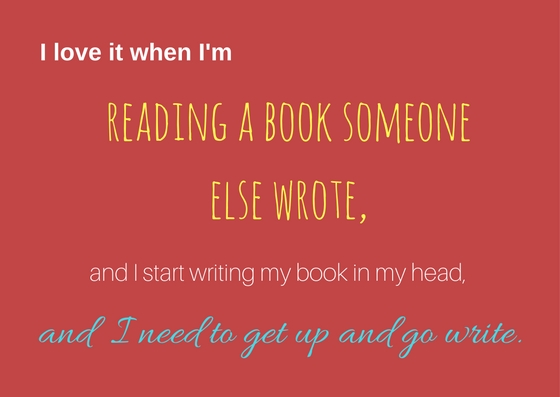
It’s a love/hate thing for me when I find another’s blog (or, like today, several), start reading their entries, and enjoy them so much that they divert me from my writing mission, and I explore their blog to see what else they offer. It’s at once diverting in several ways but also satisfying and rewarding. Reading stimulates writing. I don’t know if more hours in a day would solve anything, because I think I would just read more and want to write more.

Time to take a deep breath, drag some discipline out from my depths, pin the blogs aside, and write like crazy, at least one more time.

Pulling Threads Together

When I finished writing yesterday, I’d completed another chapter. Now I had three chapters that needed to be pulled together. Each was a thread that seemed unrelated to the others, even though I knew they were related.

Walking along, I thought about that writing process. I’d envisioned something happening to these characters, gone down several side trails (creating the three threads) and now had to tie them together to return to the original story line. I thought about how much of my writing seems like problem solving, and things I’ve done all my life, from solving math problems in school to logic problems done for pleasure, personnel issues because I’d become a manger, on to difficult business cases that required me to find, compile, and analyze data using spreadsheets.

I’ve heard people say that they wrote something but didn’t finish it, because they didn’t know what to do next. Resolving those things shouldn’t stop us, if we’re writers. We dig more deeply, searching for ways to finish the story we’re telling. How we get to that point that we find a way varies. I walk and noodle, and sometimes read other books. Reading fiction often seems to open another door in my mind. It’s a fresh reminder of the importance of reading if you’re writing. Reading stimulates my imagination and creativity.

While I walked and thought, I recognized that I was also intimidated. I was afraid of making a mistake, tying the three together. It’s a major moment in this series.

That amused me, since I knew that what I wrote when I write like crazy is rarely the finished product. I make mistakes, and correct them, trying to improve the story and how I’m telling it. But I also realized that I was over-analyzing what was going on, a regular problem I have with myself for everything from deciding what to order on a menu to, well, writing a novel.

I also laughed at myself because I thought, a million words written, and it seems like a million more to go. It staggered me to think that these four novels plus the support documents for this series added up to over a million words. It didn’t seem like a million words, but I never thought about the sum total when I wrote them. I just wrote, word by word, and it all came together.

It reminded me, too, of walking to get somewhere, and stopping partway through the journey because I’m hot, sweaty, and tired, and realized, I’ve come so far, but there’s more to go. So I pause, look around, accept that I have to walk on to get anywhere, and continue on the path that I began to follow.

So, deep breaths, I told myself. Just sit down, have some coffee, and write. I’ve written a million words; what’s a million more?

Okay, I’ve had the coffee, and I’m sitting down. Time to write like crazy, at least one more time.

Sporadic Update

An organized compilation of random subjects plaguing me that I may have posted about, but which I think I should update readers about.

  • The Trial. A plea bargain was accepted so I don’t need to testify about the break-in. The saddest aspect (besides tangible evidence that strange, sick people are out there) is that our beloved neighbor, Barb, has moved out. She’s just too frightened in her house any longer. That’s troubling. Barb and Walt were two of the best things about our location. Walt’s passed away and Barb has moved away, moving me to sigh about change and life.
  • The close call. I survived one close call in April, when I endured one of the worst haircuts I’ve ever received. This young ‘stylist’ was clearly a novice and took to my head with the same sense of style that military barbers employed when I entered basic training. Fortunately, my hair has grown out into something that looks reasonable again.
  • Tucker. Tucker suffers from conjunctive gingivitis. We submitted him to some oral surgery in April. It went terrific. Several teeth were removed, including one of his big lower front fangs, if you will, but he’s not having any swelling, bad breath, pain or drooling, so hooray! On the coin’s flip side, he’s feeling so much better that he’s very energetic and wants to assert his position as the alpha beast.
  • Other cats. Peace has been brokered between Meep (a.k.a. Popi) and Boo Radley. Boo’s PTSD also seems to be diminishing. The big bedroom bagheera without a tail has become more trusting of us. Quinn, of course, remains Quinn, a sweet, charming cat who prefers to avoid conflict.
  • Neighbor cats. Pepper, Princess and Buddy continue their visits and begging. Pepper remains the worse. That’s a little surprising. We always believed Wade’s corgi, Bella, annoyed Pepper, driving her toward us. Sadly, Bella passed away from cancer last month. She’ll be missed but with her absence, we thought that Pepper’s daily visits would taper off. They still could, with time. It could be that what was once refuge is now habit, though. Buddy is a sweet little black character. He’s clearly well-fed, but enjoys being petted and presented kibble, which, being a sucker for cats, I do.
  • The cats’ activities interfere with yard work. Here they come when I make an appearance, pop, pop, pop, Pepper, Buddy and Princess, pop, pop, pop, Boo, Meep and Quinn. (I keep Tucker away for the safety of the rest.) Boo likes to settle right beside me, instructing me about what I’m doing wrong as I weed and mulch while the rest visit each other and observe me. All flee to safe distances when the edger and mower come out.
  • Fitbit. I took some Fitbit hits with the travel last month. Daily mileage on average dropped to five and a quarter miles per day while the average of steps per day dipped to about twelve thousand for the year to date. But summer is here, so I have hope I can raise those averages.
  • Reading. Just read four books in April: ‘Ordinary Grace’ (which I loved), ‘I Am Pilgrim’ (a quick, fast read that had some flaws but remained compelling), ‘The Passenger’ (although interesting, a disappointment), and ‘The Devil’s Star’ (a Jo Nesbo Harry Hole novel). Just started ‘The Shadow of the Wind’ at my other’s insistence.
  • Writing. Really hope to finish ‘Long Summer’ soon and get it out there. Its complications absorb a lot of limited brain power keeping it all straight and then trying to present it in a manner that won’t cause insanity among readers. Still *ahem* haven’t leaped back into publishing like I wanted/planned/expected but I remain determined to do so. ‘Peerless’, ‘Everything in Black and White’, the Spider City’ trilogy, and ‘Fix Everything’ all need to undergo the editing and publishing process. Meanwhile, I’m really eager to write the third book in the Lessons with Savanna mystery series.

There are other things to write about, of course, particularly on the family fronts, but I shield them and their activities, so I post very little about that. Politics, technology and economics remain passions that deserve posts but I end up diverting too much energy to write much about them. Dreams are experienced every night, so I could write about those, too, like last night, when I didn’t like how the dream was going, and changed it in the middle, astonishing everyone in the dream. We’re also undergoing the annual raccoon invasion, and dealing with yard work. My wife’s health continues to be a concern while I remain stupidly healthy. Trips and adventures are planned, and we’re hopeful we can pull some of them off this year and not get sucked back into the black hole of family issues.

Overall, I’m excited, optimistic and hopeful, a great way to live. The writer is pestering me to get on to it with Brett, Philea, Handley and the rest, so it’s time to write like crazy, at least one more time.

Truths, Re-discovered

I read a wonderful book during recent flights. ‘Ordinary Grace’, by William Kent Kreuger, won a few prizes since its publication. My wife recommended it to me. “It reminds me of ‘Peace Like A River’,” she said, a book we both enjoyed.

“Who wrote that?” I asked. We both came up with Leif and nothing else. We were in the car, without computers and the phone wasn’t picking up a signal, so we couldn’t look up the name. Finding the novel’s author was put on the to-do list.

Yes, ‘Ordinary Grace’ reminded me of ‘Peace Like a River’, but I also thought of some of Louise Erdrich’s novels, as well as ‘A Separate Peace’, by Thomas Knowles, and even Harper Lee’s treasure, ‘To Kill A Mockingbird’. Gorgeously written, it was beautiful story telling, the sort of writing that incites a riot of fears, envy and worry in me. I want to write novels like this, and after reading ‘Ordinary Grace’, I was afraid that I wouldn’t. I was afraid the current novel-in-progress (NIP) was a miserable failure.

After finishing the novel, I stewed while visiting with friends and family and suffering through the requirements of socializing. They say you’re not normal if you don’t socialize, if you fail to sit down and chat, making small talk or exchanging witticism and sparkling insights regarding movies, politics and the economy. Though I’ve lived sixty years, employing my tongue to make demands for food, answer questions, and make presentations and speeches, I remain a novice socializer. Contrary to some opinions, it’s not a choice I consciously embrace, but that’s an altogether different post.

When I was finally freed to sit down and write, I entered my NIP, prepared to revile it. Surprise instead comforted me, surprise that it wasn’t the miserable pastiche of words that I’d decided it was, because it came to me. After reading the opening chapters and correcting a sprinkle grammar, spelling and punctuation issues, I went away satisfied that I’m not the horrendous hack that I’d accused myself of being.

I continued to think about why I liked those books so much, what it was about their imagery, story-telling, pacing, arcs and characters that reduced my writing confidence. First, these stories all harkened to eras that I understood through living, television, movies or other books. That’s a helpful, useful advantage. Phrases and expressions of the times could be used without elaboration or explanation because we knew these things. 

Second, I recognized that I could love to read certain types of novels without being a writer in those genres. Third, I can create the imagery and other matters I regarded as so masterful. It is work, requiring more critical and ojbective appraisal of what I’ve written to refine, polish and improve.

Yet, another truth runs under the surface. Years ago, I learned about the window of five. Its application then was about approaching suppliers and customers, and viewing their requirements through five windows to develop deeper understanding and forge stronger relationships. I’ve since extended windows of five thinking into other realms, such as fiction writing. Without resorting to extensive diagnosis, dissection and explanation, it’s possible to utilize windows of five thinking to peel layers back and garner insights into novels.

The truth about these novels was their power to engage, involve and inspire me is intimidating because it was artfully accomplished. Regardless of the genre or author, my goal as a reader it to find books like these, because, in the window of five about what they bring to me as a reading experience, I escape now, and am transported to somewhere else. I’m moved by the characters’ experiences and I identify with their issues. I learn some lessons, often about myself and how I think and feel about different matters.

Those are also my writing goals. I want readers to be engaged in my novels, to become transported to somewhere else. I want them to be entertained, but I’d also like them to think, without me prodding them to think.

Through all this thinking, I end up where I began as a writer, wanting to write something that I enjoy, that others will hopefully enjoy. I need to satisfy myself first as a reader when I write, understanding that others’ enjoyment will depend largely on what they bring to the book, but that it’s my writing skills that will help them enter the book and live through its experiences.

I can’t say with authority that this is what it’s all about; I’m self-taught. I’m probably often profoundly incorrect about my conclusions. That’s acceptable. What’s required is to keep thinking about what’s been learned and to keep striving to learn more and improve. I will probably never been completely satisfied with anything I write, which can be useful incentive to encourage me to keep attempting to improve myself.

It’s a truth I lose and find, again and again.
Reasonable Questions

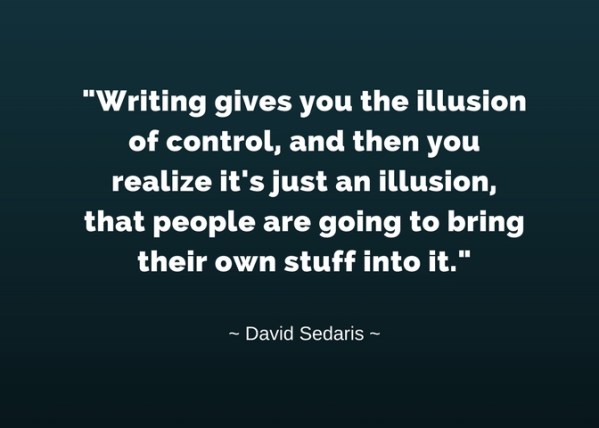
Do they honestly expect a writer to sit and read books, stories and essays without being given time to write? Don’t they understand how days without writing curdles our souls, impoverishes our moods, and devastates our spirits, especially when they’ve given us books to read? “Here,” they whisper. “I loved this book. I think you’ll enjoy it.”

They’re right, but the pain. You hunger to rush away and find time alone with your muse. At least, freed, a flood words are released one more time. You pleasure to a little temporary relief but you know, it’s gonna happen again.

Personal Levels

Eva Lesko Natiello, author of ‘The Memory Box’ questioned, “Do readers need to like the protagonist?” in a Huffpost essay.

I thought, no. I think a reader needs to care about what will happen, given the situation, morality and ambiguity but I changed my wording from care about to need to know what will happen to the character.

Deciding I needed more input, I asked my wife, the reader, what she thought of the question. “No, readers don’t need to like any of the characters.” She offered as an example, ‘We Need to Talk About Kevin’, by Lionel Shriver. “That book was beautifully written. The story seemed so real that some people were confused as to whether it was true or fiction. I enjoyed the book, but I didn’t like any of the characters.”

Spoiler Alert Warning.

She continued, “The mother was cold and seemed emotionally distant. Her son was a screwed-up killer, who killed his father and his sister.” She didn’t like the father/husband at all. The daughter was a minor character who didn’t really play into her feelings.

Ms Natiello’s question prompted further thoughts. First, not all readers will bring or take the same aspect from novels. Considering readers’ reactions to books become fascinating. As Ms Natiello mentioned, she read a book review where a book was given one star. The comment was, “Hated the main character.”

Eva goes on about the things I’d thought. Some readers seem to think that it’s their duty to like the main character and base their reaction to the book on how they feel about the main character. It’s critical to one friend. A voracious reader, if she can’t like the main character, she can’t get into the book and won’t read it. Likewise, even if she reads the book, if she can’t relate to it on a personal level, she doesn’t like the book. Relating to the book on a personal level means that something she read in the book triggers a memory of a like experience. It’s a position that appalls me because it narrows the narrow aperture into which new experiences through books can enter.

Considering Eva’s question is a reminder of how personal books are to people, as readers or writers. I struggle with the idea of characters a reader will like or hate. My characters tend to be unreliable as narrators, betrayed by memory, expectations, emotions and intentions. It fascinates me to encounter people who believe they’re telling the truth but what they describe is completely contrary to what I witnessed. They’re not deliberately lying, but are viewing it through their own prism.

Likewise, because I will relate something different, it doesn’t mean that I’m correct, either. I can be just as flawed in what I witness and how I describe it.

Natiello’s post is an inviting read into these complexities. She concludes it as I would, “Most characters are not black and white. Personally, I love deeply flawed good guys and bad guys who elicit empathy. Other people like it when characters are strictly one or the other. Of course, I support anyone’s criteria for the books they choose to read. It’s a very personal decision, and it should be. I just don’t believe a book is bad because its characters may be.”

There you go. It’s an intriguing subject, and, like her, I wonder how other writers think about it.

Blog at WordPress.com.

Up ↑