Old Paths

Ah, more ME STUFF. Yes, it’s all about me, which sounds like a good movie title, except it seems so similar to the classic, All About Eve.

I’ve been editing the third book, Six (with Seven), in the Incomplete States series. It was the first of the four books that I wrote. I finished it over sixteen months ago.

Reading and editing the book rekindled memories of how I hunted for a writing process that worked for me. I was initially a staunch proponent of outline and research. I took that route because everything that I read said, that’s how you write a novel.

It didn’t work for me. I was restless, frustrated, and bored with the process. I tried modifying it. Reading of Orson Scott Card’s process, I attempted something of the same. I attempted to flow-chart what I would write. I used Post-its, white-boards, butcher paper, and story boards. As none worked, I chucked them all with the decision, I’ll just wing it.

I started writing in notebooks. I’d edit and revise each day’s work, typing it up on my computer, and doing further editing as I went. I later learned many writers use this organic process.

That first resulting novel was a disaster. I still have it, with promises to edit and revise it someday. Meanwhile, it was a tremendous learning experience. First, I’d written a novel. That buoyed my self-confidence, but then, it needed so much work that I sank like a house in a Florida sinkhole.

The next thing that happened is, I shoved that monster aside, and wrote another novel, and then several more. Each time, they needed work, and I was too impatient to fix them. Eventually, slowly, I gathered, ah, editing and revising is part of the writing process. I wrote more, I edited them, and published them. Then I grimaced because I see the errors in the published work.

They needed more work. I needed more patience.

With my panic and self-doubt somewhat subsiding, I began to think more about my writing process, and what that meant. Insights into myself and my process grew. 

When previously reading wonderful books, I lamented that I’d never be that good, capable, creative, or talented. Now, I think, how do I write and tell stories like that? Instead of bludgeoning me to the point of retreat, those other writers and novels establish goals.

Which brings me back to this novel and series. I started out blindly with a half-baked concept, and then went down different paths until I found a path that worked. Those other paths were still in the novel, and required that I read them and decide, keep them in, or cut them — or revise them.

Done writing, editing, and revising today.

Suddenly —

Suddenly, it seems, I’ve completed editing and revising the second book, Entangled States. Suddenly, it’s time to begin editing and revising the third book of the Incomplete States series, Six (with Seven). 

You’d think it wouldn’t seem sudden. I work in MS Word. I have the navigation panel open. I always knew what chapter and page I was on, and how much remained. It all seems sudden because I was underwater in the process. Finding no more to edit and revise, I surface and suddenly, there I am, done with another, ready to begin the next.

It’s an amazing feeling of joy and satisfaction. Suddenly, the sunshine seems brighter, the sky is bluer, and the future seems brighter.

Time to end another day of writing editing like crazy.

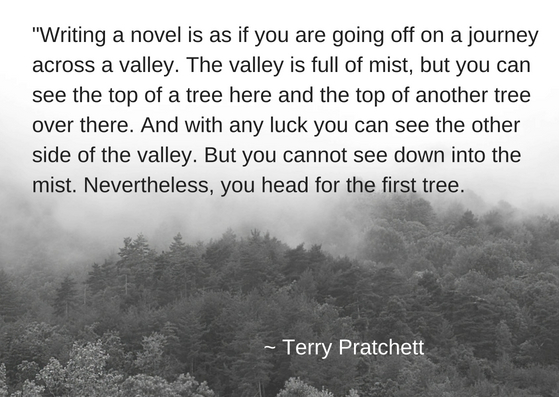
Terry Also Said

This is an almost perfect analogy for novel writing for me. I know I’m crossing the valley. I have no idea how to do it, so I see a tree and I head for it.

What Path?

I was happily typing along, following a well-defined path, sure I knew its curves and destination. Then, suddenly, the muse and character said, “Turn right here, on this path.”

Thinking my headlights flashed illumination on the sketchiest of paths through the grass between some big friggin’ dark trees, I made the turn, even though I was asking them, “Are you sure? Where are you taking me?”

“Trust me,” the muse replied.

That sentence knotted my stomach. Leaning forward and peering through the darkness as we bumped along, I turned on the wipers and windshield cleaner to clear off the windshield so I could see better. The wipers smeared the dirt across the windshield instead of taking it off, making it harder to see where we were going. I did have an idea of the direction (I’m not that stupid). But, oh, man, didn’t the muse realize that was going to make the novel longer, and take more time to finish?

“Damn it, are we absolutely sure we want to take this path?” I said.

“Yes,” the muse said.

“But the complications. You and the rest of the muses, and the characters all know where we’re going and what’s going on, but I’m not so certain.” My whining tone made me cringe.

“That’s okay,” the muse said.

“But don’t you see? That means that I’ll need to stop and think about it.”

“You always want to over-analyze everything.”

“Maybe, but it’s my name on the book. I believe I have a right to know what I’m writing.”

The muse scoffed. “The name on the book is a material matter that has nothing to do with its contents.”

“The author is immaterial?”

“Yes. The contents — the story being told — is what’s important.”

“Well, okay, I agree, but still — ”

“Yes, go do your walking and thinking. Do what you must do. We’ll be here, waiting for you to start typing okay. Only remember, the more you stall by thinking it over, the more there will be for you to type when you resume. You’ll be behind.”

As I absorbed that, the muse laughed. “You didn’t think the story stopped just because you stopped, did you?”

The muse was right. That hurt and dismayed me, partly because he seemed to mocking me. It also irritated me because the muse is always right, but the way that they guide me, it often feels like I’m being ambushed. I feel like, just when I’m catching up, one of the muses pull something like this.

Well, screw the muse, I’m hungry. With that as my excuse, it’s time to stop writing like crazy.


The Plan du Jour

Plans must be made every day. They’re compartmented by activity. They’re all based on what’s been done, and the overall goals, objectives, mission, and visions.

This is a product of my military years. Make lists, prioritize, structure and plan, hup – two – threp – four. About the only thing in my life exempt from planning is this blog. The blog is just a lark, a creative outlet, a place to vent and rant, and a channel for improving my knowledge, sparking my thinking, and making connections. Everything else is serious.

Writing is especially serious, even as it’s fun. A plan is required or an organic writer like me. The most critical part to remember about having a plan is that it’s a tool to help organize and progress. Trying to make the perfect plan is counter-productive, unless you’re murdering someone or robbing someplace. In just about everything else, it’s sufficient to have a sketchy plan.

When I’m writing the story, the story writes the plan. My novels typically begin with a concept or a setting. Ideas volunteer and find roots.

But writing is like vehicular traffic for me; everything causes a reaction. Implications, issues, conflicts, and outcomes arise. Plans are needed. Some of that planning is researching aspects to provide more depth and realism. Other planning is simply developing concepts and character background. Characters often leap into action on a page. I accept that, but to carry the story forward and keep it honest, I need to know that character. So, off I go, into a character snapshot. Some of that ends up in the novel as exposition. It depends upon the material and story. Even if I include it at that point, it can be removed later. It depends upon the arc, relevance, and pacing.

Writing and walking work well together. My mind can pick up where I left off writing the story on the last session and resume that thread preparatory to beginning a new day of writing like crazy. Reading and writing works well for me, too. Reading fuels my creativity, invigorates my desires, and reinforces my will, all good things while on a novel-writing journey.

All of this is less so with editing and revising.

In editing and revising, I already have the raw material that writing provided. The characters are established; so is the plot. The research has been completed, for the most part, and the results are embedded in the story.

I can say that research is completed for the most part. Sometimes while writing, I’ll put in some shorthand about something require greater detail, clarification, or verification that I’m not completely wrong about what I think and have based my novel decision upon. I use the shorthand because I’m in the writing rhythm and don’t want to divert myself from that path. I mark these places with <TK> and some explanation about what I wanted for there, and why. These might need research at that point. Sometimes, though, I find the research has been completed and used elsewhere. Sometimes I find that what I thought was needed there is no longer required. I go with the flow as I see it.

An editing and revising plan then evolves more into finishing the novel as a coherent and entertaining story that others can read and enjoy. I sit down to edit and revise with a goal of completing thirty pages each day. It’s just like running miles for me, or walking; having a specific objective keeps me focused on the overall course. That objective, though, isn’t the goal, and I don’t confuse the two. Editing and revising the book remains the goal for this phase of the vision. The vision is a completed, published novel.

Thirty pages is a somewhat arbitrary distinction. I often exceed that. Once in a while, I’ll fall short.

Reaching thirty pages a day is neither easy, nor difficult. It depends upon the work presented. Some of it’s already been significantly revised, edited and polished, because part of my process as an organic writer is to edit and revise as I write the novel. These sort of passages are a pleasure to edit and revise because they’re so easy. The biggest problems I encounter are writing butt and becoming complacent. Writing butt is, of course, when you’ve been sitting for so long, your ass has gone numb. Since I often have my head up my ass, this can have serious health ramifications for breathing and thinking. Complacency is when I stop thinking critically about what I’m reading.

Beyond this basic plan and structure for editing, sometimes, in the course of reading what’s been written, I’ll draw up short. Something does not align with what was previously read, or what I recall writing later in the novel. At that point, I have options.

My options depend on how big I view this mis-alignment, i.e., how disturbing or surprising I find it, and it’s influence on the rest of the plot and novel. Sometimes, it appears to me to be so large that it becomes a plan to resolve this difference. Other times, it’s smaller and I simply make a note to review and resolve. A few times, the flawed connection has arrived because I just read that part. Then, I’ll flip back to it quickly, confirm my facts, and continue. A few times, it’ll be something like a planet, ship, or secondary character’s name. When that happens, I’ll verify, and then completed a global search and replace.

With all plans, as learned in the military, it’s about mission accomplishment. What is my vision, and how does completing my mission support it? In writing a novel, it’s pretty damn simple and clear.

Now, excuse me. I have a plan to go edit and revise, at least one more time.

What about you? Do you have a plan du jour?
 

Blog at WordPress.com.

Up ↑