Bitter Modern Blues

My dependencies sicken me.

Here I am, deploring the deplorable state of the net as it drifts in and out of connectivity.

The first thing that jumps to mind is, WTF? Then, of course, I ask myself, is it me? Is it my system? Everything is checked and reset.

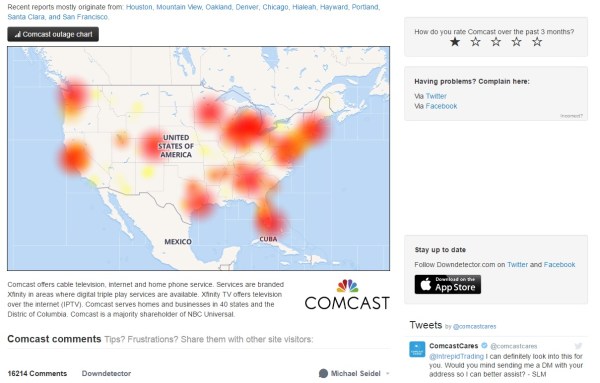
But problems continue. It started last Friday and has gone on and on. Finally, Monday, I checked downdetector.com and other sites. They verified, yep, we got problems. You can see the spikes.

gmail outages

Yesterday, the same.

More of it today.

Naturally, the Internet corollary to Murphy’s law specifies 1), your net connection will drop at the ideal time to curtail your momentum, and 2), just when you think it’s all fixed, it will leap up and bite you in the ass one more time.

Because of the commerce implications of outages, you probably won’t know what’s going on for a while. Connectivity, latency and response times equal sales and advertising revenue. Amazon owned up to its error last week because it was human error, something that is less likely to scare off customers than hardware and systems failures where they’re scrambling to figure out what the hell has gone wrong.


Change, Resistance, and Complacency

Writing science fiction, one area I end up studying and contemplating is change. I was happy to come across this Harvard Business Review (Walter Frick) interview with Tyler Cowen. Cowen’s newest book, ‘The Complacent Class’addresses how America has become complacent and averse to change in recent years.

I’ve watched this develop. NIMBY – Not In My Back Yard – was the rallying chorus to battle many new construction suggestions. Property values and appearances take precedence over more pragmatic uses of land, usually in the name of property values, especially when one small set who don’t live in the area will benefit to the detriment of those living in the area and fighting the action.

Yet, we can see the concrete results in places like Oroville Dam. Oroville Dam was headline news during some of February as record rains struck parts of California. The dam’s spillway was opened but damage caused it to be closed. With water rising behind the dam, the emergency spillway was employed but the visibly fast erosion taking place concerned many. Fears that the dam was going to collapse caused mass evacuation. Many area residents were pissed because the water behind that dam in their back yard benefited others living hundreds of miles away.

Almost as an extension of NIMBY, Homeowners Associations (HOAs), have developed to protect individual neighborhoods and developments here in southern Oregon. A large part of that is the agreement to establish a new development is centered around having an open green space, or mini-park, as part of the development. That park, and the attendant common areas, need a management focus. Hence, the HOA is used. To protect property values, the HOA restricts changes and uses. Home owners are limited to what they can plant; fruit and vegetable gardens are generally off-limits, frustrating people who want to grow their own produce. Some common interest developments address this by creating a community garden.

So, from the economic and social ramification of residing in America in the early twenty-first century, to watching and thinking about politics, to imagining our future, Cowen’s book entices me.

______________________________________________________________

HBR: And all this is happening during a time when we see a lot of change in technology, particularly in IT and machine learning, and, potentially, artificial intelligence. How does that progress fit with your thesis?

Well, there is a lot of change, but it’s concentrated in some areas. Look at a classic 20th-century notion of progress: how quickly you can move through physical space. That hasn’t gotten faster for a long time. Planes are not faster. With cars, there’s more traffic. It’s actually harder to get around, and that makes the physical world less dynamic. It’s harder to build things in the United States.

The thing that’s much easier to do is sit at home and have all of life come to you. You speak to your Alexa or your Echo, and you have things be ordered. You use the internet. You watch on Netflix. It’s made us all much more homebodies, feeling we don’t need to change things, more comfortable in our consumption patterns. And obviously that has big private gains, or people wouldn’t be doing it. But there’s nonetheless a collective effect that I think is worrying when our physical and geographic spaces become less dynamic, less mobile, less intermixed. And that’s the America we’re seeing today.

Read the entire short, engaging interview at HBR.


On This Day

On this day in 1990, the Lockheed SR-71 Blackbird set record. Flying over the continental United States, the aircraft averaged 2,144.8 MPH, and required one hour and four minutes to travel from Los Angeles, California, to Washington, D.C.

The aircraft has since been retired, and they’re no longer flown.


Downstreams

Some mental activity racing along my axons today.

  • Love that first slurp of my quad shot mocha at the Boulevard. The baristas know my preferences and do a great job of blending everything and then topping my coffee drink with with a skim of dark chocolate powder. I love the contrasts of flavors in that first tasting. Sensational.
  • It’s National White Shirt Day! This day recognizes the end of a 1937 UAW strike at GM for better working conditions. I have my white tee shirt on, under my natural wool sweater.
  • I don’t recall any dreams from last night. That’s unusual. Wonder why. Sleeping period, six and a half hours, seems about normal.
  • I’ve been reading a series of articles on sleep and whether we’re evolving from being biphasic. The latest article was on Van Winkle and provided a brief summary of the last eight thousand years of sleep.
  • I realized Part I of my  science-fiction novel in progress requires some serious editing and revising. I first realized that about a week ago and tried rejecting it. My writer within was willing to overlook changing it; the resident interior editor was reluctantly accepting of it. However, the reader in residence said, “Oh, no. That needs work.” Trust the reader. After we argued a few days, the writer and editor agreed with the reader’s points. However, the writer came up with some interesting ideas to explore in parallel.
  • The editor, though, urged us all not to make any changes until it’s all done. He pointed out that Part I is the way it is because the stories and concepts were still being explored. True; I write to understand myself, to order and structure and expand my thoughts. He pointed out that since I’m still writing the other parts, I can save myself some potential work by fully completing an entire draft before making major revisions. I accept his contention and put it on hold until the first draft is completed.
  • The novel in progress is ‘Long Summer’. Science-fiction, it’s not quite a sequel but is collateral to ‘Returnee’, as it stars Brett and Castle Corporation, and continues with many of the same themes of technological alienation and isolation, and socializing with yourself via virtual beings you develop to help people cope with life as they live far longer.
  • Talking with the barista today. “Fun plans?” she asked. Because, it’s Saturday; in her working and school world has meaning that has left my writing world. I don’t segregate the days into weeks and weekends any longer. I barely notice the date. “Movies,” I answered her. “We’re going to see ‘Lion’.” She wasn’t familiar with it. I mentioned Dev Patel and a few of his movies. Yes, she remembered ‘Slumdog Millionaires’. It didn’t occur to me until later that she was eight years old when Slumdog was released.
  • That conversation pointed me onto new vectors of changes and the differences in my values, perceptions and experiences as a sexagenarian and the same in her as a young adult. It’s the same conversation I had as a young adult with those forty to fifty years older than me. I was twenty in 1976. Those who were sixty in 1976 had been born just after World War I ended. They fought in World War II and remembered the atomic bombs dropped on Japan. Grandparents had been part of the American Civil War. The Soviet Union was founded during their lifetime and the Cold War dominated world politics.
  • It’s interesting to put into perspective. What I think of as ‘normal’ isn’t the same as the previous generation or the next generation. Besides when we were born forming us, so do our education levels. More strongly and interesting, we saw how where we live and our education and economic situations affect national politics during the 2016 presidential election. Now, this article on FiveThirtyEight tells about how where we live affects our deaths. It’s a telling insight to me.

Cheers

Today’s Theme Music

When I was young, I sought better sound in my stereos.

Whether from imagination or real ability, I often detected hums and distortion that irritated me. Conducting trail and error set-ups in those pre-Internet days of the mid 1970s, I separated power wires and speaker wires and ensured I had solid connections between everything. I bought gold wires to improve the sound and kept searching for better equipment. Vinyl had the best initial sound IMO but it was a fragile state that would begin deteriorating with play. Cassettes and eight track players always introduced warble and distortion as the tapes stretched. Muddiness would creep in.

I ended up buying an open-reel system. I developed a habit of recording my vinyl on an open reel. Although a cumbersome system, open-reel maintained the best sound quality. I would record the album on open-reel for my home use and cassette for my portable use and store the vinyl to protect it. Once the cassette quality began diminishing, I would record it anew.

But while noticing the sound difference on my systems at home, I also discovered that some albums came out sounding better in the beginning. Their colors were sharper, finer and clearer. A few of those albums mesmerized me with the beauty of their sound. Some combined that with wonderful lyrics and melodies, becoming astonishing, special albums.

The first of these that struck me in such a way was Pink Floyd’s ‘Dark Side of the Moon’, a now classic rock album. But it was only one album, not much of a data set. The second album that established itself as having high production values (as I learned it was called) was ‘Songs In the Key of LIfe,’ by Stevie Wonder. I don’t know much about music production, then or now, but I thought that Stevie’s album was beautiful in and of the ways I mentioned. I was stationed in the Philippines, at Clark Air Base with the 3rd Tactical Fighter Wing, when the album came out. Intent on staying active, reading and saving money, I did a lot of walking.

‘Sir Duke’, from this album, was my favorite walking-around sound for that era’s mental playback system. It’s a good theme song to bring on Friday.

(As an aside, I wince at hearing this digital version; it sounds way too tinny to me. But that’s me.)


Personal Windows

Friends, prompted by curious, started grilling me about some of my past life the other night. Those were my super-secret military days.

Since their questioning, I’ve drifted along currents of wonder about living amidst change and how small our windows of knowledge truly seem. Change is fast and constant. The military commands I worked in thirty years ago no longer exist; the weapons systems introduced during my career are being retired. Bases have been shuttered. They’re trying to retire the nukes I once controlled (a good thing, in my mind). God knows what’s going on in space.

I ended up in a medical start-up after my military career, first in sales operations, running customer service and spewing out reports about sales trends. We were part of a nascent business, per-cutaneous transvascular coronary angioplasty, moving into stent delivering systems for coronary applications and radiation therapy to cope with re-stenosis. After that, I moved on to another company in search of ways to cope with chronic total occlusions.

Life found me in Internet and computer security in my next phase, and then onto analytics. Whatever. I drifted through choices, jumping through windows when the opportunities arose, and was fortunate to have someone on the other side of those windows to pull me in and show me around.

The windows in our lives are always so small. They open and close so quickly. Technology accelerates the speed with which the windows open and close. For examples, consider how we now conduct war versus how it was conducted in decades and centuries past. Consider how we make, experience and enjoy music, and how we entertain ourselves. Yet, each window and moment is treated as though this is a permanent solution. Consider the plight of the coal industry, for example. They think it can be legislated back but technology and market forces have moved past them.

We, as humans, can only see and understand so far, and we argue and debate about what we see, what it means and what we need to do about it. Yet, each person’s life is defined by their personal windows. These are shaped by their culture, heritage, education, genetics and personal experiences, yes, but they’re also shaped by much larger forces. We often barely glimpse the shadow of such forces.

Sometimes – no, hell, often – I think we’re going around understanding the world backward; we believe reality shapes us, and we investigate how we shape it.

Maybe we shape reality. Maybe there is no past or future, there is only the window into Now.

Jump through it and keep on going.


Strap It On

Well, it’s been a week since we strapped them on. I had mentioned buying them in passing about a year ago. Like a volunteer seed, it took root in my wife’s thinking. After a year, we finally  took action. Now I can provide some feedback on what a Fitbit has meant to me and my life, at least one week of it.

My Fitbit is a Charge 2, worn on my right wrist. The Fitbit informs me that I walk an average of twelve thousand steps and five miles a day. My highest miles walked were five point six, measured out in fourteen thousand steps. My resting BPM is fifty-nine, with a low of fifty-five and a high of one hundred thirty-nine, reached when I walked up the equivalent of thirteen floors of steps while doing an urban hike. I averaged seven hours and fifty-seven minutes of sleep per night, awakening three times. I’m usually restless twelve times per night, with a high of seventeen.

All interesting stuff. I’m dubious about its accuracy. It seems to think you’re sleeping if you’re reclined and not moving. But my wife and I both note, yeah, we’re in bed, but we’re not always sleeping just because we’re not moving.

I’m pretty pleased with my walking activity. We’ve endured many days in the low mid to low twenties and high teens where built up ice encumbered walking. I’m also recovering from wrenching my right knee while on the ladder, cleaning smoothie off the kitchen ceiling.

The Fitbit seems very dependent on arm movement. Don’t move your arms, you don’t get credit, it seems. It also sometimes seems to work in blocks. Yesterday, crossing the house to attend the cats, I checked my steps: twelve thousand, six hundred forty. I found the cats, petted them, provided them with catnip fixes, went around checking on doors, poured and drank some water, refilled the water pitcher, and took out the recycling. Then I checked my Fitbit.

It still registered twelve thousand, six hundred forty.

I knew I’d been moving around, and I swung my arms when I was walking, if I didn’t carry anything, so I knew – what? That the steps hadn’t registered. But was it a question of yet? 

Indeed it was. After sitting down at the computer and turning on Sneaky Pet’ on Amazon, I checked my Fitbit, and my steps had jumped. It had a full charge, done earlier that day, so I put this down to a system flaw.

Despite these things, I like the Fitbit. I installed the app on my iTablet or whatever it’s called and the two synchronize whenever they’re near one another. What I like is that it tracks and counts a great deal of information. Even if it’s rudimentary or flawed, it provides a sufficient structure to encourage me to do more and be more mindful about what I’m doing. The Fitbit buzzes every hour to remind me to move around, something I appreciate. My wife and I often make a game of that, first marching around to ‘Colonel Bogey’s March’and then chasing each other around the furniture until one of us needs to go pee.

Once I have three weeks of averages, I can establish goals to move around more. The biggest thing is that I want this as a companion, and not a master. I don’t want to become obsessed with counting steps or miles and reaching higher and higher levels, but to use it to enhance my healthy practices.

Of course, part of me thinks into the future, when the Fitbit’s technology is improved and replaced. Then I expect to find it in a drawer, forgotten, and take the opportunity to write, “Do you remember Fitbits? We used to wear them to count our steps.”

Who knows what we’ll be using by then?
 

Remember…?

Tulipmania struck the civilized world in the sixteen hundreds. Do you remember that?

Do you remember when sock hops were really big in America?

Remember, “Longer, lower, wider?” That was often a new American car’s greatest advertising claim. One of the cars that bucked against that trend was the American Motors Rambler. Surely you recall it. You must remember the Corvair, right?

Do you remember drive-in theaters, or movies that cost fifty cents to see? Do you know what it means to drop a dime and why we say that?

How ’bout Pacman and Ms. Pacman? Do those games set off any memory chimes?

Do you remember ‘big hair’ and Members Only jackets? What about eight-track cassette decks?

I know you must remember 45s and LPs. What of Child’s Place and Children’s Palace do you remember?

Did you have a Walkman?  Do you now, or did you ever, own a Beta Max, or a VHS player? Do you now, or did you ever, own a Polaroid Land Camera, an eight millimeter projector, or an Instamatic Camera?

Do you remember erector sets and Lincoln logs? Are you familiar with Silly Putty, Super Balls and pet rocks? Perhaps, instead, you knew Hula Hoops.

Do you remember the Teapot Dome scandal, or the Keating Five, and Enron?

Perhaps you’re familiar with ESSO.

Do you remember G.C. Murphy? Man, we loved going to the mall and shopping at that five and dime, where we could buy sub sandwiches for a dollar.

What about S.S. Kreske’s? Remember when they became K-Mart, and remember when Sears bought K-Mart?

Remember when Craftsman Tools was part of Sears, Roebuck and Company, and their mail order catalogs? Sears, Roebuck and Company became Sears, and Sears is selling Craftsman Tools to Black and Decker.

And remember the U.S.S.R., and the Berlin Wall?

I’m just curious about what you remember, and what will be remembered in this age of selfies, Walmart, iPhones, Costco, Sam’s Club, Google, Facebook, Instagram, and Pinterest. Remember Netscape Navigator, or Mosaic?

Do you remember Yahoo? Because Yahoo will be Altaba once Verizon completes its purchase of Yahoo. Speaking of which, do you remember MCI?

I wonder, how long will we remember Altaba?

Happy Birthday!

Happy birthday, ARPANET. Without you, we would be lacking the Internet.

Some will whisper, this is an anniversary, not a birthday. Maybe they’ll make such a remark on the Internet.

Few realize how long people worked on ARPANET and its principles and processes and what its success actually represents. Like Philo Farnsworth and other inventors, their work is used but rarely remembered and celebrated. Most ARPANET and early Internet pioneers worked in teams. They’re remembered but no celebrated but they had some nifty ideas. Their accomplishments helped drive Internet development. Without them, we’d not have bloggers sharing opinions, dreams, hopes, frustrations and cat photos and videos, and complaining about government, politics, manners and movies. WordPress would probably be a lot smaller and less successful.

Where would Amazon and eBay be without the Internet? What would Facebook be without an Internet?

Seriously, take a moment to imagine a Facebook without an Internet and the web.

I need not add the rhetorical amendment asking where the rest of us would be and what we would be doing, but I kinda did.

Going back to my early Internet and computer learning reminds me minicomputers once roamed the electronic frontier. Remember the Burroughs Corporation?

Sure, some remember. Some also remember the Nash Rambler.

Such is the case with inventors, engineers and their work. Their ingenuity shapes our lives but we remember few of them. As always, the winners shape the marketing we refer to as history.

Ah, it’s all ancient history, way back, like a long time ago. Here we are, on the Internet, clicking, scrolling, and googling away the morning.

Happy New Year.

The Internet of Relationships

Dad was playing a computer game on his smart phone when his son walked in.

“Google, turn on the television,” the son said, sliding onto the sofa.

Dad called out, “The Internet is down, son.”

The boy said, “Google, turn on the television.”

Flinching with exasperation, his father called out, “Danny, the Internet is down. You need to use the remote.”

“Google, turn on the television,” Danny said.

Irritating growing, Danny’s father said, “Didn’t you hear me? The Internet is down. You need to use the remote.”

Danny looked at his father and frowned. “Google, what does the Internet is down mean?”

“Jesus,” his father shouted. “Are you serious? You really don’t know what I’m talking about?”

Studying his father, Danny said, “Google, what does he mean?”

“He?” his father asked. “He? Seriously? I’m your father, Danny. Get it? Now if you want to watch television, you need to use the remote to turn it on because the Internet is down.”

Danny’s frown danced in and out of existence as his father continued playing his game. Finally Danny looked up and said, “Google, what’s a remote?”

Gritting his teeth against a scream, his father finally said, “Google, how do I get through to my son?”

Blog at WordPress.com.

Up ↑