Head Coach Trump

I was reflecting on a Trump quote I shared in an earlier post. It triggered a need for a sports analogy for me.

Ordinarily, I avoid sports analogies when addressing politics. Such analogies are generally lazy, lowering politics and their outcome to the same level as pastimes which have grown into enormous, profitable businesses but are meaningless in the long run. Sports preoccupy many people and divert their attention from real and serious matters. (Some will rebut, that’s exactly why sports are needed, to divert us from all the problems we face but I’ll leave that diversion alone…)

First, the Trump quote:
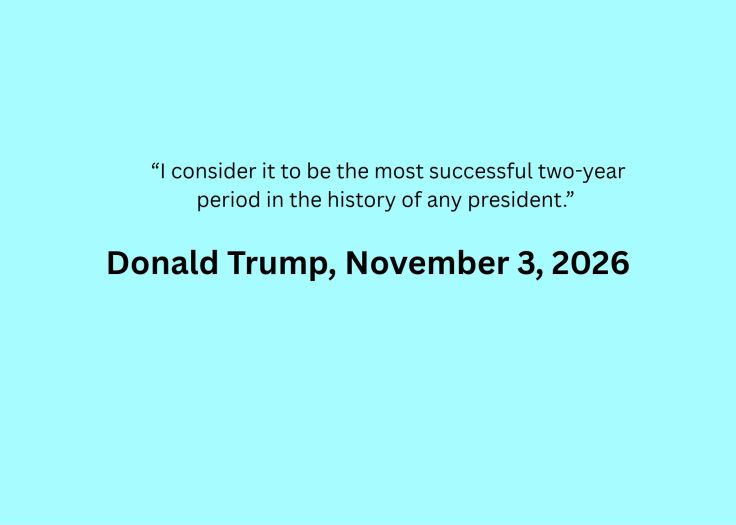
I want to add context. Trump made his statement on the day on which a blue tsunami took national elections in a stark repudiation of the direction Trump was taking the United States.

Additional context: when Trump took office in 2025 after winning election in 2024, the GOP took control of both chambers of Congress. The Roberts Court already had a right-wing tilt built into it. In essence, conservatives, led by Donald Trump, controlled the Federal government.

Donald Trump won re-election by making many promises, among these, starting no new wars, lowering prices on day one, and ending Russia’s war with Ukraine.

Trump said at his inauguration that he wanted to be remembered as a uniter and a peace president.

Since taking office, he’s broken many promises. While he’s become quite wealthy, many Americans are coping with an affordability crisis. People are struggling with food, housing, insurance, and energy prices, among other things.

Here’s where the sports analogy enters.

First, let’s pretend that Donald Trump is the head coach of a football team.

Trump’s team started aggressively but undisciplined. They stalled their own efforts with penalty after penalty. It was like they didn’t understand the rules and refused to accept the rules.

His team has not scored any touchdowns. They fumbled the ball away multiple times, challenged rulings on the field, and lost, setting them further back.

The offensive side of the ball couldn’t advance the ball down the field, so they kicked it from far away from the goal and scored a few points. The defense is worn down because the offense no longer has anything left.

The other side, meanwhile, has grabbed the momentum. Their defense has been playing strongly, keeping Trump’s offense from advancing, and now the offense has scored multiple times.

And here is Donald Trump, head coach, walking to the locker room at halftime, beyond by over twenty points, saying, “We’ve played the greatest first half in all of football.” It’s a delusional halftime speech from a coach refusing to look at the scoreboard.

As I watch, I think, Trump still refuses to admit how miserable it’s going. He’s going into the locker room and won’t make any adjustments. He’ll just keep trying to do the same miserable, failed plays.

Yes, it’s a labored sports analogy.

Just had to get it out of me.

Cheers

The Trends

Interesting trends are taking over the United States.

Manufacturing and production plants are shutting down or gone. It varies by region and industry.

The United States had about 25,000 malls in the 1980s. We’re down to about 1200. Many rural malls have shut down. Stores like Aldi and Dollar General or Dollar Store have replaced them. Some are being successfully repurposed by turning stores into churches. Some areas turn to casinos to counter the loss of malls and manufacturing.

Rural movie theaters are closing, as are rural hospitals, which is creating healthcare deserts.

These are anchor industries. As plants, malls, movie theaters, and hospitals close, jobs are lost, along with local revenue streams. Income drops; spending drops. Local restaurants and service industries suffer. That ripples into the local area’s ability to maintain public buildings, schools, and infrastructure. As these effects are felt, more people move away. People lack incentives to move there. The population shrinks.

With fewer students, rural public schools close. Small community colleges and universities feel it as enrollment drops. Falling enrollments force them to cut programs and raise tuition to fill the gaps, but factors have changed, and the loop of falling tuition and less classes grow.

Railroads, which used to be a rural lifeline, have cut way back in the United States. Small-town passenger train service is mostly gone.

Meanwhile, Data and AI Centers are being built fast. They’re being built in rural areas where there used to be mining or manufacturing. While they’ll provide temporary economic stabilization and add some revenue from construction, these places don’t typically employ many people. Automation takes care of many service needs. Such centers also don’t produce products that can be taken to a store and sold.

I was thinking about all of this because those kinds of economic and service declines in rural areas were a meaningful part of the political environment that helped Donald Trump gain support. He frames his attacks on ‘narco-terrorists’ as a war on crime and drugs. The war in Iran is part of his America First agenda. They build on the same themes of strength, distrust of elites, and national priority that resonated politically in earlier elections.

All those rural trends have been causing a youth drain. Educated young citizens are moving out of rural areas. Those left behind tend to be older and less educated and are more likely to be Trump supporters. For me, then, what Trump is now doing will do little to ameliorate the polarization affecting United States politics.

Long-term rural revitalization isn’t just about economics or infrastructure. It’s deeply tied to political will, governance, and coalition-building. Without bipartisan or broadly supported political action, even the best economic initiatives struggle to take hold.

Trump’s style, though, is exactly the opposite; he goes it alone instead of building coalitions, demonizing political opponents. At the end of the term, we’re likely to see many of the same problems affecting rural areas that we now see. The polarization will remain, but there will be less voters in the rural areas to support people like Trump.

They may have won some short-term victories by putting Trump in office, but the problems remain.

A war in Iran does nothing to help.

Blog at WordPress.com.

Up ↑