Progress

I finished editing and revising the beta version of Six (with Seven) today. That’s Book Three of the Incomplete States series. I began editing and revising it on September 24 of this year, so my editing and revising process has kept going at a decent pass.

The editing and revising process was draining, requiring most of my mental energy. Not surprising, as editing and revising your work forces you to confront weaknesses and doubts. I know that it’s made me more of pain in the ass to live with than usual. Although there are chapters that leave me a little wary, I feel good about the book and project. Part of that is the simple satisfaction of completing another step in the project, but there’s also the element that I’m satisfied as a reader that the writer wrote a decent tale. I was also pleased because some of my worries and fears were allayed. I kept thinking as I edited and revised the book that I needed to do more to clarify matters and tie together the disparate story lines. Then I discovered that hurrah, I did that when I wrote, edited and revised it back when it was the subject of my focus.

The chapters that leave me wary will confuse some readers. They’ll require close reading to follow them, patience, intelligence, and an open mind. So, do I dilute them to reduce those challenges, or leave them? I left them as is for now, as that feels right. This, of course, was the first go in editing and revising, so that can change in one of the next go-arounds.

Of course, the readers can skip these chapters and go on to the final two chapters, which strain the mud out.

I like how Six (with Seven) ends, moving the series’ stories forward, clarifying more, and setting up Book Four, An Undying Quest. I also have more appreciation for the title, Six (with Seven). It’s more whimsical and cleverer than I first realized. I’m not being immodest, but recognize that a lot of these decisions have subconscious insights going on that I don’t appreciate at first.

With three hundred twenty-two pages in Word and less than eighty thousand words, Six (with Seven) remains a slender book in my general pantheon of fiction writing.

Tomorrow, I begin editing and revising Book Four, An Undying Quest. Once it’s completed, I’ll have a first draft of all four. With some hope and luck, it’ll all make sense and flow together to a decent ending.

Now, the coffee is gone. Time to go for a walk, have lunch, do some yardwork, and maybe have a beer to celebrate.

Cheers
Old Paths

Ah, more ME STUFF. Yes, it’s all about me, which sounds like a good movie title, except it seems so similar to the classic, All About Eve.

I’ve been editing the third book, Six (with Seven), in the Incomplete States series. It was the first of the four books that I wrote. I finished it over sixteen months ago.

Reading and editing the book rekindled memories of how I hunted for a writing process that worked for me. I was initially a staunch proponent of outline and research. I took that route because everything that I read said, that’s how you write a novel.

It didn’t work for me. I was restless, frustrated, and bored with the process. I tried modifying it. Reading of Orson Scott Card’s process, I attempted something of the same. I attempted to flow-chart what I would write. I used Post-its, white-boards, butcher paper, and story boards. As none worked, I chucked them all with the decision, I’ll just wing it.

I started writing in notebooks. I’d edit and revise each day’s work, typing it up on my computer, and doing further editing as I went. I later learned many writers use this organic process.

That first resulting novel was a disaster. I still have it, with promises to edit and revise it someday. Meanwhile, it was a tremendous learning experience. First, I’d written a novel. That buoyed my self-confidence, but then, it needed so much work that I sank like a house in a Florida sinkhole.

The next thing that happened is, I shoved that monster aside, and wrote another novel, and then several more. Each time, they needed work, and I was too impatient to fix them. Eventually, slowly, I gathered, ah, editing and revising is part of the writing process. I wrote more, I edited them, and published them. Then I grimaced because I see the errors in the published work.

They needed more work. I needed more patience.

With my panic and self-doubt somewhat subsiding, I began to think more about my writing process, and what that meant. Insights into myself and my process grew. 

When previously reading wonderful books, I lamented that I’d never be that good, capable, creative, or talented. Now, I think, how do I write and tell stories like that? Instead of bludgeoning me to the point of retreat, those other writers and novels establish goals.

Which brings me back to this novel and series. I started out blindly with a half-baked concept, and then went down different paths until I found a path that worked. Those other paths were still in the novel, and required that I read them and decide, keep them in, or cut them — or revise them.

Done writing, editing, and revising today.

Unabashed Pleasure

Yes, I’m reading my baby, but I’m enjoy what I wrote almost two years ago. My baby in this matter is the second novel, Entangled LEREs, in the four book Incomplete States series. I’m often surprised as I’m reading it, thinking, “I wrote that?” I impress myself, but I was writing to me, and I’m easily impressed, so I wouldn’t be impressed that I’m impressed, if I were you.

This isn’t the first time that I’ve posted something like that. *shrug*. My observation about my writing pleasing me also belies how my writing process works. I usually stream scenes through me. “Release the muses!” I shout, and then write like crazy. Writing scenes are often like encountering a tsunami and being swept away. I know what I wrote and can give you the details, but I don’t recall thinking about it much. I think about it before I start writing and after I stop, but I rarely think about it during the process.

The point is, those words are a first shot at writing the scenes. Editing follows, and polishing, and more editing for continuity and pacing, and polishing and editing. I’m an organic writer, so that scene is often edited to help fit a later narrative that emerges. I learn the characters as I go, so their thoughts and interactions in these scenes are revisited and modified to suit their personalities, motives, and agendas. It’s a long way from the first stream of writing to even the beta draft that I’m editing into a first draft.

It’s also a little scary. As I read through these scenes, I wonder, do these things get sufficiently resolved? I won’t know until the entire series is edited.

I’m not worried about being scared. I suspect that I missed some thins when writing the beta draft of the series. That’s why I edit and revise. If I find that my fear is correct, I’ll edit and revise again, continuing that process until I’m satisfied that I’ve answered the questions in a manner and to a degree that will satisfy the reader, moi.

In an aside, as I’m reading and revising, it’s fun to re-discover how I’ve integrated friends and family’s names and segments of their lives into my fiction. For example, a comet that breaks up and destroys a planet is named Santella-Klements. The first is another part of the extended family and includes cousins close to me growing up while Klements is a friend’s last name.

Okay, time to write edit like crazy, at least one more time.

Terry Also Said

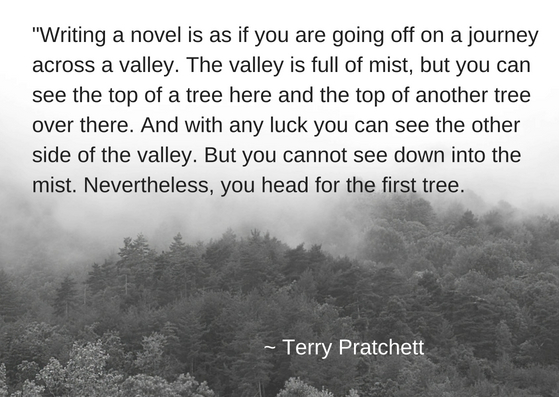
This is an almost perfect analogy for novel writing for me. I know I’m crossing the valley. I have no idea how to do it, so I see a tree and I head for it.

Piece Work

I was thinking about my organic writing process, and how much of it is piece work.

Like many writers, I had a concept in the beginning. Then I developed a sketchy framework. Then, like many writers, I wrote to tell myself the story, to realize most of the facets, discover the plot, story and character arcs, and to find where I will begin and end. Today, I’m working on a climatic chapter, the penultimate moment. I’ve already written the end and denouement. Writing this series of scene that is this chapter means that the series’ beta version is done.

In true piece-work fashion, I’ll put together all these raw chunks of words and story until I can see the entirety. Then I’ll begin reading, editing, and revising, cutting and changing as necessary to find the right story (or stories) out of this mass of words. I’m reminded of a sculptor studying rock, marble, and wood, studying it to see what art is within the mass, waiting to come out.

From the beta will come the first draft. From the first draft will come a second draft, something that’s workable and complete. With the second draft, maybe I’ll have something to give to an editor. I’ll see. If I need to, there will be a third draft.

It’s been a long process for me to learn these things, that the first product isn’t the final product, that it won’t be perfect — that it’ll probably have substantial flaws — but whatever flaws are found doesn’t mean that I’ve failed. Writing is a journey and exploration. But it’s not just the story being explored; the novel isn’t the end-all of the journey. Most of the journey and exploration is about me, about learning how I think, what I imagine, and what I don’t know. When I write, more of myself and my attitude is revealed to me through the characters and novels than I ever realized would happen back when I first thought, “Hey, I think I’ll write a novel.” Part of this is learning, how do I cope with setbacks, disappointments, and frustrations? How do I found and maintain the pace and discipline to traverse the arcs and write a novel, or a series? How do I deal with going the wrong way?

I think that may be where many beginning writers struggle; they don’t realize how much of writing is about themselves as much as it is about the story they’re writing. It can be daunting, descending into our private depths to face the person within. It’s a test of resilience to face yourself and your shortcomings, and find ways to address them.

Time to write like crazy, at least one more time.


Then Again

I didn’t know what I was going to write today. I knew I had a scene in progress. In theory, there was another scene ahead. With it in mind, I was puzzling around what do I write today to get there, and considered just jumping ahead to write that scene.

That didn’t feel right to my instincts, though, so I sat down, and started typing from where the last sentence left off. Once again, I went off in an unanticipated, unexpected direction. When, twenty pages later, I finished the scene and stopped, I was pleased and touched by what had happened. It was so in character with the series and novel in progress. I hadn’t planned it; the characters and muse seemed in control. Intellectually, I know, it must be me, right? I’m the one with the brain behind the skull and fingers on the keyboard, but the writing had that dreamlike flow, as if I was a pipe and it was just being pumped through me.

It’s unnerving, honestly, because I wonder if I’m not a little crazy. (Okay, I concede that I’m a little crazy; I suppose what’s in question is how crazy I might be.) I like what I wrote, and I worry that others won’t like it. Then again, I don’t care. Some readers won’t; some readers will. The words are out there as part of the record, subject to the editing and revising processes just like everything else.

Now — amazing, I’ve been here for over two and half hours. My rear end is in pain from sitting. I still have coffee in that twelve ounce mug. An oily film covers the coffee’s cold surface.

Time to drink up, mask up, and call it done for another day of writing like crazy.

Baking the Novel

First, decide you’re going to bake a cake (write a novel). To start, make a cup of coffee to drink while you conceptualize what you’re going to bake (write).

Come up with a story idea from your concept. Collect some ingredients – characters, setting, initial incident. Start mixing them together (writing).

Realize that you’re missing some ingredients (like motivation, background, and other characters). Make some coffee and hunt for the missing ingredients.

Coming up with the missing ingredients, you add them in, and then decide to make something different (a variation of the concept that just blows your mind with excitement). 

Find and add more ingredients (setting, characters, motivation, story twists).

Realize that you forgot to turn the stove on (yeah, you overlooked some huge aspect and now have a gap in the story).

Go to turn on the stove but then stop to pet the cat, and then feed the cat. Smell the kitty litter, and clean it. Also notice that the floor is dirty. Turn on the robot vacuum.

Monitor the robot vacuum, cursing it as it goes around and around a piece of dirt you want it to pick up that you refuse to pick up because that’s why you have a robot sweeper. 

Decide to check the mail to get away from the madness. Come back and make coffee, go through the mail (why do they keep sending you this junk?) and also look for something to eat because you’re hungry (even though you just ate, like, three hours ago, but, hey, writing is a strenuous mental activity that drains energy (something that non-writers will never understand!)).

Discover that there’s nothing in the house that you want to eat. Decide to make a shopping list, and then go to the store. (While you’re out, you’ll also stop and fill the car’s gas tank and do any other errands (because you’re efficient).)

Because you’re now too hungry to return home and make something with the stuff bought at the store, go somewhere and buy something to eat right now.

Return home, put away the groceries. Make and drink coffee while thinking about your cake (the novel), nosh on a snack item that you purchased, pick up the stuff that the robot vacuum missed,  pet the cat (because he’s following you around and underfoot), give the cat treats (to buy him off), and then —

Brainstorm! Make the frosting because this cake with that frosting would be fantastic (in other words, write an ending because you think it’s the perfect ending).

Remember, you never did turn on the oven, damn it. You missed a huge step. 

Realize, this is a layer cake. And you can’t put the frosting on because there’s nothing to put it on.

But you really like that frosting, so you go ahead and make it (write it up) and set it aside for use later, and then — epiphany! — decide every layer will be a different flavor of cake, with a different icing. It’s not really a cake, but a torte, you decide, and then go off to the computer to jump on the Internet to research tortes and cakes.

Check your email. Catch up on Facebook (like, post, and share), Pinterest and other social media, blogs, the news (he said what?) and sports (or fashion). Play some games (because, without acknowledging it, you feel stressed, and games — going for a new high score, or beating others on an online game — gives you instant gratification and validates you).

Turn on the television. Surf channels. Shake your head at the things on television these days. Wonder if some of the actors you’re seeing in the re-runs are still alive. Turn the television off.

Then, oh, it’s late. You’re tired. Another cup of coffee is needed but you’re too tired for that, and it’s too late (where’d the time go?). The rest of the family will be home soon, and there are the things you’re supposed to do with friends and family, going to movies, dinner, cut grass, wash car, clothes, dishes —

Well, you’ll continue tomorrow, you tell yourself. This cake (or torte) is going to be a masterpiece. It’ll blow people’s minds. It’s just so exciting, but there’s so much to do. There are more ingredients to collect, and then it all must be baked, frosted, and put together —

It’s so real, you can see, smell, and taste it. You sit for a while, absorbing the wonder of the cake (or torte) that you imagine.

Tomorrow, you tell yourself, tomorrow will be different. You don’t want any half-baked cake.

Right, you’ll begin by making coffee and listing all the ingredients, and maybe brainstorming all the steps that you need to do to complete this masterpiece, like turning on the oven. Yes, that’ll be the first thing that you do.

Tomorrow.

The Turn

The turn I’ve encountered with my muse and the characters develops into a complex scene. I struggle to see the setting and put the pieces together.

It’s not writing block. This is like trying to solve a complex logic puzzle by assembling and analyzing disparate bits of information. Part of me is bucking against the muse, because it’s work, and I feel like I should understand it before I write it, while the muse just encourages me, “Don’t worry, just type.”

Part of this is laziness of the whiny, I-don’t-wanna immature sort. It’s groan-inducing work to think about how this fits into what has happened and seeing how these twists and turns affect the ending.

Part of it is annoyance of the sort experienced when you think you’re almost done and then experience a last-minute delay.

A friend comes by. I haven’t seen him in a few months. He apologizes for interrupting me,. I brush that off, and we chat. (His interruption secretly relieves me.)

His wife died of lung cancer almost two years ago. He’s been at a loss and he’s now seeing a grief counselor. He’s visiting his son and grandchildren, and his brothers. One brother lives down in Healdsburg, he said, which surprises me. I thought this brothers live in Chicago and New York. Yes, the one that lives in Ithaca still has a place there, and still teaches one semester a year at Cornell, but has decided to live in California for most of the year.

We chat further and exchange offers and promises. Who knows if we’ll keep them?

Returning to writing, I realize that his interruption was fortunate. As my muse knows, I over-analyze. Part of my issue when I do that is I fall into the weeds of the details. Down there, I can’t see the larger parts and picture.

I know and recognize this from my days as an analyst. It was always useful, after being presented with a problem, collecting and compiling information, to walk away and let my subconscious mind work on what it’s seen without the interference of my conscious mind and its foibles. Because I knew that worked, I cultivated the methodology and was successful with it. Collect, compile, regard, walk away, and then come back. The break always allowed me to see with sharpened focus and new clarity.

It happened today with the writing as well. Resuming, I understand where the muse is taking me and what I need to type. Lesson learned, once again.

Now I can write like crazy, at least one more time.

What Path?

I was happily typing along, following a well-defined path, sure I knew its curves and destination. Then, suddenly, the muse and character said, “Turn right here, on this path.”

Thinking my headlights flashed illumination on the sketchiest of paths through the grass between some big friggin’ dark trees, I made the turn, even though I was asking them, “Are you sure? Where are you taking me?”

“Trust me,” the muse replied.

That sentence knotted my stomach. Leaning forward and peering through the darkness as we bumped along, I turned on the wipers and windshield cleaner to clear off the windshield so I could see better. The wipers smeared the dirt across the windshield instead of taking it off, making it harder to see where we were going. I did have an idea of the direction (I’m not that stupid). But, oh, man, didn’t the muse realize that was going to make the novel longer, and take more time to finish?

“Damn it, are we absolutely sure we want to take this path?” I said.

“Yes,” the muse said.

“But the complications. You and the rest of the muses, and the characters all know where we’re going and what’s going on, but I’m not so certain.” My whining tone made me cringe.

“That’s okay,” the muse said.

“But don’t you see? That means that I’ll need to stop and think about it.”

“You always want to over-analyze everything.”

“Maybe, but it’s my name on the book. I believe I have a right to know what I’m writing.”

The muse scoffed. “The name on the book is a material matter that has nothing to do with its contents.”

“The author is immaterial?”

“Yes. The contents — the story being told — is what’s important.”

“Well, okay, I agree, but still — ”

“Yes, go do your walking and thinking. Do what you must do. We’ll be here, waiting for you to start typing okay. Only remember, the more you stall by thinking it over, the more there will be for you to type when you resume. You’ll be behind.”

As I absorbed that, the muse laughed. “You didn’t think the story stopped just because you stopped, did you?”

The muse was right. That hurt and dismayed me, partly because he seemed to mocking me. It also irritated me because the muse is always right, but the way that they guide me, it often feels like I’m being ambushed. I feel like, just when I’m catching up, one of the muses pull something like this.

Well, screw the muse, I’m hungry. With that as my excuse, it’s time to stop writing like crazy.


The Loops

The characters have become weary and cynical near the end of the Incomplete States series. I wonder how much they influence me and the converse. It’s an interesting loop on its own.

But of course I taste what they feel. It’s necessary. Regardless of my process, whether it’s all deeply in me and I’m mining the story, or it’s being fed to me or channeled through me from some other existence, as it sometimes feels (thanks to the power of focus and imagination), I taste the words, and they affect me.

Balancing the scales, writing and progress continues, and I’m enjoying it. It’s an empowering experience. (The end is nigh!) Thinking about it, it’s almost the opposite of the Doom Loop. It’s the Success Loop. (Weird that as long as I’ve heard of the Doom Loop, I’ve never thought about the Success Loop. I looked it up, confirming, yes, such a creature exists – of course.)

Like the Doom Loop, the Success Loop is a spiral. But where the Doom Loop takes you down (because you expect less, so you try less, etc.), the Success Loop lifts you up. You’re building on what you’ve achieved, adding success. As success is added, success is expected, so you work harder for that success. You learn to know and love the taste and feel of success, and the power and confidence that it generates.

The Success Loop is often a strong but fragile thing in a writer. Like a spider web, it has impressive strength for what it is, but like a web, it’s easily broken. If I’m an average writer and others are like me, we worry about not having enough talent, skill, luck, drive, energy, or time to be the writer that we think we can be, that we want to be. We’re always worried that we’ll fall short.

That’s not bad. Those worries anger and inflame me, often encouraging me, try harder, work harder, and do not give up. 

The characters have become grittier as I come to the end. “I want to reach the end,” they tell themselves and one another. “This must be ended.” And they push, and push, thinking that they can succeed.

In this case, I know more than them. I know the ending. It’s been written. All of this action is the final bridge to what will be, what already is. What they do now will not affect their ending.

I think that with such confidence, knowing how I’m tricking myself. These are written words. They’re subject to change. Especially once editing and revising begins.

As a final loop, I wonder, has my ending been written? Is what I’m trying to write and achieve all for nothing because my destiny is established and sealed, and nothing will change it?

Maybe, but perhaps not. Perhaps there multiple loops.

Maybe I’ll leap onto one of those.

It’s been a good day of writing like crazy, once again. I’m hungry, the coffee is gone, and, man, my butt feels sore.

Time to go on to other things.

For now.

Blog at WordPress.com.

Up ↑