Going On

Have you ever seen a movie or read a book about a prisoner who uses a spoon or other small implement to chip away their rock or cement prison and eventually escape? I was thinking about that the other day as I was editing Entangled LEREs and realized, that’s not how it feels editing the second book in the Incomplete States series.

It also doesn’t feel like I’m struggling to move the needle. Nor does it feel like I’m climbing a mountain or swimming an ocean.

It feels pretty damn good.

I miss writing like crazy each day, truly. I resent, too, that it’ll take sooooo looong before these novels will be published. By ‘sooooo looong’, I mean like months or more. Yes, I’m indulging in some hyperbole to expose my natural impatience.

I’m not good at this persistent, slow stuff. I eat fast, drive fast, think fast, and talk fast. I like doing things fast. I like being intense and immersed.

But, I’m enjoying this leisurely editing and revising. I’m reading other books as I edit, novels that are best sellers or prize winners, prizes like the Man Booker, Peabody, and Pulitzer, or books by authors who won a Nobel Prize for Literature. I used to avoid reading such lofty others while I’m writing or editing. Correcting myself, I used to avoid reading most published literature while I was reading and writing because I often felt that my writing could never achieve such heights, and it depressed and demoralized me.

I’m more confident about it now. While I still enjoy and admire the aforementioned sort of books, I’m not cringing from my efforts when I go back and forth between the two. More often, when I find something special by someone else that I’m reading, I pause to understand the passage’s impact on me and explore what the author did and how they did it, hoping that I can learn how to do it.

The process has helped. I can see improvement in my writing. I sometimes find beauty or insights in my work that startles me.

Like many writers, I’ve found that writing is a progression. With a little talent and heavy loads of persistence and determination, we can improve what we’re revealing and how it’s revealed as we tell the stories that flow through us. This progression shines in the editing process. Further away from the fiery crucible of creativity where the flow is so intense, I can apply the lessons that I perceive. I’m more mindful. While I’m doing this, my appreciation for the diverse processes of writing/creativity and writing/editing/revising increases. As with many facets of our existence, it’s a spectrum.

Of course, on the obverse of this coin, when I read portions of my earlier published works, I cringe. There’s a plan afoot to edit and revise some of that stuff stirring in my head. What’s that? Don’t look back? You might have a point.

Time to resume editing like crazy.

“Four On Kyrios”

I’m feeling breathless, worried, and giddy today. You probably suspect that it’s the smoky air because I’ve been complaining about the wildfire smoke so often in July and August. Well, you’d be wrong, suckah. We have good air today.

I’m breathless and giddy because I completed the first draft of Four On Kyrios today. The novel has officially made the transition from beta to first draft. At the same time, I received feedback from two friends who volunteered to read the beta version as a second pair of eyes. They’d finished reading the manuscript and offered their comments. Both were enthusiastic and are ready to read the next book in the series. That pleases me, but I’m worried because, as a writer, I’m unique among writers, and worry whether others who read what I wrote will describe it as gilded garbage.

That was decent sarcasm, wasn’t it?

Four On Kyrios is the first book of the Incomplete States series. It didn’t take me long to read, edit, and revise it. I attribute that speed to several points.

One, it was the third book in the series to be written. That advantage means that a great deal of thinking about the concept, plot, background, and setting was already completed.

Two, I edit and revise as I write. My organic writing process drives this pattern. Writing what’s already written helps me connect with the muses and continue discovering and telling the story. It shouldn’t surprise anyone that I fix grammar, punctuation, pacing, and continuity issues when they’re discovered. (Are you surprised?)

Three, Four On Kyrios is the smallest of the four novels in the Incomplete States series. MS Word clocks it at ninety thousand words and three hundred seventy-five pages.

Four, of the four novels, it has the simplest plot and the fewest characters. Those factors keep it easy to read and edit.

As this is the first novel in a series of four, it’ll stay in first draft status while I read, edit, and revise the others.  The four books were written to tell one larger tale, so they’re interconnected. I came out of the editing and revising process with one page of notes. Some are reminders, a few are continuity questions, and the rest were issues. All of the issues except two were resolved. They’ll remain open until I complete the other three books.

Most of the changes in the novel were more about expanding some scenes to slow down and let the characters breathe. I’ve been reading a lot since I finished the beta draft of the four books. Reading others’ published novels impact my ‘sense’ of the book. To me, this is the instinct we develop as writers because we read. It’s a feel for what seems right and correct about something we’re reading. It’s about flow and story-telling.

Just for the record, I’ve read Lincoln in the Bardo, A Visit from the Goon Squad, Godless, The Midnight Line, Time’s Eye, and Diary in the past few weeks after finishing the first three books of the Dire Earth Cycle. I’m now reading The Pagan Lord and The Order of Time and searching for The Triggerman’s Dance. I think La Rose might be up next on my reading, though. The Order of Time is a fascinating book about time, physics, and quantum mechanics by Carlos Rovelli. I don’t agree with all of his points, but it’s fun thinking about them.

Now, on to the next novel in the Incomplete States series, Entangled LEREs. I’ll begin editing and revising it tomorrow. Right now, though, my stomach is posting orders for something to eat.

I think I shall comply.

Editing & Rewards

I’ve learned more about myself, again. I’m happy to report this. I think it’s important to recognize that we’re always changing. That means that we always have some mystery about who we are that we need to confront and resolve. (At least I do, but I suppose others like to leave some mystery to themselves.) Some changes are as slow to witness as a snail’s progress across a patio. Other changes can be seen like a meteor’s flash in the August night.

One thing that I’ve learned is why I like editing, a lesson learned and forgotten. Writing like crazy in my finest efforts is primal, immersive, and intense. It’s also rewarding. Reward is associated with solving problems that are created as part of exploring the plot and understanding the characters. Reward also comes from the tangible progress of putting words onto pages until hundreds of pages are done and a novel is completed. That’s very tangible and satisfying.

Editing, though, lacks that sense of progress and reward of writing like crazy. I miss both of those things. But I’ve found that the editing process grounds me. As it’s more relaxing than writing because it’s less intensive, it has a gentler and more reflective quality in it.

Writing like crazy is also exhausting. That might seem strange to people who don’t know how much thinking is involved in writing. Editing, being less exhausting, leaves me with more free energy. Weirdly, I don’t know how to use that energy. I end up reading more. Conversely, reading more triggers the write-like-crazy impulse in me. But I’m editing, so I need to shun that. It’s a frustrating dynamic.

There is a sense of progress inherent in editing. It’s measured in the number of pages and chapters read, the number of notes made to check on this, and the number of those items that become resolved and checked off. But creative writing is problem-solving; editing isn’t, to me, so different areas of my brain are engaged. When I’m editing, I’m mostly reading. Remembering, I’m reading and editing my own work. I’m familiar with it. That’s exactly why others need to edit it for me when I’m satisfied that the draft is sufficiently complete to hand it off to someone to edit.

Done editing for the day. Not a great deal was accomplished in the sense that I didn’t cover many pages. (Ten, actually, when I go back to see how many I read.) That was because I discovered a name was spelled incorrectly. I was surprised to find that I’d spelled it wrong in the manuscript and in my bible of information. Global find and replace was needed, but to reach that point required research and decisions about which spelling to use.

That’s editing though, finding and correcting the mistakes, along with revising the story to improve flow and clarify.

At least in my mind.

As Always

Done writing like crazy for today. 

Done writing like crazy on Incomplete States. I finished the beta version of the series today when I wrote the last words of the chapter that bothered me.

I went through it today, and it didn’t bother me as much as I remembered. It worked better than I realized. So, okay, it’s acceptable for now. We’ll see once the first draft of the series is finished.

I began this series with a half-assed concept on July 16, 2016. It was just supposed to be one novel with a working title, The Long Summer. I didn’t expect to be working on it for over two years, but as I explored the concept and it grew, so did the novel. As I learned the story, I learned that there were a few more novels to it. I realized it was a series. And, as I wrote, I realized, as many writers do (as Thomas Weaver reminded me), I didn’t start at the beginning. That forced me to go find the beginning.

Now the four books and the series are completed, in a beta version. The fun part, the most exciting part, the creative part that lets me gulp down coffee and write like crazy, is completed. Now work is required. Revision and editing.

Revision and editing is fun in its own way. I know from editing and revising other novels, what I wrote will surprise me. Hopefully, that’ll be so this time, and the story will engross me.

Starting that will need to wait until tomorrow. I feel comfortable going back and reading the first book tomorrow because I began writing it last October and finished its beta version in January of this year. It’s been a few months, time enough for it to slip out of mind so that I can look at it with fresh eyes.

As always, as expected, I experience a spectrum of emotions with being done with this phase. I’m elated. Writing a novel or a series is challenging. It takes some fortitude, discipline, hope, and persistence. Finishing one is satisfying because I established a goal and achieved it. I also feel a little free, because a burden has been lifted. I’m anxious, too, because now I need to edit and revise it and put my baby out there.

As always, too, I feel sad. The fun part is over. That was amazing. The writing process often presented unexpected twists and turns in what I was writing. I feel privileged to enjoy such a creative process.

Now, too, as always, not having the series to write means changes to my daily routine. Change is always a challenge, so I need to work through that.

As always when writing that first effort, it’s been a ride.

Now, as always, my ass is in a little pain from sitting for so long. I’m hungry, too. The day has moved on without me, and I need to go out there and catch up. To use a favorite final line from a favorite author, novel, and series, “Good-bye and hello, as always.”

Later.

Writer’s Strike

I was contemplating going on strike this morning. Why not? I can, can’t I? My muses and characters go on strike when they’re disenchanted with the story. Isn’t it fair that I also go on strike?

I do not like the chapter I’m working on. It’s almost finished. The characters and muses agree, yes, that’s the chapter. It’s perfect.

My reaction is, I respectfully think you’re fucking nuts.

I’m aware that I am the writer, that the characters and muses are imaginary constructs that exist as part of my writing process. (Well, I hope that’s the case.) It’s a subject that takes me into an existential hole. I’m the writer, and I think, therefore I write, but I always seem to be driven by the muses and characters’ preferences and decisions. When I stumble in my writing, it’s generally because the characters object to the story’s direction, or the characters’ development.

This, I think, is turnabout is fair play. I object to what they’re doing. I don’t like it. There isn’t a writer’s block involved. The characters gleefully push their words their my fingers, and we make great progress toward the conclusion. So, it’s not a block. It’s a disagreement.

Frankly, the situation has been developing for a few weeks. Just a few days ago, I was complaining about my characters’ tendency to talk things over. I wanted action. No, they needed to talk it out. Well, they’re the characters, right? I’m just the writer. Despite our artistic differences, I yielded to them.

I’m going to yield to them this time, too. Because, number one, I feel the urge to write like crazy. I don’t like what I’m writing, but I feel obligated to write it. This brings up a couple questions. One, is it totally insane that I feel obligated to write it? Two, do I need to like what I’m writing?

I answer the first question, yes, you’re fucking nuts, but that’s not a problem, per se, and I answer the second one, but if I’m writing for me, shouldn’t I like what I’m writing? This prompts some internal dialogue between me, myself, and I, and the suggestion that maybe I do secretly like it, but I’m worried about how readers might react.

Interesting.

I’ve not put on my reader’s persona to address the issue because it’s just too early. It makes no sense to read this as a reader when I haven’t completed it as a writer. It’s a work-in-progress.

I console myself that this is the beta draft, not even the first draft, dude. I also console myself that many writers think their first draft is crap. So, you know, write the crap that the characters and muses are pushing, and then revise and edit the hell out of it once it’s written. Despite my disagreement with my muses and characters, getting it written remains the key. That’s my function as the writer. The mantra is, get it written. The mantra is, you’re still learning the story. 

Okay, now that I’ve vented, time to write like crazy, at least one more time.


Another Complaint to Make

My characters are irritating me. I’m itching to get to the action, but here they go, talking it all out, establishing what they know. It’s maddening.

“Come on,” I shout at them. “Let’s go.”

But, no. They continue to challenge each other’s memories, grasp of what’s going on, and what they’re supposed to do. It rankles me.

Yet, I understand it. They’re people who have been forced together, selected for what they don’t know and what they haven’t done. They’re not the same people they were earlier in the series. Of course they’re confused. Some are also resentful, angry, and suspicious. In this situation, some don’t speak, but watch and listen. Others must verbalize it all.

I thought, hey, let’s initiate an attack on them.

No. That was rejected.

Not even a sniper killing one of them?

No.

A fight among them?

No.

An interruption, something that disrupts them and forces them to action, a realization, perhaps, or a sense of urgency? Only Richard has a sense of urgency. (Richard has assumed the mantle of mastermind at this point. The other character that’s restless and worried is Seven. But she’s an imaginary character, existing in imaginary time, biding the moment when she acts, waiting to see what happens, because she thinks she might have screwed it up.)

No; they’re talking.

They’re doing pages and pages of talking.

It’s too much dialogue, in my opinion. It kills the pace.

Sorry, the characters and muse answer. Pace isn’t our concern.

I guess I’ll let them talk for now, and then see if I can edit or revise it later. Honestly, working through their dialogue seems like the only way to move forward.

It was a frustrating day of writing like crazy. Thank god for coffee.

Piece Work

I was thinking about my organic writing process, and how much of it is piece work.

Like many writers, I had a concept in the beginning. Then I developed a sketchy framework. Then, like many writers, I wrote to tell myself the story, to realize most of the facets, discover the plot, story and character arcs, and to find where I will begin and end. Today, I’m working on a climatic chapter, the penultimate moment. I’ve already written the end and denouement. Writing this series of scene that is this chapter means that the series’ beta version is done.

In true piece-work fashion, I’ll put together all these raw chunks of words and story until I can see the entirety. Then I’ll begin reading, editing, and revising, cutting and changing as necessary to find the right story (or stories) out of this mass of words. I’m reminded of a sculptor studying rock, marble, and wood, studying it to see what art is within the mass, waiting to come out.

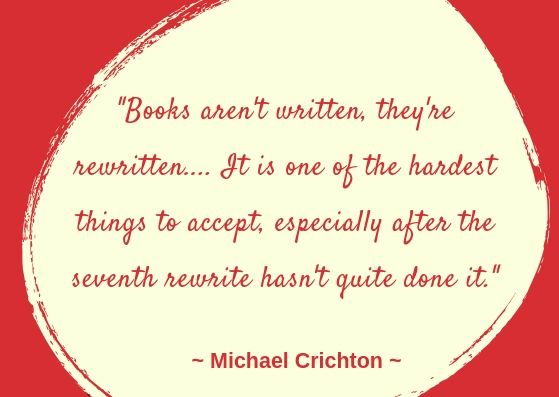
From the beta will come the first draft. From the first draft will come a second draft, something that’s workable and complete. With the second draft, maybe I’ll have something to give to an editor. I’ll see. If I need to, there will be a third draft.

It’s been a long process for me to learn these things, that the first product isn’t the final product, that it won’t be perfect — that it’ll probably have substantial flaws — but whatever flaws are found doesn’t mean that I’ve failed. Writing is a journey and exploration. But it’s not just the story being explored; the novel isn’t the end-all of the journey. Most of the journey and exploration is about me, about learning how I think, what I imagine, and what I don’t know. When I write, more of myself and my attitude is revealed to me through the characters and novels than I ever realized would happen back when I first thought, “Hey, I think I’ll write a novel.” Part of this is learning, how do I cope with setbacks, disappointments, and frustrations? How do I found and maintain the pace and discipline to traverse the arcs and write a novel, or a series? How do I deal with going the wrong way?

I think that may be where many beginning writers struggle; they don’t realize how much of writing is about themselves as much as it is about the story they’re writing. It can be daunting, descending into our private depths to face the person within. It’s a test of resilience to face yourself and your shortcomings, and find ways to address them.

Time to write like crazy, at least one more time.


Blog at WordPress.com.

Up ↑