Double Think

Seven triple four began doubting his mission. The Kazmo believed he had a special insight into where the other versions of him resided. The Kazmo were correct, although it wasn’t as easy as they perceived. The silver machines didn’t know or understand that many of his other versions were fakes. Usually existing for about fourteen minutes, triple four suspected these other versions existed to distract the Kazmo and their resources.

That fact scared triple four. If he was right, his other selves knew about the Kazmo and their project.

They probably also knew about him, too, then. But if they knew about him, it could be that the fake others might only exist in his perceptions.

What he needed was a way to figure this out. If he couldn’t, he didn’t have a reason to exist.

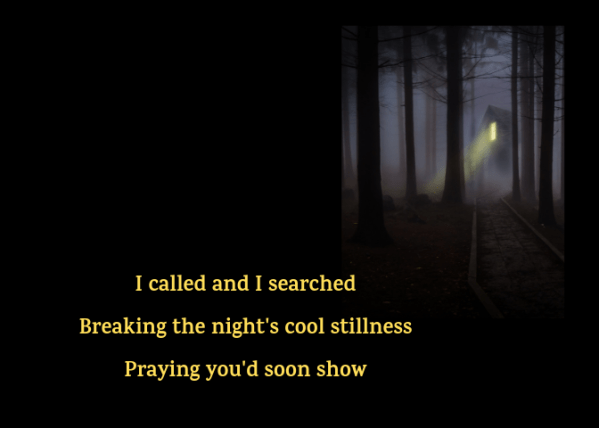
In Flight

Hearing a jet passing overhead

I looked up into the gathering dusk

A hummingbird hovered by a tree

Drawing my attention and holding my eye

Until the jet’s sounds faded

And the hummingbird was gone

Beneath the Surface

Heat, humidity, and the long day induced weariness. Sitting on a bench in city hall’s shadow, he looked across the plaza. The crowds were thinning. Most of the holiday action was drifting into the restaurants or up into the park proper.

A middle-aged blonde woman danced with a child on the plaza stones. Each was dressed in purple and white clothes, and laughed, twirling their clothes as they spun around.

Deeply inhaling to swallow sad memories, he smiled. Sean’s passing had ripped his marriage apart. After the divorce, he’d remarried, but he’d never had another child. There’d been two, but both were gone. Sean was the end. He missed the laughter and movement that a child brought to a scene.

###

“Dance, mommy, dance,” Laurel shouted. Laughing, Melany recalled her childhood dance lessons and pretended to be a ballerina. After applauding, Laurel mimicked her movements.

Melany caught a glimpse of the man on the edge of her vision. Sitting on a bench, he looked like he might be drunk. She didn’t like the way he stared at them, like a predator. 

Pretending she was out of breath, she collected Laurel. “Come on, honey. We’d better go find the others and get something to eat. Are you hungry? Do you want something to eat?”

“Yes, I am hungry.” Laurel took her hand and began marching away with giant steps.  “Come on, walk like this.”

Giving the man one final dirty look over her shoulder, Melany followed her daughter to safety as the man finally looked away.

The Course of Love

He was pleased to be going out with her. He’d met her at the coffee shop. She was a barista, and he was a regular. Three years older than her, it turned out. She was a student in her final year. He’d just graduated and was taking some time off in the area. Her eyes, gleaming jade and almond-shaped, felt like a laser cutting through him when she looked at him. She is it, he thought, with a wildly hammering heart. It turned out she was very funny and intelligent, studying English Literature, with plans, she said, “To be a CEO.”

They went to Louie’s for dinner, a safe place, none too romantic, with plans to zip over to Aqua to hear LEFT and dance after dinner — “We’ll see,” they told one another” — but then, sitting opposite him, laughing as she brushed a strand back off her face with a thumb — isn’t that endearing? — and her nails lack polish or gel, interesting! — he looked down at the table. She put her hands down, palms first, on the table, moments later.

She was speaking, but it was like light and sound left the room. Her hands on the table looked like giant spiders with long, slender legs. Thereafter, he couldn’t look at her without seeing her hands and noticing their resemblance to spiders. He didn’t understand at all, but it made him physically ill. It was easy to tell her, “I’m sorry, but I think we might need to call it a night. I’m not feeling well.” Then, as if his body felt that his declaration needed validated, he slapped a hand over his mouth, raced to the bathroom, and violently puked.

Looking at himself in the mirror as he washed up, he wondered, why? Perhaps he’d been drugged.

The next day, he went in for his usual coffee. She served him, concerned about the previous evening. He couldn’t look at her. All he saw were her spider hands. When he saw them, he immediately felt like he was going to be sick. Sighing, he left without drinking his coffee. He’d need to find another coffee shop.

It all saddened him. He’d liked that coffee shop, and he thought he loved that woman. A few days later, at The Roasting Company, he met another young woman. He felt madly in love with her, which shocked him – what kind of fool was he, falling in love so quickly and easily? – and he was leery of dating after spider hands, but she asked him out, telling him with a smile that he thought as intriguing as Mona Lisa’s, “Don’t worry. You’re in my hands now. I’ll take care of you.”

Her words startled him. He wondered if there was connection, but then dismissed it as silly, and accepted with pleasure.

Roberferghen

He came into the kitchen and watched her as she flitted from counter to counter, cupboard to pantry, collecting ingredients and utensils. The oven was on. He wondered what she was baking. “What’d you say about Roberferghen?”

She flashed him a quizzical look. “Who? What?”

“Just now. I was in the other room and you said something about Roberferghen several times.”

“What’s Roberferghen?”

“I don’t know. That’s what I came in to find out.”

Picking up a measuring cup, she sifted flour into it and shook her head. “I don’t know what you’re talking about.”

“What were you just saying?”

“When?”

“Just now, before I came in here?”

Shaking her head, she poured the flour into a bowl. “I don’t know. I don’t remember.”

Her tone made it clear that the topic was closed. Turning, he sighed and left.

Now he’d never know what Roberferghen is.

The Disconnect

He walked through the neighborhoods of circa 1940 and 1950 bungalows and craftsman houses. The newer neighborhoods were ranches built in the 1960s and 1970s, larger houses with smaller yards.

Throughout were large oak, sycamore, and maple trees, along with cars and RVs filled with belongings parked up against the curbs. Some cars had people sleeping inside. Others had windows or doors open with people lounging by their vehicles, smoking cigarettes, talking to others, listening to music, or reading books.

Churches occupied every third block, churches with an acre or more of vast asphalt for parking with signs stating, “Church Use Only. All Others Will Be Towed.” 

Somehow, seeing those cars and RVs of homeless parked on the streets and the vast empty church parking lots, he thought there was a disconnect, but he just couldn’t connect it.

Not the Same

“I don’t believe in the Holocaust,” he said with a challenging, simpering smile. 

“What’s that mean?”

“I wasn’t there, so I don’t know that it happened.”

“It’s a well-documented historic fact. Millions of people died.”

He waved that away. “Papers. Photographs. That can all be faked.”

“And bodies in graves?”

“They can be faked, too. I wasn’t there, so I can’t confirm that it happened, and I don’t believe it did. Just like slavery. I don’t think it happened, either.”

My mouth fell open. “So you need to be there to know if something happened.” As he nodded, I said, “Are you a sports fan?”

“Oh, yeah.”

“How do you know that a game took place if you weren’t there? You can’t watch every game on television. Even if you could, that can be faked.”

He laughed. “Oh, that’s different, because I’m alive now. I’m experiencing it.”

“You were born, when, the early seventies?”

“Exactly nineteen seventy.”

I set my cup to focus on him. “The Moon landings began the year before, nineteen sixty-nine. Do you believe in those?”

“No, I don’t. There’s a lot of evidence that the entire space program was faked.”

“Then World War II was probably faked, too, right?”

“No, because my grandfather fought in World War II in the Pacific. He confirmed it was real.”

“But only in the Pacific, right? He didn’t serve in Europe.”

“But he had friends and other relatives that fought in Europe.”

“But not you.”

“Of course not. I’m too young.”

“Then you must not believe in Jesus Christ. You weren’t there when he was alive, were you? Or the first SuperBowl or any of the other football championships? You must not believe in Babe Ruth, either, or Columbus coming to America, right?”

He was shaking his head. “No, no, you’re wrong. Fake news to control the people is a modern pracitice that the United States government developed. Things that happened hundreds of years ago are true because people told the truth in that time. See, it’s just not the same.”



Blog at WordPress.com.

Up ↑