Sundaz Wandering Political Thoughts

The Trump Regime announced its foreign policy during this past week, quietly dumping it .

Donald Trump’s bleak, incoherent foreign-policy strategy

Trump’s security strategy slams European allies and asserts U.S. power in the Americas

Anyone who has been paying attention notices that Trump is pretty okay with Russia and is eager to abandon established international protections and orders. The Trump Corollary pretty well spells that out.

Several things are made much clearer for me now.

  1. The Trump Regime, embraced and empowered by the Heritage Foundation and IAW Project 2025, has decided that the only elected political office that matters is the presidency.
    • They’re pulling hard on the unitary executive theory. The POTUS can do whatever he wants so long as he declares it as a threat to the United States.
    • Reinforced by the Roberts Court shadow docket, they are confident that this will advance with little challenge.
  2. Trump and his minions will employ the United States’ military power and reach to do whatever they want.
    • This is along the lines of Russia’s thinking. It’s basically an imperial “we’re bigger than you” attitude, so go screw yourself.
  3. Bombing ships and killing the people onboard was their deliberate statement that the Trump Regime thinks it can and will get away with it.
    • They believe the POTUS is bigger than history and law, whether it’s national or international.
    • POTUS makes policy and executes wars as he sees fit, in the Trump Regime’s opinion.
    • The boat bombings of 2025 were a test as well as a statement to see how everyone else reacted.
  4. That the attacks are illegal and horrid and counter to law doesn’t affect the Trump Regime at all.
    • That they’re purportedly Venezuelan boats and citizens have everything to do with fossil fuels and Venezuela’s reserves, and nothing to do with whether drugs are onboard and destined for the United States.
    • The target and efforts were perfect test scenarios for them after they first flexed military power by bombing Iran under the guise of protecting Israel.
  5. The Trump Regime is aware of blowback from previous efforts to bully other nations and/or conduct regime change.
    • That’s one reason why they’re shutting down inroads and making the U.S. hostile to people coming to our nation.
    • By aggressively doing so and making migrants, immigrants, tourists, and foreigners less prevalent among our population, they can more easily keep tabs and more heavily surveil them when they’re here, and more swiftly and ruthlessly come down on them. In their minds, that probably equates to being less susceptible to terrorist activities.
    • They’re discounting what could happen to U.S. bases and corporations doing business outside of the United State, or what can happen to tourists beyond our borders. It’s another amazing example of how they think with blinders on. They think the threat of military retaliation will keep U.S. businesses and citizens safe in other nations.
    • That’s part of their ‘obey or else’ doctrine as Trump has warned others several times.
    • The Trump Regime is encouraged by how NATO and others responded to Russian aggression.
  6. Trump’s economic policies completely align with the Trump Corollary.
    • Trump claims that he wants to return manufacturing to the United States. That’s clearly just another promise to satisfy his base.
    • By breaking trade agreements and increasing tariffs, the Trump Regime has slowed the flow of goods to the United States.
    • Via this slowdown and tariffs, the Trump Regime can now manipulate what materials enter the country, affecting food supplies, consumer goods, manufacturing, construction, and prices. This becomes another weapon for Trump to coerce cooperation from states, businesses, and people.
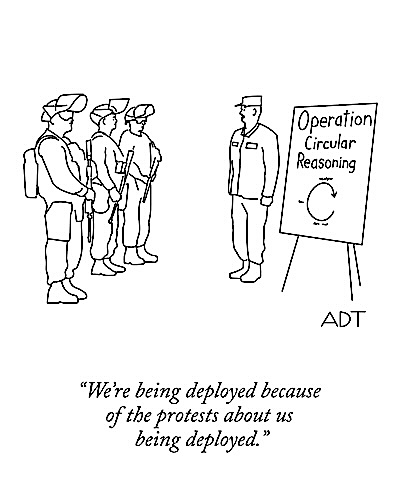
  7. Putting U.S. national guard units in ‘blue’ cities along with attacks on the media and the persecution of his political enemies is a deliberate and orchestrated Trump Regime three-pronged strategy.
    • Their goals are clearly to mute criticism of Trump and his policies.
    • The strategy permits the regime to control the flow of information and to have boots on the crowd to quell public protests and outcry.
    • The Trump Regime knows that’s coming. Trump might not know of increasing unpopularity of him and his policies but his regime knows, are they’re expecting it to grow worse, and are planning against it.
  8. Dismantling the Department of Education and shifting focus from public education to private schools empowers the Trump Regime.
    • The Trump Regime is basically following the old communist game plan. Teach them young, and teach only the ‘facts’ which the Regime wants the young to hear.
    • This practice creates an easily malleable young population, perfect for expanding military forces.
  9. The icing on the strategy is ICE.
    • By establishing and heavily funding a huge paramilitary organization, the Trump Regime has created a de facto national police force.
    • They can then use that ICE force to curtail and restrict travel and enforce curfews in the name of ‘national emergencies’.
    • Trump, as POTUS, can declare a national emergency at will. Given the nature of the GOP-dominated Congress, Congress would only make mewling noises about it.
    • That would leave relief about Trump’s declared emergencies to the judicial system, where the Trump-friendly Roberts Court rules.

Can anyone say Iron Curtain? Through the ‘Trump Corollary’ and the Trump Regime’s already well-established practices, this administration is creating the Trump Wall. They, with ‘they’ defined as the primarily white fascist Christians of Trump’s base and the oligarchs courting Trump’s favor, believe that this policy will make the United States stronger and more successful by isolating it and using its military power to bully others. It completely discounts twentieth and twenty-first economic, cultural, political, and military history. It also belies the truth about how the United States advanced through education, opportunity, and international military, diplomatic, and economic cooperation. But remember that those successes and advances were often done when Democrats were in charge. This Trump Corollary is a reactionary throwback to a far different time, one well before computers and the vast technological communications systems that now exist.

The Trump Regime is on that, though. By developing relationships through business, profits, and grift with the techno brothers, they’re establishing the framework for shutting down and manipulating the social media information flow. AI will only enhance the Trump Regime’s ability to manipulate facts and the truth…just as foretold in 1984.

Bottom line, the Trump Corollary is a death knell for true freedom, democracy, and equality in the United States. Unless you have the money or power to procure them.

Good luck, people. Good luck.

    Twozdaz Wandering Political Thoughts

    Stuff from around the web.

    Ha, ha, remember when Kristi Noem said this? My goodness, those Trumpers really lack memories, conscience, and principles, don’t they?

    More of the same, Stephen Miller edition…

    Trump’s actions are not popular. Is the country heading in the wrong direction? You bet! Will that stop him? No, because he’s locked into an alternate reality.

    Priorities, priorities, priorities.

    I don’t understand. Why would ICE agents go to a restaurant in a war zone?

    Country Star Zach Bryan Divides Fans With Anti-ICE Ballad

    Once again, from Trump’s alternate reality…

    1982

    Daily writing prompt
    Your life without a computer: what does it look like?

    I’ve lived without a computer before. It actually wasn’t terrible. Yes, I’m now spoiled. Personal computers have been life changing.

    But jump back to 1982. I was in the U.S. Air Force, stationed at Kadena Air Base on Okinawa, an island that belongs to Japan. Commodore’s VIC 20 had us abuzz about computers. While we could easily see how it would make many things easier, shopping wasn’t yet on the menu. Nor was getting news updates. It was only toward the end of 1983 that I began learning about the concepts of ‘bulletin boards’, the Internet, and the worldwide web.

    So back then, we watched television. Movies were watched via VHS tapes. That was the latest, greatest tech move for us, and such devices were still running close to $1,000. But we had one to help us weather the lack of entertainment inherent in being overseas. Remember, this was before satellite TV, too, for all practical purposes. All that stuff was just coming out, as were microwave ovens. They were also huge, bulky, expensive machines, but we purchased on of those, as well.

    It’s hard to believe how fast everything changed. In late 1983, I bought my first CD player. It played one CD at a time. Returning to the U.S. from Japan, we gave our VHS player to my wife’s parents, and bought ourselves a new, smaller one with more features, including a remote control. That was the same year that I bought my first computer, a small but heavy Kaypro. Running at 4.77 megahertz, with a tiny green screen, it ran on CP/M and offered minimal RAM and two floppy drives that used 5 1/4 inch disks. It was a wild scene. We learned how to add RAM, make things faster, and double our floppy disks’ storage. Ten megahertz machines were being touted as possibilities, along with 64K of RAM and a 5-meg hard drive and 16 color monitors! Wow!

    Back before that, we read. A lot. Books were checked out from the library, and research was done at the library. I subscribed to multiple magazines, such as Writer’s Digest, Autoweek, and Road & Track. Went for walks, played sports, read newspapers, which were delivered daily. When I lived in San Antonio, Texas, I subscribed to both the San Antonio Light and the Wall Street Journal. Even with the computer and VHS player coming along, and the CD player, and DVD players, most of that didn’t change. We still visited malls to shop, and used Sears and Spiegel catalogues to make orders, calling in to toll free numbers to put the order in. Board games like Risk, Life, and Monopoly were popular with us, along with Trivial Pursuit, and card games like Tripoli and King on the Corner, and Solitaire.

    No, the big change came when the Internet finally fired up. My experience with it began in 1991, when I came back from Germany. Slow as hell, to be sure. Connections through modems which had to be hooked up. LOL. That changed fast, too, as built-in modems came along. I was both a Compuserve and AOL subscriber. Email was a new, exciting idea.

    Then, suddenly we went to 256 colors and beyond on our monitors. The mouse became popular. 100 megahertz machines were being sold. I remembered buying and installing a 100-meg hard drive, and laughing. How was I ever going to use that much storage? It seemed so excessive. By then, our floppy drives were down to three-inch little colorful things. Now, we’re like, floppy drive? What the heck is that?

    Going online was a wild scene back in the mid 1990s. Weren’t many websites in those early days. The games were something else. Research, news, and sports all became much more accessible. Then, boom…social media. That’s when things really flipped.

    I’ve gone a few days in 2025 without my computer and without the Internet. Like before, we read, played games, and went for walks.

    Just like it was 1982, just forty years ago, when I was younger, and so was the personal computer.

    Floofllantis

    Floofllantis (floofinition) – To brighten a space or existence with an animal’s representation or presence. Origins: Floof Marketing PLC, 1999.

    In Use: “During the pandemic, when people were urged to stay home and many businesses were shuttered, the popularity of floofllantis grew, resulting in a large increase in housepets.”

    In Use: “Realizing how the Internet could be employed to enhance animals’ situations, Floof Marketing PLC launched the first floofllantis campaign, urging existing housepets to act silly, cute, loving, or interesting to entice their hoomans to share videos on the net.”

    Satyrda’s Wandering Thoughts

    Not too long ago, I learned more about sudoriferous or sudoriparous glands. These are basically our sweat glands, if you’re human. My reading instructed me about the apocrine sweat glands, and eccrine sweat glands. I never gave sweat glands much thought before, but this was related to something I was writing, in a really thin tangenital way. I don’t want to get all pedantic about it because most of your probably already learned these things that I’m just coming upon, but all sweat is not the same. I kind of guessed that from the smell and feel of sweat in my armpits and groin area versus everywhere else there where sweat glands reside. Also, check out how tiny these sweat glands are on this photo of a fingerprint. Pretty amazing, right?

    Human sweat gland pores on the ridges of a finger pad

    In an aside, it’s good to have the net available to provide this info. I ding the net for not being perfect but it really can be helpful.

    The Writing Moment

    The coffee shop had net problems today. Shrugging that away, I told myself, “Just write and check the net later.” Two and a half hours later, I’d finished 2300 words and the story had progressed as if I had some notion of what the hell was going on.

    The Hunger Band was on my stomach’s center stage by then, their first notes careening through the rest of my bod. Coffee shop net still down, I listened to the Hunger Band’s sorrowful lyrics about dying of starvation and decided, “Yes, I’ve written enough. Time to go home and eat.”

    Now to explore the kitchen to see what the Hunger Band will find acceptable. Salad? Maybe. Burrito?

    Hmmm.

    Thirstda’s Wandering Thoughts

    TL/DR: AI is fucking up. And that’s fucking us up.

    One of my childhood passions were cars. From that grew an intense interest in auto racing. It wasn’t something that I shed as an adult. Passions aren’t easily surrendered. Yeah, as an adult, auto racing, with its environmental impacts, ridiculously increasing costs, and inherent dangers, lacked substantial commonalities with the human condition and the challenges Earth and humanity face. I excused myself for decades with the subterfuge that we don’t want a vanilla existence. Year after year I followed sports car and Formula 1 racing. For a while, I also hunted NASCAR, IMSA, and IndyCar news. But sports car and Formula 1 was it for me. As I aged, the passion became muted and dulled. Part of that was that the sport just wasn’t as competitive. Aspects of its relevance to real existence also troubled me, though, and that grew.

    One of the Internet’s commercial strengths is that it notices what you look at, and then baits you with more of the same. The net noticed I checked out LeMans this year. It came up with reminders about Ford’s victories at LeMans in the 1960s via the Ford GT. That effort was highlighted not long ago in a movie called Ford v Ferrari.

    A story about Ford’s 1967 LeMans victory grabbed my eye. Driving a red Ford GT Mark IV, American drivers Dan Gurney and A.J. Foyt took LeMans in record form. I built a model of the car within a year. It sat on my dresser among my other models until I moved out of Mom’s house four years later. Eagerly, I read the story. Then I wondered: how many drivers have won both the 24 Hours of LeMans and the Indy 500?

    I put it to AI; how many drivers have won both the 24 Hours of LeMans and the Indy 500?

    AI responded, slightly paraphrasing, Lewis Hamilton won it in 2011 and Max Verstappen has won it four times recently.

    WTF?

    I know that Lewis Hamilton has never raced at Indy or LeMans. Nor has Max V. Both are Formula 1 champions.

    The entire AI answer was fantastically fucking wrong. Now, if I didn’t know the sport, I may have been fooled by the answer. Which pushes the wonderment in me, how many people consult the Internet for truthful and factual information and are being fed wrong answers? How many lack the resources or awareness to challenge the veracity of what they’re being fed?

    For shits and grins, I asked AI again. This time, one source said, “…while only Foyt has won both the 24 Hours of Le Mans and the Indianapolis 500.” Another told me, “Only one driver has won both the Indianapolis 500 and the 24 Hours of Le MansGraham Hill.”

    So, both answers are wrong, because I knew before asking that Foyt and Hill were the only drivers who accomplished this.

    Wrong info on the net is not new. We’ve joked for years, “It was on the Internet so it must be true, ha, ha.”

    But the shit is getting deep. The way that wrong information is advancing and spreading with AI’s gentle assistance, the joke is now on us.

    Do You Want to Connect

    Daily writing prompt
    Do you remember life before the internet?

    Life before the net. Do I remember those dark, soulless days? Oh, yeah. I remember those days, just as I recall life without the world wide web, life without cable and DVDs, life without CDs, eight-track and cassette tapes, life without microwaves, and life without cell phones and more than three networks. I remember life without remote controls, which my wife calls, the clicker.

    Yes, I remember buying my first personal computer. I remember using the first one at home. Then I recall signing us up for Compuserve and Mindnet. I remember getting my first email address and having no one to email. That soon changed. Viagra offers quickly found my inbox. With it came an understanding of something non-meaty called ‘Spam’ and wealthy Nigerians in need of money.

    Yes, I remember pre-net life. Primarily because our TV schedule was fixed according to the cable schedule. Cheers on Thursday, for example. But when the net came into its full flowering, I was able to find a huge variety of things to stream from around the world, watching them when I wanted, instead of waiting for their schedule. Long as I was willing to pay for it.

    With the net, the days of going to the front door and looking for the daily newspaper disappeared. There was no need for all that inked paper to stack up and get put out for the trash. Now the news was right there online. I didn’t need to wait until 6 PM to check to see what was happening. Of course, information about what was happening locally soon began fading. We could no longer just pick up the paper and turn to the police log to see what the hell the sirens were all about the other day. No, that faded. Now, there are sometimes stories on Facebook or Nextdoor. Some others are struggling to bring the local news back to us. It’s a challenge. Many efforts arise and fall.

    Freedom came with online ordering, too. I no longer needed to prowl through brick and mortar stores, making comparisons, trying to figure out what to buy. Boom, the net was heavy with choices. It was still onerous in the early days to compare things but then came Amazon… Suddenly, whoa. It was a desperate consumer’s dream.

    Do you know what it was like to travel in pre-net days? Calling the airlines to get price checks, listening to them look up schedules for you, explaining options? Same with hotels. Expedia and the like made it easier…for a while. But wherever money and humans are involved with money transactions and information, others are there to scam us for their share of the pie.

    Yes, I remember life before the net. It was simpler and harder, easier, and more problematic. That’s how it always is with progress. Each step unfolds with new and surprising insights, and the things we used to do begin to fade.

    Just think: one day, people will be asking, do you remember life before AI?

    And someone will reply, I remember the days before cars. And then we’ll all wonder, what was that like, and turn to AI for the answer.

    Blog at WordPress.com.

    Up ↑