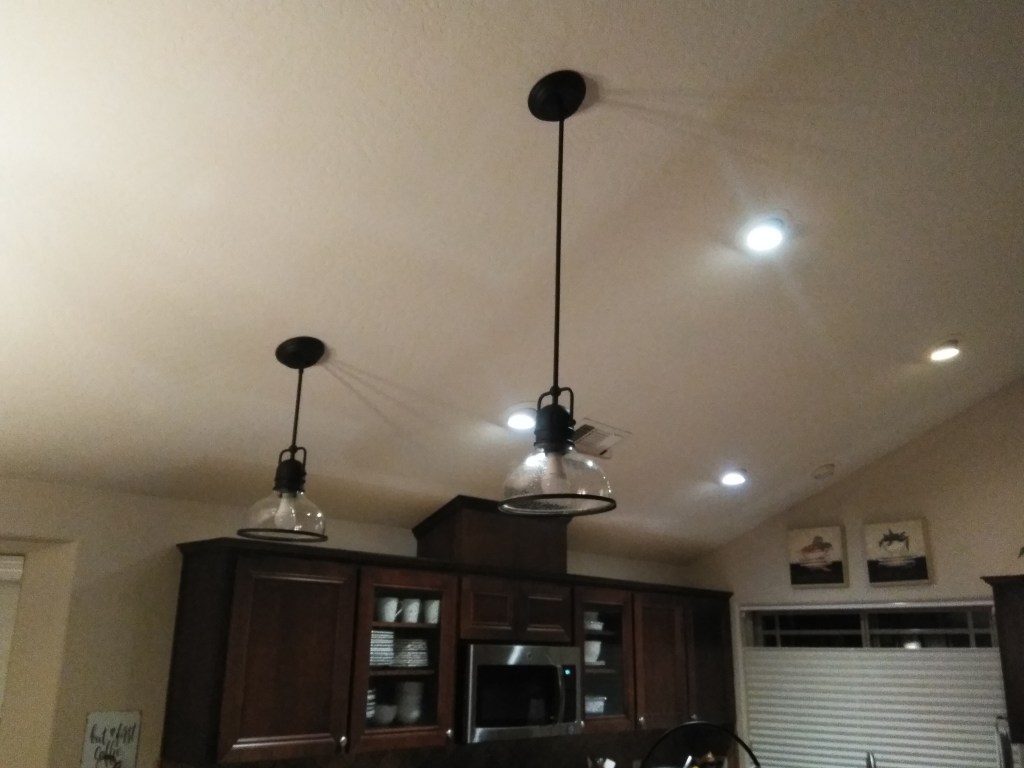
‘Nother DIY Done

I reaffirmed my firm position as a budgeteer DIYer. My wife kicked this one off.

“I think we need new breakfast bar lights.”

A zillion responses went over my brain’s hill and dale. One landed. “Sounds good. What do you have in mind?”

She had a general description. Phase I began: we began the search. Found them. My wife asked, “Do you think you could install those?”

“Of course,” I confidently replied without consulting any Neurons. The Neurons freaked. “You fool, what are you saying? Did you learn nothing yet?”

“Pshaw,” I replied. The Neurons knew I was nervous but my wife’s easy acceptance that I could the job. I couldn’t let her confidence in me down.

Phase II, we ordered them, received, and inspected them. They came across the country from Philadelphia, PA, on a truck. Eight days in transit.

Next phase: install the suckers. Installing lights aren’t a BFD. Technically. However…they’re mounted on a high vaulted ceiling. I dragged out our tallest ladder and climbed. At a few hairs short of being five feet eight inches tall, I could’ve used two to three more inches to have a comfortable reach for the screws and wires. Beyond that physical limitation, the hardest thing was removing and adjusting the stems to make them level and a height that satisfied us.

But it’s done. Results achieved, and no injuries scored. BTW, those bulbs are our emergency bulbs. Batteries built into them. They work like normal digital bulbs. But when the power goes off, they become emergency lights which provide illumination for six to eight hours. They’ve proven to be a great buy in the last two power outages. Coolest of all, they can be unscrewed and carried around like flashlights.

Next: a new dining room light. I have no doubt I can pull that off. The Neurons are a little worried, though.

It’s Not DIY Without Some WTF

I took on an easy DIY project yesterday. This was a new foyer light.

The new foyer light.

This was my wife’s idea. I thought the old one was fine. We’d installed it shortly after moving in back in 2005. It worked, putting out light and everything. Click on, click off.

My wife said, “We need to update our lights. It’ll make the house look newer.”

Sure, I thought with a mental shrug. I had no reason to buy a new light but had no real reason to oppose buying a new light. They don’t cost much, and the old one will be donated to Habitats for Humanity and re-used.

We went on a light search together, an outing I found tedious and boring. I found this light and offered it as a possibility. “Let me think about it,” she answered, walking away. A little while later found her back at the light. We discussed its pros and cons.

“It’s black,” I said. “With seeded glass.” She’d specified those things. That’s what attracted me to it. I’m a hunter; she established those parameters and that’s what I sought.

“It’s flush mounted,” she said. “Can you install it?”

“Yes.” I was surprised she asked. I’m a budgeteer DIY. There’s little that I don’t think I can do, given time, tools, and video instructions. But the reality is, I’ve installed over a dozen ceiling lights in my life. The first was in Germany, where I shocked myself in an episode which will only die in memory when I pass away. I’ve been a lot more respectful of electricity after that.

So, she was out yesterday — Girl’s Night at the Movies, done at 1 PM because none of them want to drive at night. The feature was Earth Girls Are Easy. With her out, I pursued the new install. Half an hour, I figured.

I’m such a stupid optimist.

After turning off the power to the light (see, lesson learned), I pulled out the ladder and removed the old light with relative ease. So far, so good. But I needed to remove the installation plate as well; the new light and old plate did not match up. No big thing, right? Just two screws.

Here’s where WTF entered the project.

I could not get one screw to turn. At friggin’ all. Different screwdrivers were tried. WTF, over? I mean, I screwed it in. I should be able to screw it back out.

By now, my body was running with enough sweat to fill a bathtub. Repositioning the ladder a few times, I positioned myself to apply max torque. I realized that part of my issue was that the mounting plate was not perfectly aligned with the screw, and that extra pressure was hampering my efforts. So, I wedged that thing around just a little. With the slowness of a MAGAt realizing that Trump lied to them, the screw finally began turning. Of course, it’s a two-inch long screw, a bolt, really. I finally got it out, though.

The rest was as easy as eating pizza. I was just finishing as my wife arrived home.

“How’d it go?” she asked.

“No sweat,” I answered.

We agreed, it looks better than the old one. The photo doesn’t do it justice. It’s a lousy camera phone’s lousy photo. But the change was startling. The other light hung down about half a foot more, so it had more of a ‘presence’. The change to this light opened up the space.

I told her all that. She agreed.

“Now we just have to do the breakfast bar and dining room chandelier,” she said.

I’d installed them. Sure, that was twenty years ago, but I nodded.

“No sweat.”

Two More DIY Jobs

It’s another year. That means more do-it-yourself work.

First, praise be to the net and the help that it provides.

My DIY needs began without any foreshadowing. We have up / down Duette honeycomb blinds in the office. The right sash raises and lowers the blind’s top while the left sash raises and lowers the blind’s bottom. This arrangement allows broad and flexible configurations. We drop the blinds’ top halfway in the morning to let early daylight into the room. Later, we raise the top all the way and then raise the bottom about two feet. Bushes block most of the bottom window so we get light without direct afternoon sunlight, which can be scorching, but still have privacy.

I pulled the cord to make this arrangement the other day and won ‘snap’ for my efforts. The ribbon tape which controls the inside mechanism broke apart. First thing I did was remove the blind and take photos of the labels. Labels on products are packed with information.

Then, to the net! I researched how to repair it. I figured I could do it. As usual, the challenge is to find the right parts. Unable to do it, I reached out to the manufacturer, Hunter-Douglas. Six emails, four days, and two photos later, they sent me a link to a KB article for how to fix it and told me they’re sending the needed parts, free, in ten to fourteen days. I’ll update you after that.

The second job came to light an hour later. I preheated the oven to bake potatoes. Only the oven didn’t go on. The burners lit so it wasn’t a gas issue, nor a general electrical problem.

To the camera!

To the net!

Quick research pointed to the igniter for my eight year old GE Profile range model PGB911ZEJ4SS. I should trouble shoot to pin it down but I gambled, hunted down the part, WB13X25500, and put in the order. I’m waiting for its arrival.

Will it work? As with everything, time will tell.

Ambitious? Just Back Off

Daily writing prompt
Describe the most ambitious DIY project you’ve ever taken on.

When it comes to DIY, ‘ambitious’ isn’t in my vocabulary. Honestly, I keep it simple.

I miss the old days, when part of my DIY routines were working on the car. Changing oil, cleaning or replacing the spark plugs, setting the ignition timing, rotating the tires, installing new brakes, bleeding that system, replacing the radiator coolant, etc. Those were fun and rewarding DIY projects. Then, though, cars became complicated. Engine bays became packed so tightly that reaching spark plugs was an ordeal. Getting to the oil filter was a nightmare. I’m reduced to installing a new battery in the car and topping off the windshield wiper fluid.

Around the house, I’ve done multiple small jobs. Replaced the furnace’s control board. Installed new thermostat. Replaced the filters, installed capacitators on the air conditioning, along with some other pieces on it. I’ve installed new light fixtures in various rooms, took the dishwasher apart and fixed it, and did troubleshooting on the microwave, replacing fuses and different parts. Likewise, I’ve done some plumbing work but I keep it simple. I’ve painted all the rooms except two, installed a blower in the gas fireplace, and do all my yard work. Yes, I’ve installed some shelving and assembled furniture.

On my computers, I’ve swapped out hard drives, processors, fans, video cards, and power supplies, and added or changed memory. In many ways, I think of them as the modern equivalent of working on cars back when cars had mechanical systems. I’ve installed and replaced routers and modems, replaced keyboards, added different streaming devices and printers, and did basic troubleshooting on software and security, uninstalling, reinstalling things as necessary, and took apart the keyboards and cleaned them.

Many of these things are driven by being cheap. I don’t want to pay others for what I think I might be able to fix. I’m also driven to understand these things more. I want to know how they work, how the parts interact, etc. These systems are mature and demonstrate ingenious engineering solutions. Finding how they work amazes me, and the Internet is a useful tool for that purpose. Then, to restore them when they’ve died is such a validating process.

That validation process is a big component. In a complex world, where so much seems beyond our control, it’s satisfying to take something broken apart, and make it work again. Just keep it simple.

Get Rid of Them!

Daily writing prompt
Something on your “to-do list” that never gets done.

One thing has been hanging on my to-do list for years.

I must get rid of my old computers.

I’ve been using my current laptop for ten years. It replaced a laptop which replaced a laptop which replaced a tower.

I still have all of those computers which I replaced. They’re neatly stacked in a hutch.

Besides those, I have my wife’s MacBooks. She’s on number four since 2001 and numbers one, two, and three are part of the pile. My main thing is that I want to pull all those hard drives before I get rid of the computers. Then I’ll wipe the hard drives and get rid of them. Sure, I can pay people to do that sort of thing for me but I’m a staunch DIYer.

So it hasn’t been done. They’re a permanent part of my “to-do list”. Someday, though someday…

Maybe.

DIY Fail

I’ve been working on my home HVAC system. The AC did not kick on when needed two weeks ago. Playing around with the system, the fan didn’t come on, the heat didn’t turn on, the air conditioner did not engage.

After tracing wiring and troubleshooting, I drew down on the stepdown transformer. The board wasn’t getting energy. The board’s fuse was intact, all circuit breakers and switches in the proper locations, etc., but the board’s diagnostic light was dark. I thought I’d accurately followed all the steps that led to the transformer but replacing it did nothing.

That leaves me at a circuit in the road. Call in a pro or keep at it myself. I’m reluctantly inclined to bring in a pro but my inner idiot (I2, also sometimes referred to as I squared) is saying, “No, mate, don’t give up, you got this.” That aligns with my overall philosophy that to succeed, failure must be risked and overcome.

My wife seems inclined to let me continue. Although we have high heat, she’s been using an electric fan and shrugging it off. That reminded me that we’ve existed without AC before. Both of us grew up in homes deprived of having AC. Early duty stations in the military included Randolph AFB, Texas, outside of San Antonio. I remember us enduring a string of days over 100 degrees F. Our military homes on Okinawa and our home in Germany also didn’t have AC.

So, you know, we can survive without the air conditioning if we’re prudent and thoughtful. It is a nicety we’d like to have but we don’t find it overly necessary. As far as fixing the AC, I’ll get with my wife and talk it over.

I think I’d be happy either way.

DIY Part Infinity

Every other year, it seems like I’m working on my air conditioner. It’s less than twenty years old by a handful of years, so you’d think it’d be fine. But the truth is, pieces on it regularly fail. The first year of failure, a service guy told me what failed and why, and added, “Parts are made to fail anymore. They have a short life.” He didn’t know if companies were cheaping out on materials or making deliberate choices to reduce parts life to generate more business. He and I agreed, it was probably both. Since I was skeptical of his claims, I researched his assertions on the net and found there’s growing supporting evidence for them.

That aside, I began teaching myself DIY stuff via videos and forums. Replacing the garbage disposal, fixing toilets, sinks, and sprinkler systems, repairing the furnace and air conditioner, whatever came up, I sucked up a deep breath and muttered, “Charge.” Fortunately, the net is full of advice and instructions. Some of it is shit, but there are some solid, helpful sites.

It looks like the air conditioner is in the batting box again in 2024. I flicked it on the other day and…nothing. The usual first steps of settings, circuit breakers, and switches were checked. All good.

I went right out, removed the air conditioner’s service panel, and then the little protective cover on the starter, and pushed in the plunger with a screwdriver. The A/C roared on. Good, it’s getting two forty. Good. A multimeter showed, yes, there is 240v coming to it, but hey, no 24 volt power. Ah.

Back to the thermostat. I pulled the cover off and checked the batteries. Then I checked voltage on the red (power) line and yellow (AC). Nothing. Ah. Must be up in the furnace.

The furnace is in the ‘attic’ crawlspace, a vertical unit sitting on its side above the garage. I laddered up there into the heat. 89 F outside, it felt like it was the upper nineties up there. My body turned on my sweat like I was watering a garden

I turned off the furnace at the switch on the wall and pulled the panels. Safety switch looked good. No loose wires. But also, no blinking diagnostic light on the control panel. The control panel didn’t seem to be getting energy. I checked the little five-amp fuse: intact. Okay.

Power was put back on and the panel safety switch was taped down. I used the multimeter to check voltage on the black L1 power line in and a neutral. No power. For grins and giggles, I also checked the 24v power line and found no power, kind of as expected. Tracing the L1, I realized that in my system, it doesn’t come directly in from the safety switch; the line goes to the stepdown transformer.

As it’s a dark, cramped space, I took a photo of the transformer with my phone so I could study it. When I did, I immediately spotted what looked like damage from aging. Deciding WTH, I went down to the computer, found the piece online, and ordered it.

A heat wave is coming. Upper nineties tomorrow, 106 to 112 F here in Ashlandia on the fourth, and like degrees on the fifth and sixth. The part is due in anytime between the third and the eighth. Hope it gets in on the third but…not holding my breath on that.

Also, hope it is the transformer, because it’s an inexpensive part and an easy fix. If it ain’t the transformer, it’s either the wiring going through the house (which really doesn’t make sense) or the controller board. The board is more expensive and more involved to replace. I don’t want to do that but…if I must…

As stated, I so hope it’s the transformer. Fingers. Fucking. Crossed.

Dishwasher DYI

TL/DR: fixed the dishwasher by taking some of it apart and testing and cleaning things.

“Look at this,” my wife stormed. “These dishes are not clean.” Profanity followed. I think she’s been around me for too many years.

Yes, our GE Profile dishwasher has been giving us poor results a lot recently. It’s six years old but we generally only run it once or twice a week. Which, actually, could be bad for it. I learned from research this week that some systems use a count to recalibrate things.

I found and wrote down the model number and serial number. More research was done. Youtube videos were studied. We ran the machine for troubleshooting. Hot tip: with our machine, at least, there’s no need to run an entire cycle. If that’s not desired, just use whatever cancel feature is set up on your machine. With our machine, turn the start button on as if we’re going to start it, then hold the start button in for more than three seconds. When that happens, the cycle is canceled and the pumps drain the dishwasher.

Our symptoms beyond dirty dishes emerging from the clean cycle was also the soap not getting fully used/dissolved or even dispensed from its compartment on the door. Not to blow my own coronet, but we’re frulk (shorthand for frugal folk) and buy our dishwasher pods at Costco. But doing research, it appeared that the upper and lower arms might not be spinning.

To test the arms, it’s recommended that you note the arms’ positions (some companies refer to the arms as wands) and run the dishwasher for several minutes. You then interrupt the cycle, open the door and see if the arms have moved.

No. They hadn’t.

Next step is a little trickier. There’s a door latch sensor, I guess you call it at the top center of the dishwasher opening. Slipping a long but slender screwdriver in and holding the door open permitted me to see if the arms were spraying at all, or if anything was spraying, in fact. ‘Nother hot tip: if you do this method, make sure you’re ready for a little water to the face if the spray arms are working. Also be ready to pull the screwdriver back fast.

From all of the research and pondering, including listening to it, I concluded that I had to put the diverter assembly. In point of fact, it would be the last thing we did. Our DW uses a four port diverter with two tiny magnets. If they get gnarly, they can cause a problem.

So I removed the racks. We have three: a bottom one with the utensil basket, a top silverware drawer, and the middle rack, with bottle washers. The middle rack was a challenge. It’s an adjustable one and doesn’t use the standard end clips or levers. Instead, two hex screws, one on either side of the rack on the raise/lower mechanism, hold it in place, 7/16″ in a tight, tight spot. Once they’re removed, tabs are slipped out on either side, and then the drawer is pushed backward to clear quarter inch pegs.

After the racks were taken out, I removed the lower arm (turn the plastic locking mech to the left), unclipped and removed the water conduits, unscrewed and removed the micro filter, and then the macro filter. Now I could get to the diverter assembly, which sits in the bottom of the DW basin, in the middle. Two screws secure it. A third, which holds the water conduit to the utensil basket in place, had to be removed to free that conduit so that I could turn and free the diverter.

With all that done, I took a toothbrush and liquid dish soap and cleaned it all. I ran water through the wands and conduits to ensure they weren’t clogged or blocked. Then it was all put back together and a test conducted.

Yes, I put the screwdriver into the latch.

Yeah, I got a face full of warm water and water across the kitchen floor. But I laughed because it looked like success. I put the arms into a parallel position, noted that, and ran it again for a few minutes.

And yep, they were moving, baby.

It felt good to fix something again, but this one had my back and neck complaining after I was forced to work on my knees, bending in and reaching across the DW basin to undo things, remove them, and then put them back. After finishing, I told my wife, “Baby, I’m starting to feel like I’m beginning to get old.”

She replied, “You’re JUST STARTING to feel that?”

Yeah, I laughed.

DIY, Again

This DIY project was about replacing a screen on a patio door. The screen door was on the bedroom slider. Long ago, Quinn, the gorgeous and sweet long-haired floof who shared our domicile, decided stretching out and scratching his claws on it was wonderful. Quinn was smart. He quickly discovered that we didn’t like it. Therefore, he restrained himself from scratching when we were around. Once in a while, he’d start, then jerk to a stop with a look at us that said, “Oh, sorry, didn’t know you were here. I’ll come back later.”

When Papi, the current ginger-in-residence, joined the household, Quinn thoughtfully taught Papi how to use the screen. Papi then came to understand that plucking on the screen when we were in bed at night and he was outside would bring us to the door and open it for him.

Naturally, all this scratching and plucking damaged the screen. Damaged is such a simple word it feels dishonest. They tore that booger up. So I watched some videos and replaced it. Hardest part was getting the door off the tracks. This was one recalcitrant door. Years ago, my wife said, “Can we take that off?”

“Sure,” I replied, flexing. “Normally you can lift up, clear the bottom tracks, and slide the door away.” As I mansplained this, I attempted to demonstrate. The door would not go. “Sometimes you need to loosen the screws.” I found the screws and loosened them, then tried again.

Wouldn’t clear. I couldn’t even see the bottom wheels so I couldn’t push them up with a flat blade. Frustration set in.

I’d try to remove the screen door every other year or so. Nothing, nothing, nothing. This is the year, I decided. 2023 was the year for freeing the door and replacing the screen.

It was a battle. I completely removed the adjusting screws and lifted. The theory was, raise the door as high as you can, expose the wheels, and use something to press them up into their recess so they clear the track. A putty knife is normally recommended.

It wasn’t working. The putty knife wouldn’t work — couldn’t see the wheels enough to press them in. They just weren’t being exposed, no matter how high I lifted the door, which, of course, was limited by the frame. Eventually, after searching through my possessions, I found a plastic square that’s used for edging when I’m painting. It’s actually a very shallow wedge. By lifting up one end of the door, I made enough space where I could shove the wedge in. Um, wedge it in, as it were. Then I fiercely dragged the door with the wedge under it, gently tugging the door outward, along the track until one part of the bottom wheel assembly cleared the track. Next, I used my putty knife to hold that up while continuing to tug and drag.

Sweaty job, but it worked. After that end was done, I did the other in the opposite direction. With the bottom wheels out of the tracks, removing the door was ease itself.

The screen door was set flat on the patio dining table, spline pulled away, then the screen remains were torn off. Phase one done.

I’d already measured the screen and purchased new screening at Ace Hardware downtown. I could have replaced the entire door rather than the screen. That would have presented some challenges but would have likely been easier and less time consuming. But the current door and wheels were in good shape, so that seemed wasteful. I don’t like to waste. Besides, the new screen material was less than ten dollars compared to some larger price for a completely new door.

Working methodically, I laid out the screen, strung the spline along the groove, and set to work. Beginning on the bottom, I set up the screen to match the opening, providing some overlap, and then inserted some spline on the bottom edge as a place holder. Next, I worked one side, doing the same, pulling the screen tight. So it went, around the entire door. As I worked, I’d pulled the screen tight across the door and push the spline into the groove to hold it until I was satisfied.

My spline tool was a bottle cap remover. Narrow, curved, it wouldn’t damage the spline as a screw driver would. A spline roller would have been ideal but I didn’t have a spline roller and didn’t buy one. I just didn’t want more stuff, especially when I didn’t believe I’d replace another screen. I’m sixty-seven years old and this was my first. I don’t really see another one in my future.

Also, I’d been through my tools recently. In there I found tools for removing car oil filters, oil plugs, and doors for setting points, and gapping spark plugs. As I’d had American, Japanese, and European cars through my lifetime, I’d had to buy tools to account for differences. However, you know how long it’s been since I changed my own oil and filter, or sparkplugs. My last several cars didn’t even have points in that sense, having been replaced by electronic devices. I just didn’t want to add another special tool along them and the Koehler facet tool which I needed to buy to replace their ‘washers’.

So the spline roller was nixed but the bottle cap remover worked well. After I’d done my initial placement of the spline and wanted to push it in deeper, I brought in some diluted dish soap. Dribbling as I went, I lubricated the channel, making it easy to put the spline fully and uniformly into the channel. After that, I trimmed the overlap screen, cleaned off the tracks and window, and re-installed the screen door.

Huzzah. Felt good to get another thing done. On to other matters, like the sprinkler heads.

Cheers

The Help Dream

Sunshine streamed in through large windows. I was younger and installing something involving wires in my home’s living room when I asked my wife for help. I needed to go back into a small space and I wanted her to hand the wires through to me. She asked me if I could do it by myself. I countered, I could, but she was there, and that made it easier.

She said, “How would you do it if I wasn’t here?”

I replied, “I have a ball of twine. I’d tie the wires’ ends to the string, and then tape it so it wouldn’t pull loose, and then just pull it through.”

Turning away, she answered, “Then why don’t you do that? Just do it yourself.”

Blog at WordPress.com.

Up ↑