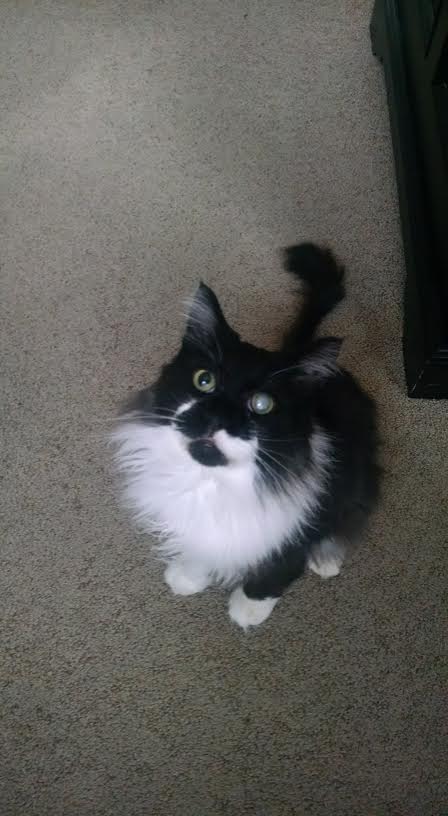
Floof-timing

Floof-timing (catfinition) – to betray a cat by friendship or attention with another cat; to deceive a cat.

In use: “When she came into the house, her cat stopped short of greeting her to lean forward and sniff her pants legs. “Yes, I petted another cat,” she said. Giving her a hurt look, he turned his back on his floof-timing person and walked away, refusing to answer her when she called his name.”

Multiple Choice

So, cat folks. Have you ever been busy doing something, or killing time while you’re doing something, and look up, and see a little cat head peeking around the corner, watching you? Do you find this:

a. Oh, so sweet, it’s almost precious.

b. Cute.

c. A little freaky.

d. Irritating, because you can’t get a minute to yourself.

e. All of the above?

Yeah, one of my floofs do this, like he’s a spy. The rest just barge in, and either a), rub up against my legs; b), try to get on my lap; c), sit down and watch me while meowing; or d), all of these activities.

Floofyeurism: when a cat spies on you.

The Sausage

We’ve always had cats. We claim them as ours. That’s because we paid the rent or the mortgage, bought the food, and paid the other bills. We thought we were in charge because we control the money. Yeah, we control the money, but they control us. Cats have us. Out of the most recent who lived with us (Sammy, Scheckter, Pogo, Smudge, Lady, Quinn, Tucker, Boo, and Papi), all came to us. They picked out our house, walked up, and meowed, “Hello. Feed me.” The exception is Lady. We took her in because the elderly man who took care of her and six other cats was moving into a home, and couldn’t care for her any longer.

The thing about cats is we love to entertain them, because it entertains us. We love watching them pretend to stalk and kill strings because they’re cute and funny. Plus, we need to entertain them. When they’re not sleeping or eating, they need entertained. Fortunately, they’re eating or sleeping twenty hours out of the day. But if you’re not entertaining them for the other four hours, you will become their entertainment. They’ll start playing head games, like the Door Game, or they’ll start walking around, meowing, the game they call Meow Polo. It’s like the Marco Polo game humans, but crueler, and sans water.

These circumstances drive us to hunt for cat toys. You’d think it’d be easy. Cats like chasing mice. Bugs. Spiders. Each other. Lights. Strings. Pieces of foil. M&Ms. Blueberries. Should be easy to find them a toy.

But no. One of the mind games cats like to play with people is to be indifferent to what we offer them. Food, snacks, treats, toys…cats like to look at them, sniff them, maybe give them a bat, and say, “No thanks,” and walk away. And we know this about cats, so we try to out-think them. But we can’t, because we’re using human logic, and they’re using cat logic, which is superior.

Yet, we still try.

That’s why we’ve been so happy with the sausage. Sixteen inches long, it looks like four sausage links. It’s stuffed with catnip. Every cat we’ve had will walk into the room, see the sausage, walk over to it, and go into some frenzied but gently violent feline foreplay with it. They’ll lick it, bite it, seize it with their front paws and kick it with their back paws, roll around on it, drool and dribble on it, and gently rub their faces against it. Then they’ll get up, step away like, “That’s enough,” wash, and generally pretend that what just happened, didn’t.

And we love it because we feel special for finding something that entertains the cats, so they can entertain us, and re-establish our balance about who is supposed to be in charge.

Inside/Outside

Inside the house, he’s a large gray fur ball with a sweet face, green eyes, dignified whiskers, ready purrs and a soft meow.

Outside the house, he stalks and watches, on guard against every threat – and threats are seen in every leaf quiver, heard from every soft rustle to every loud noise.

Inside the house, he curls up in a tight ball and falls into deep motionless slumber with his black paws covering his eyes.

Outside the house, he hunkers against the weather, whatever it may be – cold, raining, snowing, windy – 

Well, not windy. He goes in the house when the wind blows. He does not like the wind.

Outside the house, he forages for his food, grateful to find something to eat.

Inside the house, he sniffs the offerings and attempts to cover the offensive material as though he just let it out of his bowels.

Then he runs for the door and releases his cry,  “Freedom!” I open the door. He flies out. Then I put the bowl of rejected food out — 

And he comes and eats it, for he’s outside the house, where the world is wild, and food is never ignored.

Cat Forensics

Yeah, it’s not pretty but it happens.

I have cats. They vomit.

Yeah, bleah.

Three cats live with me. Two others that belong to neighbors make my house their de facto home.

Five cats. Each display distinctive traits and personalities in everything. Eating, of course. Quinn is finicky. So is Meep. Meep will just sigh (so it seems) and shake his head in disappointment and disapproval (so it seems) and leave it, but Quinn will back away and stare with brooding sadness that this food is so terrible, and then turn and state his displeasure by pretending to cover it, like its feces he’s found. Although he will return a little later and eat it, after the initial dejection faded. It’s usually less than ten minutes.

Boo will eat anything but likes to take it out of the bowl to consume it. Tucker likes having the food presented to him and follows a ritual leading up to the moment, and then he wolfs it down with intent focus. Pepper eats anything, usually licking the bowl clean. She’s like Mikey, from the old Life cereal commercials. YouTube it if you don’t know the reference.

Meep, the neighbor’s cat, brought in for weather protection during the heavy snowstorms last year (because he’s not permitted in their house…WTF…), has a weak, high-pitched broken meow. It sounds like a stretched meep. (Yes, that’s how he came by his name. We’re not real original feline namers.) Quinn is a cat whisperer, whose soft noises often sound like wounded coos. Tucker, probably owing to his rough history (we assume it was rough from his state of health when he found us), has an old man’s husky baritone, “Mrere-oww,”  even though he doesn’t seem that old. Boo Radley’s meow is a straightforward and honest, “Meow,” as matter of fact and no-nonsense as him.

Miss Pepper, who lives next house over but sleeps on our porch and begs us for food, is a beautiful black and brown long-haired calico with a Queen’s demanding, insistent, sharply ruling, “Meow.” It’s LOUD, like ROCK CONCERT LOUD. Her meow can be quickly strident, startling all, including the other cats, who keep away from Her Majesty. Which is fine with her. If she was a superhero, her meow would be her primary super power. (“Here, let me put that fire out. MEOW.”) That, and eating.

Cat puking is likewise unique for each. In bed, in sleep’s clutches, I can guess which cat is vomiting from their sound – except Tucker, who likes to employ stealth puking. If there is a feline upchuck in the house and I didn’t hear a noise, he’s the prime suspect. Quinn has an elaborate noisy production, accompanied by whole body heaves as the sound builds like a thunderstorm coming closer.

Other factors can be examined to learn who puked, necessary to follow up and ensure the cat is okay. The contents and presentation is significant. If there’s a hairball that looks like a dark mouse amidst the results, it probably originated with that perpetually grooming long haired handsome fellow, Quinn. If the splatter pattern appears like the cat was backing up as the puking was accomplished, that’s Tucker. Straightforward puddled mess on the porch points to Meep.

It’s important to know these things, not just as one of the gauges of the cats’ health, but also to keep you on your toes, you know, so you avoid stepping in one of these presents. Nothing makes a night time trip to the bathroom more delightful than stepping in a pile of this, which might be warm or cold, but strikes me as disgusting either way when it squeezes up between my toes or clings to my heel.

This has all been learned from observation, of course, from hearing the noises while awake, investigating what’s happening, and witnessing the behavior and results. Cats have owned me for decades.

I’m starting to tumble onto their ways.
The Kibble Beast

Poor Tucker. He loves kibble.

Kibble despises him.

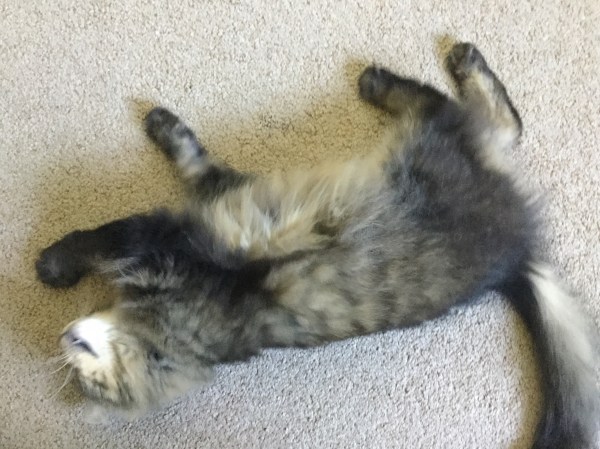
Kibble is not a creature, but the hard cat food. Sadly, Tucker, a large black and white cat with an injured eye (who may have some Maine Coon in him) suffers from an auto-immune condition, gingivitis stomatitis. He came to us in this condition, someone’s pet lost on the streets, looking for food, shelter and affection. We stopped up because we’re suckers like that. He was not in good shape and it took almost a year for us to discover the terrible conditions of his gums and teeth. Bleeding, infections, bad breath, ulcers, inflammation, pain and sensitivity, he had it all.

We started him on medications and steroids to contain the problem. Our vet recommended we pull all his teeth. No, no, no, no, no, we replied, no. Instead, we sought methods for containing and reducing the problem. Through reading and testing, we found he can’t eat kibble, period. So all kibble was taken from him. He eats wet food only but not just any. I’ve found that those wet foods with carrageenan causes swelling, ulcers and inflammation in him so they’ve been taken out of his diet. This finding of mine is contrary to the pet food industry’s findings, that carrageenan doesn’t contribute to these issues, but since restricting him from them, he’s doing much better, so I’ll accept my findings over their findings. Then, after reading of others’ success with L-lysine, I initiated a daily practice of dosing him with L-lysine. Buying it in capsule form, I dilute it a little water and squirt 100 CCs into his mouth before his morning and evening meals.

These practices have worked well with him, and he’s not needed any shots in four months. A year ago, he was going every 30 t0 45 days.

Sadly, though, Tucker is a huge kibble fan. We also feed it to our other cats (we have one, but ‘take care of’ two others). So Tucker remains on a perpetual quest to get to the kibble and gobble it up. He’s also a fighter. Although amazingly sweet and docile with humans, when it comes to other cats, he wants to fight, not chase or hiss or yowl, but launch himself fangs and claws out and battle! So we segregate the four cats. The matter is more complicated as Boo Radley, the big black tailless stray, taken in to protect him from the frigid winter but now probably also our pet, fights with Meep, the ginger cat that isn’t allowed in his house. (We bring him in to feed and offer shelter from foul and cold weather.) Only Quinn, our black paw buddy, gets along with the others. It’s trying, to express the most minimal impact, to deal with the fights when Meep, Tucker or Boo encounter one another and unsheath their claws.

It all works in a way, but we need to find a way to end the fights. At least we’ve mitigated many of Tucker’s problems. Maybe someday we’ll find kibble that doesn’t cause him issues. Then he’ll be one purring kitty.

Blog at WordPress.com.

Up ↑