Aging Reflections: the Balance.

A NYTimes headline scored my attention today:

5 Money Lessons From Readers in the Trenches of Elder-Parent Care

Regular visitors to my blog know that my family have been dealing with my aging mother for years. She’d been living a good life; a fall on some stairs changed that trajectory.

Mom fortunately had a good partner, Frank, as she moved toward her 80s. His drawbacks including increasing deafness, blindness, and being five years older than Mom.

We could see what was coming: Mom would need more and more care. The care would become more and more expensive. Frank would be less and less able to help Mom.

I spoke with Mom about it over the years, advocating to get someone in to help her clean and help her take care of herself. I also kept suggesting that they move into smaller place, such as an assisted living facility or a ‘senior’ community.

Mom resisted most of the suggestions. She didn’t want to leave her house. That home represented her life. She bought it on her own, then got her GED and went to nursing school. Mom opened her home to her grandchildren, taking care of them while my sisters went to school or worked.

I eventually convinced Mom to accept someone coming in and cleaning a few times a week. I paid for it, which helped Mom accept the help. She was also willing let that person in because it was a neighbor and someone she knew.

The arrangement ended when the cleaner suffered cancer and could no longer work. Worse, Mom was falling more often. Her recovery arcs were longer. Each hospital episode left her with more challenges. Yet her will to live was undiminished.

Things took a drastic turn last year. Frank, her partner, fell down the stairs. Hospitalized, he went into a coma and died, 95 years old.

This was devastating for us on multiple fronts and forced Mom’s health from concern to crisis.

Mom tried living alone when Frank was in the hospital and everyone hoped he would recover. Falling, though, Mom couldn’t get up several times and slept on the floor. Cooking was a struggle, so she took shortcuts such as eating sardines with crackers for dinner. She grew thinner and weaker.

My sister took her in. Sis set up a nice space for Mom. Perhaps the biggest drawback was that it was located in my sister’s finished basement. It started out fine but soon devolved into a cold war between Mom and everyone living there. Mom has been vulnerable to UTIs, and we think that was part of the problem.

Mom ended up making suicidal comments. She ended up hospitalized and then in an assisted living place where she does not want to be.

All this is just foreshadowing to me. I’ll be 70 in a few months. My wife is a year younger. One sister is two years older, and another is two years younger. The other two sisters are 8 and 10 years younger than me.

The thing is, even as Mom needs help, all of us are also reaching that point. While I’ve been hospitalized and treated for several issues in the last five years, I’ve rebounded. The same can’t be said for my wife, my sisters, and their husbands.

We’re all facing the same issues that others face in this article: how do we help our parents when we’re crossing the threshold into needing help ourselves?

This is the Silver Tsunami, a term many do not like.

I’ve considered moving to be closer to my sisters and Mom. There are many legitimate excuses for why that hasn’t happened. While our southern Oregon home is ideal for us, the location is not any longer. Just under 1900 square feet, the house is single storied with two bathrooms, and three bedrooms. One bedroom is the home office. This is where we spend our most time, reading, exercising, watching television, on the computer.

The area, though, has been enduring droughts. With the droughts have come water shortages, wildfires, and smoke. As those hit, the local economy has suffered. As a result, Ashland is facing a financial crisis. Adding to that crisis is that two major employers, Southern Oregon University (SOU) and the town’s hospital, Assante Ashland Community Hospital, faced their own crises. Those crises forced them to drawdown in significant ways, with more on the way.

At this point, the future is not ideal. As the article points out, we’re not alone in our problems, both with our own health and aging, but also with helping our parents.

What’s troubling me as much as anything is how the GOP has responded. Trump has cut social services to the aging population. He instead wants to spend more money on the military. Equally troubling is that the GOP goes along with this.

There’s already a growing rural hospital crisis in the United States. With Trump in office, madly spending, the national debt has crossed the point where it is now larger than our Gross National Product.

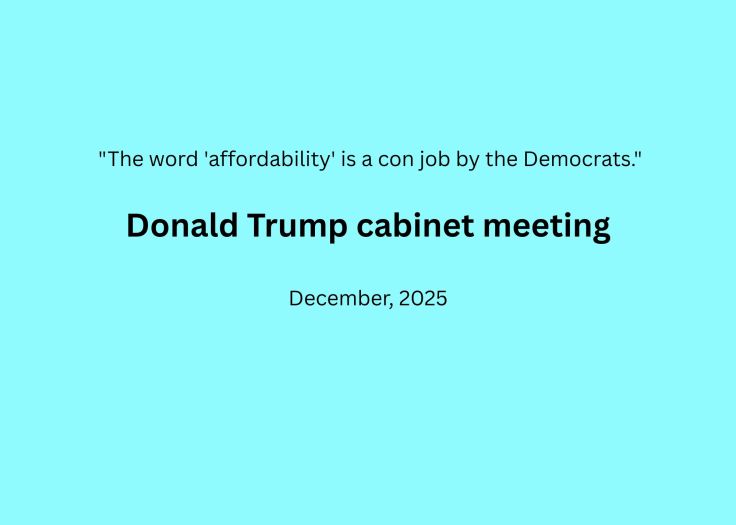
Yet, Trump’s spending priorities are geared toward bailing out countries, starting wars or using the military as a stick to threaten other nations. These do nothing to help our nation’s aging citizens. Trump’s policies have instead resulted in higher prices across the spectrum, which makes everything worse for anyone living a marginalized life. Including people like Mom.

Projections show that it’ll probably get worse, with more citizens requiring healthcare and living assistance. Natural supply and demand for personnel, food, assistance, and medical care will further drive up costs.

It’s a terrible spiral. As wealth becomes more concentrated in the hands of billionaires who care mostly for themselves and their businesses, the rest of us will keep sliding further into debt and crisis.

Sadly, that is Trump’s America. As it now stands, it’s the future for far too many.

Some may say that I’m being fatalistic. I reply, I’m just reading the news and watching the trends.

Thursday’s Theme Music – Fronts

Ashland, southern Oregon — April 30, 2026.

A new weather front has moved in. It’s 54 F under layers of clouds and sprinklings of sunshine, a typical Ashlandic spring day. Highs in the upper 70s are forecast for us. Right now, with all those clouds, it feels weirdly chilly.

Good news from the home front. Mom is electing to stay in assisted living and cooperating. She’s also agreed to sell her house and furniture. While it’s welcomed, it’s also so sad for her and our family. She wanted to be there; we wanted her to be there. Yet, practically, it could not work. Personally, I will miss go home, to her house, to hugging her in her living room, chatting with her in her kitchen, helping her with her laundry. And I will miss the many wonderful dishes she used to make. Her potato salad, spaghetti with meatballs, and chili all remain the best I ever had.

I will say, though, my sisters are a little annoying with their texting. They get up early, before six, and text. My first text from them came at 2:12 AM. I have my phone set up to notify me of texts from the family, in case there’s an emergency, but these were casual, informational texts. Okay, rant over.

No, I haven’t spoken to them about it. They’re doing so much to take care of Mom and help, etc. It would be really petty of me to complain to them about the time they send their texts. I’ll just whine here instead. *smile*

I’ve not seen much surface changes on the Trump front. The voting front is rapidly changing as the Roberts Court dish out their rulings and states respond. A situation as messy as first graders fingerpainting is going to get muddy and sloppy. That mud and slop favors the GOP and Trump. That’s why they’re pressing it. Not about democracy; it’s about staying in power.

Meanwhile, it’s been quiet on the Operation Epic LOOK — SQUIRREL! front and the Epstein front.

With the war in Iran at a stalemate, more conversations about the US military’s capabilities are emerging, such as this one. And they’re right; as often happens, the military fights the last war. We’re built for vast nuclear battles in the US with technologically sophisticated but expensive systems. Iran is countering us with different tactics and inexpensive weapons.

In a sense, what we’re seeing in this war echoes wars for the US back to the American revolution. The British were fighting an old war. The colonist changed tactics and won.

Changing policies and weapons in the US will be a challenge. As President Eisenhower warned, the military-industrial complex has a firm hand on procurement. Defense companies manage Congress through projects, manufacturing, and employment. We build systems as much for our economy as much as we do for our security. Meanwhile, the public nods agreeably because, ‘patriotism’.

Trump is responding by increasing the defense budget and calling for more expensive weapons systems. He’s pushing hard on a new class of Trump battleships. As with many things Trump, the battleships he envisions are outdated and bloated relics better fit for the past.

As the war stays stall, oil prices are slowly rising. A Gasbuddy AI analysis from March of 2026 is hilarious to read:

“GasBuddy’s latest projection paints a starkly different picture from the past. The company now forecasts the 2026 U.S. gasoline price average to fall to $2.97 per gallon, marking the fourth consecutive annual decline and the lowest average since 2020. This sets up a clear seasonal pattern, with prices expected to peak in May around $3.12 per gallon before declining steadily to a low in December of $2.83 per gallon.”

Mock Paper Scissors found a saner prediction from a Gasbuddy expert:

“GasBuddy’s Patrick De Haan, a widely cited gas price expert, predicts the national average price at the pump will hit $4.50 a gallon within a week (currently $4.30).”

Never to shirk from taking advantage of a bad situation, British Petroleum is making some handsome profits from the war and the world energy situation.

Oil giant BP announces huge rise in profits in first results since Iran war

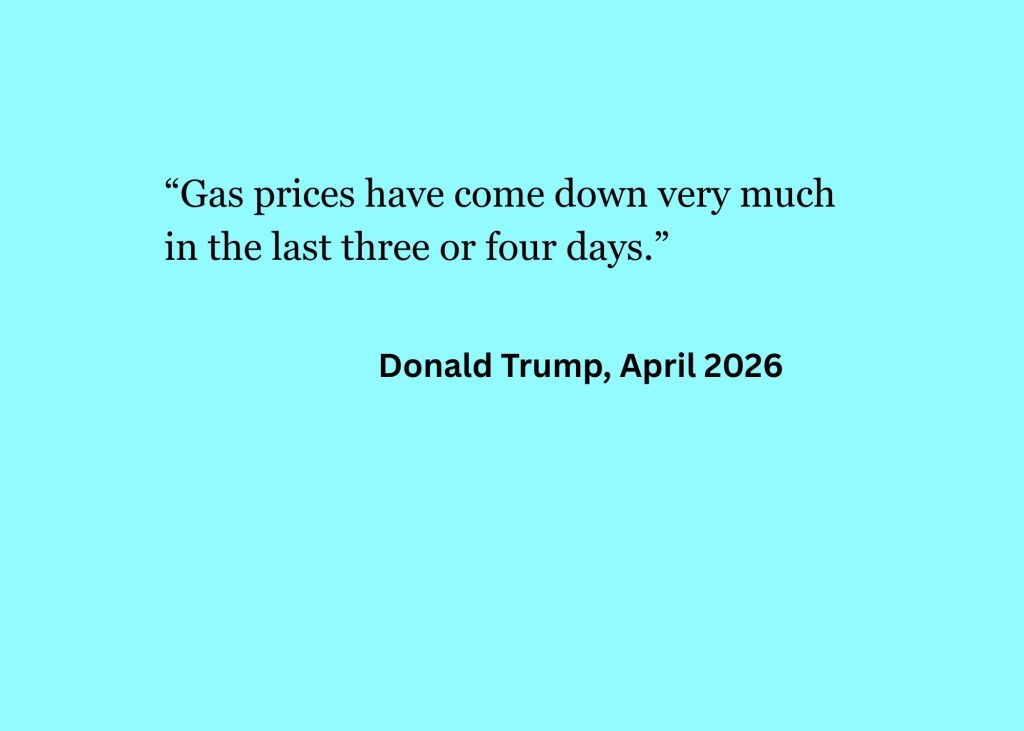
Your Trump quote of the day:

“Gas prices have risen 49% since the beginning of 2026, according to prices tracked by AAA. They dropped by an average of 7 cents a gallon after a two-week ceasefire was announced last week.”

And as any driver now knows, that drop is already gone.

The Neurons observed my thoughts on fronts and responded. They put Elton John and “All Quiet on the Western Front” from 1979 in my morning mental music stream. Lifted from a movie of the same name, it’s not a song that comes on the radio much. The song’s tempo’s and musical style reminds me of “Someone Saved My Life Tonight” from 1975.

I hope your front is calm and peaceful and that you progress to better and better places for you in all ways possible.

Cheers

Blog at WordPress.com.

Up ↑