Unabashed Pleasure

Yes, I’m reading my baby, but I’m enjoy what I wrote almost two years ago. My baby in this matter is the second novel, Entangled LEREs, in the four book Incomplete States series. I’m often surprised as I’m reading it, thinking, “I wrote that?” I impress myself, but I was writing to me, and I’m easily impressed, so I wouldn’t be impressed that I’m impressed, if I were you.

This isn’t the first time that I’ve posted something like that. *shrug*. My observation about my writing pleasing me also belies how my writing process works. I usually stream scenes through me. “Release the muses!” I shout, and then write like crazy. Writing scenes are often like encountering a tsunami and being swept away. I know what I wrote and can give you the details, but I don’t recall thinking about it much. I think about it before I start writing and after I stop, but I rarely think about it during the process.

The point is, those words are a first shot at writing the scenes. Editing follows, and polishing, and more editing for continuity and pacing, and polishing and editing. I’m an organic writer, so that scene is often edited to help fit a later narrative that emerges. I learn the characters as I go, so their thoughts and interactions in these scenes are revisited and modified to suit their personalities, motives, and agendas. It’s a long way from the first stream of writing to even the beta draft that I’m editing into a first draft.

It’s also a little scary. As I read through these scenes, I wonder, do these things get sufficiently resolved? I won’t know until the entire series is edited.

I’m not worried about being scared. I suspect that I missed some thins when writing the beta draft of the series. That’s why I edit and revise. If I find that my fear is correct, I’ll edit and revise again, continuing that process until I’m satisfied that I’ve answered the questions in a manner and to a degree that will satisfy the reader, moi.

In an aside, as I’m reading and revising, it’s fun to re-discover how I’ve integrated friends and family’s names and segments of their lives into my fiction. For example, a comet that breaks up and destroys a planet is named Santella-Klements. The first is another part of the extended family and includes cousins close to me growing up while Klements is a friend’s last name.

Okay, time to write edit like crazy, at least one more time.

Philip Said

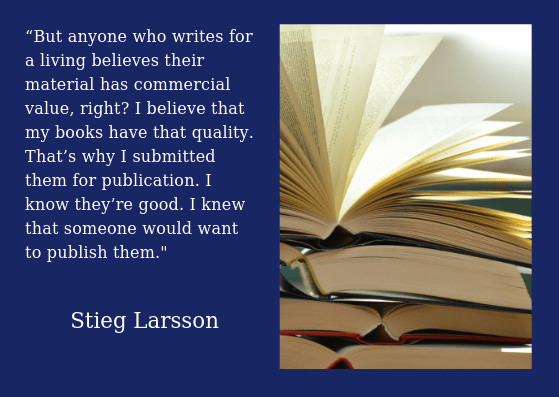
I used a foggy background for this quote because I think the quote illuminates the fog of writing. It’s applying your experiences, and things others describe to you, to imagine another’s experience to tell a story.

A Good Day

Today was a wonderful editing and revising day, mostly because there was little of either required. It’s a good day, I thought.

Having a good day feels like a reward. The bad days must be endured, and they often end up being productive. I mean, by a bad day, a day where I feel tired, depressed, and flirt with thoughts about not writing ever, ever again.

I know, though, that the writing on good, bad, indifferent, and mediocre days isn’t likely to be any different. Bad days mostly refer to my attitude before I start writing, editing, or revising. Once I start and my focus is on my writing, my attitude doesn’t matter.

For all that I know, what I read, edited,and revised today could have been written on a bad day. There’s a good chance of that being true, because I covered almost seventy pages today. I generally write one to two thousand words a day, which typically amount to less than ten pages, depending on dialogue and density. I probably covered a week to two weeks of writing, so there were probably some bad days in there.

Now I’m done writing like crazy editing like crazy. Time to go do other things, like eat.

Grounding Myself

Here we go, more self-indulgence. What’s new? This is a vanity blog with a primary purpose of understanding myself and my thinking through writing and coping with my writing efforts, with secondary purposes of entertaining myself and sharing ideas with others.

I struggled with how much to share today. I’m telling what the series, Incomplete States, is about. I decided that I typically don’t have many visitors, so I have little to worry about. I expect this post to get eight views and five likes, and perhaps two comments.

I was thinking about all of this in connection with where I stand with editing and revising the second novel, and by extension, the series. I felt a need to ground myself about where I’m at in the series, where it is, and where it goes.

To begin, consider three questions.

  1. Do you ever feel disconnected from your life, as though things have happened that you don’t remember or understand?
  2. Have you ever thought, didn’t I already do this?
  3. Is there ever a time that you feel like you’re a completely different person, resulting in a struggle to fit in? Perhaps you think, I was a male, and now I’m a female.

If you feel that you’ve experienced these things, it’s possible that you have an entangled LERE. A LERE is a Life-Experience-Reality-Existence. Entangled LEREs are caused by Chi-particle issues. Chi-particles are imaginary quantum particles that are lack mass and energy and travel faster than light. As they slow, they acquire mass and energy, becoming a fundamental quantum particle before devolving into some aspect of classic physics. Chi-particles exist as isotopes and variants just as elements often exist as isotopes and variants, which affect their behavior.

This is the situation that my characters experience in the four book series, Incomplete States.

I was exploring and thinking about the series as I walked this morning. Specifically, I thought, oh my God, what have I done? 

No, that’s not true. That was inserted for comedic effect. It’s sometimes true that I think this, but that wasn’t the case today.

Today brought a more rational review of the books and the story arc. I’d conceptualized, what if there is only now, no past, no future, and no cause and effect? What if the arrows of time are a convenient commodity we use to explain our existence (including our Universe) because it fits with our organic biology and creates a simple framework for being?

When I think about this, I’m forced to think about multi-verses, but also to challenge the ideas that our Universe is expanding. We believe we observe its expansion through light shifts because that cause and effect is the prevalent belief of our existence, along with the arrows of time that go from the past to the future, shooting through now. In my reality, E = mc2 is a fallacy that we cling to because it fortifies our foundations of being.

We hang onto the concepts of a greater being in the same way.

None of these things are easy to lose. Grappling with not accepting them and actively rejecting them is hard to keep in mind when you’re writing. I kept wanting to return to cause and effect and our universe’s foundations.

As I played with those concepts, I introduced characters who were undergoing the symptoms expressed in the opening questions. Unlike you, they often also remember what else happened. They remember other worlds and other lives that they lived and then come to a grudging grasp that they’re still living in these other worlds and lives.

All of this is told through their stories. Throughout, the things that happen to them cause gaps in logic, cause and effect, and expectations. They endure twisted memories and confused understanding, resulting in a knowledge vacuum.

Humans dislike vacuums. We always want to explain what’s going on via some mechanism. That mechanism can be via magic, religion, science, and technology. Those are the broad categories. People also suspect they live dream existences, but struggle to understand which part of their LERE is the dream existence, and which is the reality, coping with the possibilities that maybe both are dreams, or maybe both are realities. They struggle with plots to explain what’s happening to them, plots that involve governments, conspiracies, virtual realities, and other intelligent life forms.

The existences, experiences, and coping become a huge matrix, but the matrix is different for each of the six main characters. The delta between their matrices fluctuates.

That’s where the tension resides, evolving into wonder about which theory filling the vacuum is correct, and how the stories will resolve.

I had several writing rules I employed while writing these four books. Chapters were addressed as episodes. Cause and effect can be perceived, but readers can’t depend on it. Consistently inconsistent logic would be employed. Life — or reality — is a vacuum, and our search for understanding and explaining it all is a farce. What we interpret as life through our experiences forms a reality that’s a slice of existence that doesn’t linger.

don’t treat my science as junk science. I treat it seriously in the novels. I don’t expect it to hold up to scientific reviews or validate string theory, loop quantum gravity, or the theory of everything. I offer no math to support my science, although I’ll point out that in my concept, anything anyone offers to support or tear down my science is wrong because of the inherent observer’s bias held by being in and part of this universe.

Yeah, it’s fun. It makes me laugh. That’s what writing’s all about, innit? Entertaining ourselves.

Hopefully, after reading the series, the typical reader will think, “I see.” And then they’ll wonder, “But what is it that I see?”


So, Progress.

My editing slowed down in book 2 (Entangled LEREs) of the Incomplete States series. I blame it on three things.

  1. Life distractions
  2. A poorly written chapter
  3. Mischievous muses
  4. Misophonia

Life distractions happen. Part of it this week was enduring my normal descent into the dark troughs of my being. It’s a regular thing. I scowl, swear, and endure it, hoping to emerge as a perkier and happier person on the other end (which I do) while trying to reduce the dark side’s impact (which I barely manage to do) and reduce the time I’m affected (which I don’t do). I shrug. It’s over until the next episode.

The poorly written chapter is another matter. The first time I read the chapter, “A Dark and Stormy Night”, I finished confused about what I’d read. I immediately suspected that it’s probably not good when the author doesn’t understand what they wrote. A second reading was required, and then a third to drill down into why I was confused and what I can do about it. Two days were then spent on fixing it before I continued.

During that period, I reckoned that the changes were not significant but that once I’m done editing the four books, I’ll have a complete set of the first draft. Then I’ll edit and revise it again.

I had resigned myself to no writing like crazy while I’m editing the series. The muses, though, have become restless and bored. That makes them mischievous. Out of this, they’ve begun tossing out novel suggestions. They often use, “Wouldn’t it be fun to write,” as their opening prelude.

Yes, I enjoy hearing their ideas. It’s stimulating and exciting, which makes it harder for me to rein the muses in and gently tell them, “I’ll keep that in mind.” See, the muses always want me to drop everything else and start pursuing their idea right now. I don’t want to discourage them, but I need to be disciplined and finish this series and publish it first. This is growth and maturity for me, because just two years ago, I would have let the muses ride me like a horse and answer their spurs.

Misophonia (in my terms, based on my limited knowledge) is a strong emotional reaction to sounds. I have such a reaction to people smacking their lips while eating, or walking around humming and singing to themselves in pubic places like coffee shops. I’ve always blamed Mom for this behavior in me because I thought I’d learned my reactions from her. Mom was always snapping at us about the way we ate or chewed our gum, or for humming, turning pages loud, or making clicking noises.

As I do with things that bother me, I sought information and stumbled across misophonia. That linked page states, “The latest research suggests it is sensory processing issue within the brain. Misophonia elicits immediate negative physiological responses to certain sounds that most people don’t seem to notice. This sensitivity can have an adverse effect on a person’s life causing problems with activities of daily living.”

Well, shucks, that’s exactly what I endured this week. Twice, a particular woman came in, sat down at the table next to me, and hummed and sang to herself. Except for when she spoke, she hummed, even when others spoke to her. She hummed whether she was sitting, standing, or walking.

It drove me nuts. I recognized that it’s not her being inconsiderate, and that murdering her or growling at her wouldn’t help anything. As I processed her sounds, I realized this could be a coping mechanism. It could be subconscious.

It still annoyed me. I struggled to cope. I looked for somewhere else to sit (but also resented that would need to move because of her). 

So, I didn’t cope well, and it affected my editing. She’s not here today. I’ll shrug it off while researching how to cope.

Now, I’m ravenous for lunch and I’m done writing like crazy editing like crazy, for at least one more day.

Multiple Dreams

I had multiple dreams last night. Most remain in pieces in my mind like debris after a storm. The essences:

  1. I was plotting a murder and intent on carrying it out. I don’t know who I was killing or my motive.
  2. A cat was the size of an American nickel. A happy little animal, he was kept in a jar. I watched over him, ensuring he wasn’t lost or injured, and played with him.
  3. The third dream found me playing a game that may have been a show on television. I was winning by answering questions and advancing through levels. It seemed to combine physical prowess and the ability to answer questions.

Not much further information is available on the murder dream. Awakening and thinking about it, I attribute it more to my writing muses than an intention to kill another person. I’m always thinking about escaping, surviving, killing, investigating, flying, traveling, exploring, and robbing places. They’re exercises for my imagination, IMO.

The cat dream was a simple anxiety dream. Quinn hasn’t been well. His breathing bothered us. We’d endured a summer of wildfire smoke and hazardous air, so I put his breathing problems down to that. We’d been keeping him inside and addressing his breathing issues. When he didn’t improve after the air improved, I thought I’d take him in for an antibiotic shot.

But the vet found a lump on Quinn’s neck, so we’re going through the challenge of treating him, keeping him hydrated, and feeding him. We’re not certain of his issue, yet. Never a large cat, he dropped two pounds and now weighs just five. He’s mostly perky, though, but not eating and drinking enough on his own. I take comfort and hope in signs like him rubbing up against me, jumping on my lap, stretching, trying to claw furniture, and yawning.

Meanwhile, I’m going through the process of letting him go. I’ve endured this with other pets, so I understand some of the emotional, physical, and intellectual dynamics. It’s always different, of course, and it’s never easy.

I enjoyed the game show dream. First, you’d press a button to start the big wheel spinning, and press the button again to stop it. The big wheel had activities and numbers. If it landed on the activity, you did it. Doing the activity, such as twenty push-ups, authorized you to rob a competitor by taking a token or moving them back by a spin on the punishing wheel.

If the big wheel landed on a number, that was the number of spaces you’d move. Climbing, crawling, jumping, and swinging on ropes were required to move along squares. After moving forward and stopping on a square, you were asked a question. Fall to answer it correctly — it was timed, but you had three chances — meant you faced the punishment wheel.

Come to think of it, there was a television audience cheering us on. Writing about it today prompts comparisons to an updated game of Life combined with Trival Pursuit, which sums up my writing life, I think.

Spinning wheels, killing time, chasing trivia, and hoping to advance, it’s a writer’s life.

Blog at WordPress.com.

Up ↑