I paced the room, waiting for word about my wife’s 2003 Ford Focus. The car was recently stopping on its own, unsafe and inconvenient.
I resisted thinking it was a battery at first. The car cranked up and fired without any issues but then died.
My wife didn’t think it was a battery. “It starts up. Nothing dims, and it doesn’t have that weak, sluggish sound when it starts.”
I agreed in principle. I checked the battery, confirming, no loose wires or cables, intact and clean. A date on the battery’s side, 05 20, surprised me.
Telling my spouse about it, I added, “I didn’t think the battery was that old.”
We reminisced about buying it. Delivering Food & Friends alone because the COVID pandemic was underway, her car died enroute. She called me to rescue her, which I gleefully did to escape the house.
I reminded her, recent ‘high-discharge’ batteries don’t show the same dying battery symptoms we grew up seeing. Then I recalled, it was cold when the car died on her a couple times this week. Cold affects how much energy batteries can deliver.
I decided, checking the battery was where to begin. An appointment at Les Schwab, a mile away, was made for 10 AM this morning.
I started the Focus without any issue; it died five seconds later. I started it again. Death came five seconds later.
Three times was a charm, but I worried about the car dying as I drove to the appointment.
The Les Schwab tech confirmed, bad battery. “One cell is completely dead,” he said.
That fit, to me. A couple hundred dollars later, we believe we have the problem solved.
Whether the problem is truly solved won’t be clear until the car has been driven normally a few times. I have high confidence it’s fixed, though.
My wife’s car died on her the other day. Absolutely no power — lights, radio, engine, etc., a very disconcerting event. Fortunately, she was in a parking lot and easily steered to a safe place. It started right back up, but you can imagine the alarm a car dying without warning can give you.
A 2003 Ford Focus purchased new, 110,000 miles are on the car’s odometer. It’s been garaged for all of its life and pretty well maintained. She only uses it for local buzzing around, usually driving just three miles in any direction. Once a month, she might go further, up to twelve miles away.
Now, though, she’s working on a project that requires her to meet with others, pick up things, all that. The big event is Feb. 1. She’s been working on it for months, pulling it together.
I’ve been trying to convince her to trade in the Focus for new wheels for years. In fact, when we bought our CX-5 over ten years ago, it was supposed to be her car to drive. We would then purchase a second car for me and trade in the Focus. She reneged on the agreement and kept her car.
I told her to take the Mazda but, she doesn’t want to drive it, having driven it once since we bought it.
So, it’s a drop everything, change my schedule day to get this resolved. I drove her to her appointments and local garage will check it tomorrow. I have my suspicions about the cause, but we’ll wait for the experts.
It was the weirdest damn thing. I backed out of my garage and drive this lovely Saturday morning. As I straightened the car and drove down the street, a gray Tesla 3 pulled from the curb, preceding me. We were close enough and angled right that I noticed the driver — an older-looking, white woman, short gray hair.
She went down and stopped at the hill’s bottom. As I pulled in behind her, another gray Tesla 3 cruised by. Hand to Dog, that Tesla’s driver looked just like the first two.
The Tesla ahead turned left, falling in line with the first gray Tesla. Gasping with delighted surprise at such serendipity, I pulled up to the stop sign. Another gray Tesla 3 went by with another white, female, gray-haired driver.
No way, I thought. It was almost like a surreal dream.
Settling behind the three gray Teslas with their gray-hair white drivers, I wondered. Is this a trick of my mind, or triplets driving identical cars? I also imagined that an elaborate ruse was being pulled, but who was the intended victim?
Temptation arose to follow them and see if the three cars ended at the place and if the drivers really looked alike. But coffee, writing, and routine called, and I peeled away, leaving the mystery to be solved by another.
Married while they were young, divorced while I was young, Mom seemed to give Dad a bum rap, something I didn’t appreciate until I was older and knew Mom and Dad better as adults.
Dad married three times. He sired seven children, two girls and five sons. Only two of his sons lived to adulthood.
One son tragically died in a car accident when he was just five years old. Dad was at his saddest and most silent then, and I was beside him at his son’s funeral.
I only lived with Dad twice: when I was very young until I was about five years old, and then again between the ages of fifteen and eighteen. I’d run away from home. Dad, in the Air Force and just returned to the U.S. from assignment in Germany, gave me a place to live. I was at his wedding with his second wife.
I’ve seen and visited him sporadically throughout the years. We talked on the phone more during the last few years, something that he actively pursued, trying to mend and improve our relationship.
Dad at 92, August of 2025.
Dad taught me to pee behind a bush. We lived in Arlington, Virginia in a rented house on a cul-de-sac at the top of a hill. Dad was in the Air Force; Mom was a telephone operator. Mom was working, and Dad, with the children, was locked out of the house. I announced that I needed to pee. Dad led me behind some bushes by the side of the house and told me to go. I was horrified but did it with his encouragement.
Mom came home just after I finished my business. I rushed out to her to inform her of my milestone. She was shocked and angry. Dad just laughed and laughed. He would’ve been in his mid-twenties.
I also give Dad credit for teaching me how to wrestle, how to catch and throw a ball, and how to ride a bike. He gave me his baseball gloves and bats when he came home on a visit and realized that I didn’t have either.
He also gave me his love of automobiles and encouraged me to think about problems and find my own solutions. Looking back, he was surprisingly patient and positive.
I don’t remember any Thanksgivings with Dad. We did share a few Christmases, and some July 4th celebrations. Most of those, though, were with Mom. He did take me on a fishing trip and gave me my first and only fishing rods.
Like many of us, Dad was a balance, a study in life, striving and trying, learning, and sometimes failing. But he always got back up and went on. I haven’t seen him much since he turned 85 seven years ago. I’ll miss him.
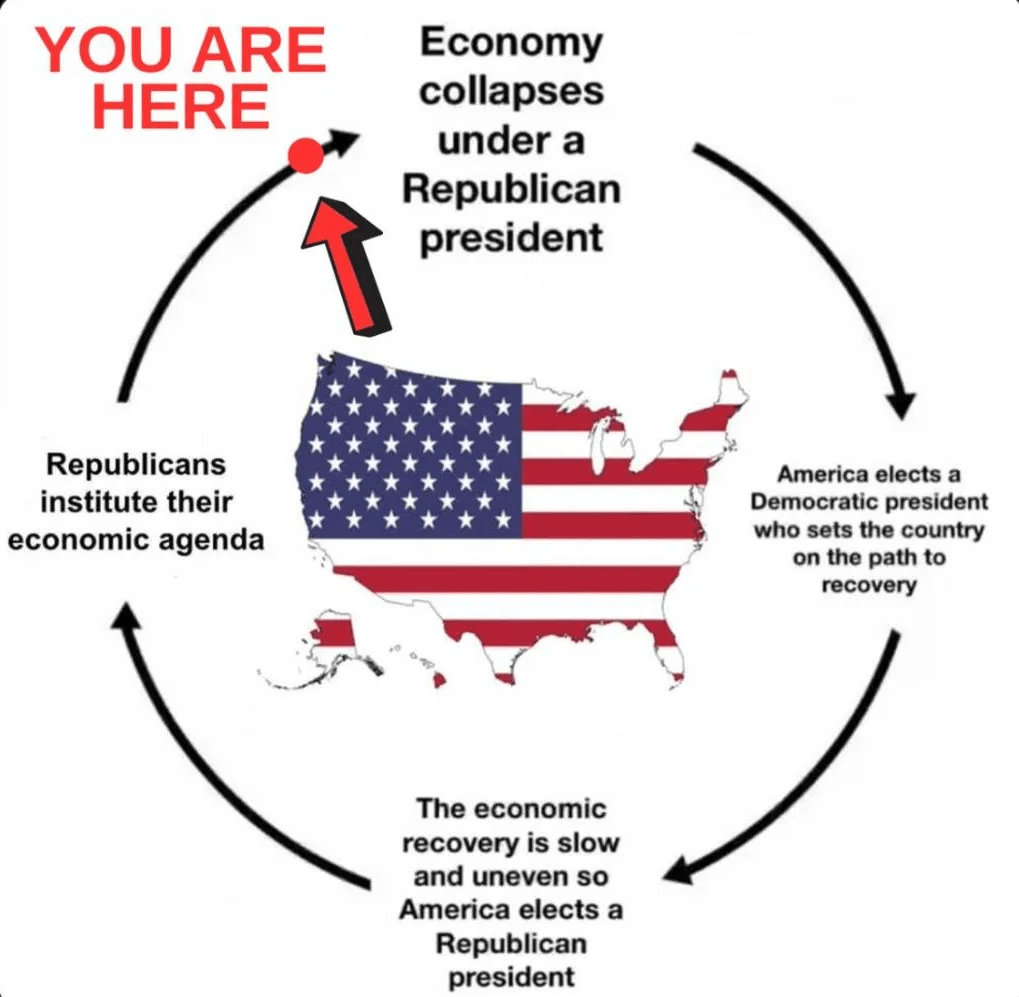
I’ve read a number of recent pieces about the economy. They focus mostly on the confusion now seen in the U.S. economy. Why tariffs didn’t increase prices as much as expected. Why customers are so negative about the economy when the numbers aren’t bad. Why consumer spending remains up while consumer confidence is down.
Trump’s antics play much into their impressions. He’s broken trade agreements. Then, by leveling tariffs on everything in the name of national security, he’s shifted expectations. Prices are expected to increase due to tariffs. So are shortages due to tariffs and trade wars. These factors advance negative perceptions of what’s to come. Paul Krugman refers to this as vibecessions. These are vibes that a recession is coming, that the economy is not really doing well.
Well, for one, there’s been some surprise in the tariffs. The effective rate has turned out to be much lower than the declared rates. Part of this is because most economists expect Trump’s tariffs to be declared illegal and withdrawn. They suspect companies are eating much of the tariff costs for the short term so they won’t lose customers. This makes sense, if they expect the tariffs to be short-lived. It also makes sense if you compare the cost of finding and luring new customers to your business compared to the cost of keeping them. Getting new customers is much harder and more expensive. Loyalty, once broached, is very expensive. Then, when the tariffs are withdrawn, companies can, as necessary raise prices under other pretenses.
As for employment and unemployment, economists suggest this is because of uncertainty with the economy. Part of this is due not just to reporting confusion (more on that below), but because of the economic activity being generated by cryptocurrencies and AI developments. Both are areas where vast investments are being made. Both are relatively new. Their actual impact on the economy is uncertain.
This is especially true with AI. Artificial Intelligence. It’s here, but meaningful impact from using artificial intelligence in business to increase productivity and profits is slow to emerge. Meanwhile, huge centers are being built to support AI. These are expensive centers. Their need for electricity will drive up energy costs if they’re not countered by the construction of new energy sources. The Trump Regime’s deliberate decisions to cut funds to build solar and wind farms to generate more electricity puts the nation way behind planning and building new power sources.
Additionally, with so many huge AI centers being built, there will be some which don’t successfully compete and then fail. Think back if you can to when personal computers came onto the scene. So many businesses sprang up to build computers to fill this new need. Likewise, look at the airline industry when commercial airline travel was growing, and how many airlines sprang up and then either got bought up or shut down and faded away. Same with automobile manufacturing. Video renting. Streaming services. Malls. Craft beers and micro breweries. Each advance is littered with the remains of failures.
Plus, there is some fallout that’s going to grow because of provisions in the Big Beautiful Bill. What it will do to healthcare costs aren’t clear. Premiums for many seem to be climbing. How this load on their spending patterns hasn’t been clearly demonstrated. Likewise, cuts to SNAP, school systems, college enrollment, are still to be expected. As Federal funds don’t make it to the state level, state funding doesn’t reach local levels, affecting the economy at multiple levels. Then, too, there is the declining tourism, especially from foreign locations. It’s affecting state economies who depend on tourism, but how deeply will they be affected is the looming question.
Additionally, I think many consumers might be like my wife and me. In my house, we made many purchases with the expectations that the economic crap is going to encounter the economic fan, so buy now, while prices aren’t too bad, while the stuff is available, while we can. Basically, it’s spend more now because we can’t buy later. We deliberately stockpiled things we regularly use, like coffee and canned and processed foods from other countries. We do replenish as we can now, using the same rational.
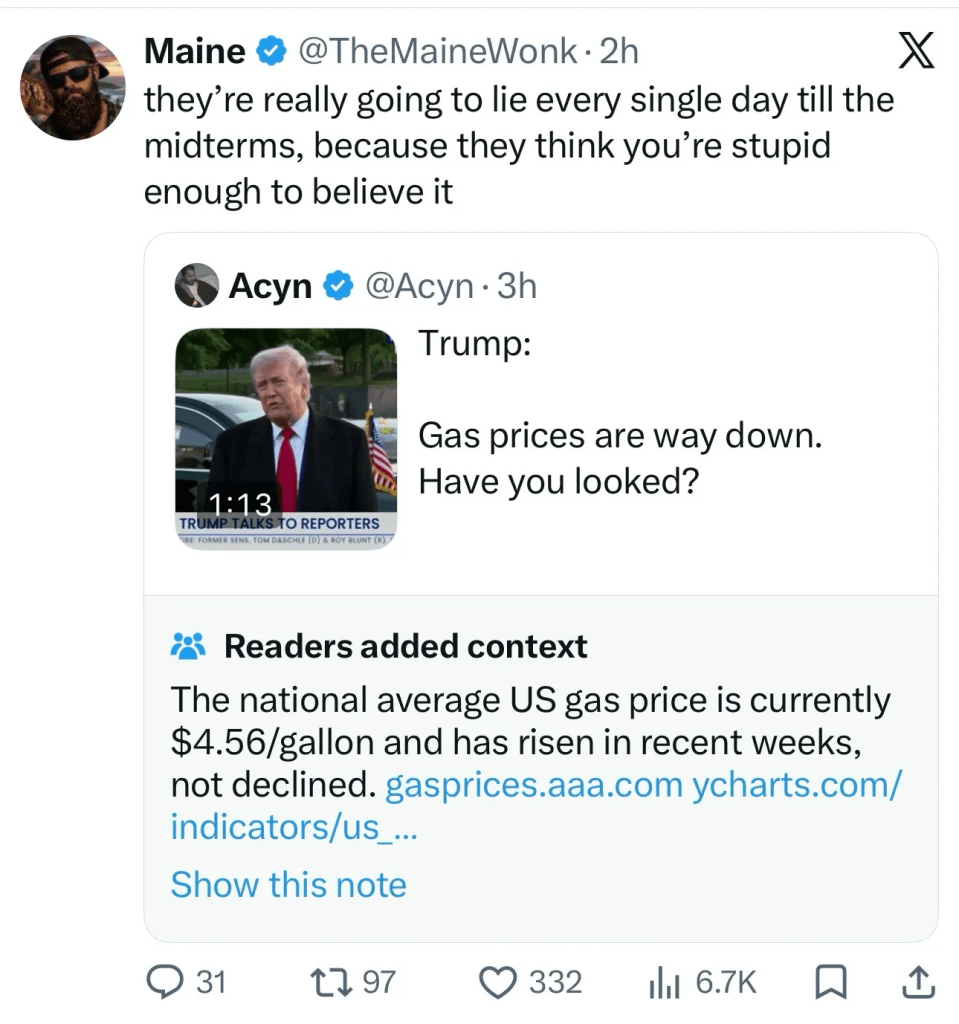
Beyond those things, we know that Trump is a liar. We’ve also noticed that those surrogates in Trump’s Regime who speak out in public are liars. Not just liars but do everything possible to prop Trump and all things Trump up and light it up in the best possible light. As Trump via DOGE slashed through the government, he broke many things. Among them is the reporting mechanism for several economic indicators. He flat removed people who gave truthful numbers, such as the BLS. That burned him, so he burned them. That’s just the things that came out in public. What’s going on behind in the dark can only be guessed out.
That leaves us confused. Can we trust Trump and the numbers his administration releases? Fuck no. Only fools and sycophants believe those numbers. With that uncertainty, businesses struggle to make any long-term plans, because reality might catch up any day now.
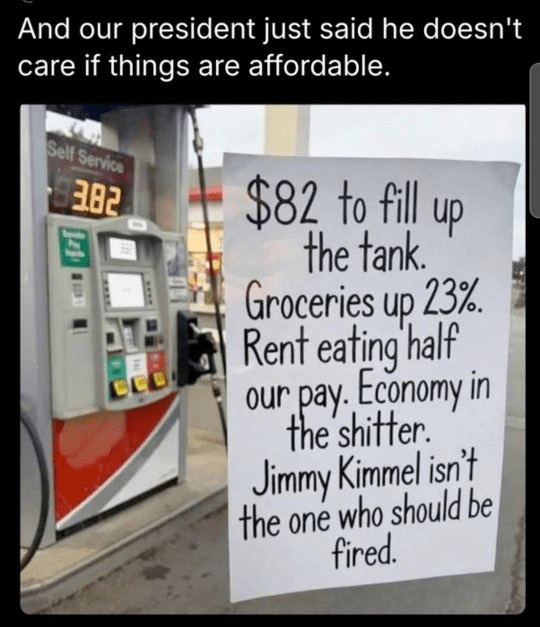
Trump thinks he can keep up his numbers game and lies. We know that’s not true; we see prices rising, causing the affordability issues we’re now facing.
We also have Trump’s personal history. That history shows that Trump’s lies are always exposed. He lied about his accomplishments, his wealth, his businesses, and his prospects. Each time, those were exposed. He was taken to court. Convicted. Filed for bankruptcies to escape his mistakes. Cheated on taxes. Stole money from charities he or his family set up. Used word games and sleight of hand and secrecy to build himself up. But it all catches up to him. Right now, we’re waiting to see what the Epstein files show who he and what he’s done. Trump has been fighting like hell to keep that from happening.
So that’s the thing, for me. Beyond the numbers, there is a simple truth: Trump is a failure who lives behind a curtain of deception. But that curtain keeps getting torn open. When it does this time, it’s going to be a freaking mess.
Ferrari red, it’s a wide, low vehicle. My wife is my passenger. We’re backing out of a garage. The passenger mirror hits the garage door frame. My wife gasps. I grimace. We finish leaving the garage and see that there is a Ferrari Testarossa mirror-shaped scallop removed from the garage door’s frame. I get out and check the mirror while my wife grumbles. The mirror is there but is upside down. A twist and I fix it, good as new. Nothing wrong with it, which amuses me; the mirror is stronger than the materials bracing the garage door. How funny is that?
We drive for a while at a fast but sedate pace. Then…in a jumbled shift, I’ve driven the Ferrari onto some kind of large transport. It’s like a train without a track, with a living room, kitchen, etc., and the mad chaos of eighteen people, including children. Many of the others there are known to me as actors and musicians, Oscar winners and Hall of Fame rockers. I’m amazed to be with them but also think, “About time.” A young blond Helen Hunt is present, herding three children running around. She’s managing but tells her children with a wicked smile and a gleam at me, “Hang on, children, Mommy has to drive this as fast as she can. It’s going to be hairy. Do you want Mommy to drive fast?”
“Yes,” the children all agree in repeated shouts while I’m agape, accepting, this is what I signed up for but I didn’t know what I was signing up for.
“Okay,” Helen Hunt says, “here we go.” She has a wooden stirring spoon her hand and is standing in the center of a room, children around her, toys strewn across the carpeted room. “Zoom,” she shouts, and thrusts her wooden spoon up.
The vehicle rockets forward. She waves her spoon and it rocks left, right, left. The children are laughing. I’m paralyzed in amazement. But we’re moving.
A conference among others is called and I attend. “Where are we going?” David Niven asks. “We’ll know when we’ll get there,” replies Bruce Willis, and a third who I couldn’t name tags on, “But we have to move fast.”
I offer to drive my Ferrari. It’s faster than this vehicle, so I can pull it along and we’ll get there faster. This is given serious conversation. I’m eager to do this but all decide, hold off for a while, let’s see what progress we make.
I go into another room and sit in a chair. A noise warns me, something is going out. “That’ll bring the ants out,” I think, looking down at the floor. Sure enough, as expected, a phalanx of black and red ants rush across the tiled floor. They’re going to be a bother if they go in the direction they’ve begun so I use a foot to divert their path. More obediently than cats, they turn in the new direction, and some wave thanks to me, because they understand why I diverted them.
David Niven finds me. “There you are. Come on, into the Ferrari. We need more speed. See what you can do.”
In a dream shift, I’m in the Ferrari but I’m alone. Others are hooking up the vessel and then shout, “Go.” The Ferrari is now black, I notice, and wonder when the color changed. Yet, I know it’s my Ferrari. I smashed the gas pedal and take the car up through revs, up through gears, snaking the car around traffic along an undulating and busy Interstate. Looking back, I confirm the vehicle is still being towed. I’m impressed that there’s no wind and little impression of speed. I feel in command, in control. This is a breeze, I think, speeding toward some brightly lit collection of skyscrapers looming larger on the horizon.
I have been reminded of how privileged I am. How easily I succumb to convenience.
I’m back in my regular drive. Mazda CX-5. Nothing fancy, we’ve had it for ten years. It’s packed 64,000 miles around its waist. The thing about this, though, are the automatic creature comfort features. And the key.
When we were visiting family in the Pittsburgh, PA, region, we trundled around in an older Toyota RAV4. Fine car but nothing special. But it lacked things like a key FOB that let me unlock doors just by pressing a button as I walked up to the car. The FOB permits me to start the Mazda without taking the key out of my pocket.
Man, did I miss that. I ended up putting the RAV4 keys in and out, out and in of pockets multiple times across the day. Oh, the horrors, right? But see, this is a matter of connections. With the FOB, I stick it in my left pants pocket and leave it there. With this RAV4 key, I was constantly putting it into a pocket or setting it down somewhere and then asking myself, where is that fucking key?
Wife and I approach car. It’s cold. About 40 F. Gray, with a light drizzle falling.
ME: “Wait.”
“What?”
“I can’t find the key.”
Wife stands, stares, waiting, not tapping her foot but looking like she’s on the verge.
Pockets are patted and felt, squeezed, then reached into it. “Here it is.”
My wife’s restrained look called me IDIOT so loudly, it hurt my brain.
One time I got out of the car to put gas into it. When I returned, it’s like, OMG, where is that damn key? Pat pockets again and again, dive into them…”Oh, here it is.” Damn it.
It was one of those big, long keys on a clunky handle. The key itself could be swung close to make it ‘more compact’. That was good because otherwise that thing gets caught on clothing. You press a button to flick it out, like a switchblade knife. This all required additional thinking about what I was doing, soaking up Neurons’ limited attention.
Me: “Where’s the key?”
Neurons: “We don’t know.”
Me, looking around and feeling pockets. “No one knows?”
Neurons: “We weren’t pay attention.”
Me: “Here it is.”
The button is clicked. The long key extends. I unlock the door. Put the key back into pocket. Get into car. Go to start it by putting my foot on the brake and pressing a button. The button is missing.
Neurons: “Dude, what are you doing?”
Me: “Trying to start the car.”
“You need the key. You must put it in the ignition and turn it.”
“Oh, yeah. Where’s the key?”
Neurons: “We don’t know.”
Thank tech that I’m back home where I just stick the FOB into my pocket and forget it.
Breaking away from writing, I step out for a walk. The sun has warmed us to a comfortable level. I stride along, nodding and saying hello to others encountered.
A shineless brown hot rod comes along. Roadster. Something out of the forties. Driven by a man who looks like he also originated in the forties, and a woman who might be a little younger, maybe even his daughter, as a passenger, bundled up in heavy clothes.
Putting along at 20 MPH, he guides the car to the side and waves a following vehicle past. Silver SUV, its twenty something driver gooses it faster. An electric vehicle, it glides by with a rising brash hum.
The scene on a small-town street seems so perfectly emblematic of change. Trees and their colors tell of the season changing around us, and there goes an old internal combustion car of a kind rarely seen, passed by an electric car, of the kind now commonly encountered.
This was a variation of a dream which I’ve had several times. It’s been several years, as best as I can recall. Basics include a water related disaster while I’m in a huge building. The building’s purpose is never fully clear, but it reminds me of modern office buildings.
Toward the dream’s end, I look out a window. The building is on a shoreline but raised above the beach. From my vantage, I can look down and across. I see deep blue water lapping at the upper level of rocky breakers. It’s clear that water broke over those breakers but has receded some. “Oh my god,” I said, “I didn’t realize the water got that high.”
The person I’m speaking with agrees, and tells me it was much higher. The building had been evacuated. Almost everyone was gone. I decide the time is right for me to get out. But I know where my car was parked. I know that area was flooded.
Then I think, wait, I had another car parked on another level. Do I have the key? Yes, I do. Good. Just need to reach it.
I go to use some stairs to go down. They’ve been severely damaged. Pipes and wires are exposed, blocking part of the way, and some of the wall has been knocked over. I attempt to go down one side but the way is blocked. Seeing another way, I precariously cross from one side to the other as others watch and anxiously call, “Careful.” But I make it without issue.
Going down, which in real life seems wrong but made perfect sense in dreamland, I reach my old car. It gets muddled here; the old car is sometimes an old green Mercury Comet sedan I drove as a teenager but it’s a silver Nissan 200 I once owned at other times. While I’m confused while remembering it, it seemed straightforward in my dream.
I start toward the car when three women interrupt me. All are dressed in the Air Force ‘office’ uniform that we used to wear, a light blue shirt with insignia, ribbons and awards, and name plate, along with black shoes and dark blue pants. Their uniforms are immaculate. One is a stranger, one is my sister, and the third is an actress. But they’re just friendly strangers in the dream. The one who is my sister says, “Can you answer a question for us? We’re trying to figure out if running the radio slows down a Formula 1 car.”
The actress says, “I think it would slow down a NASCAR racer but they’re still pretty fast. They can go three hundred miles an hour.”
Several responses bounce around my head. Like, Formula 1 cars don’t have radios in the way she’s talking about, which becomes clear as she explains that she thinks drivers probably enjoy listening to music. I tell them that race cars don’t have radios that play music and that it would slow them down anyway. They thank me and start talking to one another. I go on.
As I approach the car, two cats appear. They are Jade and Roary, two cats who once lived with us but at different times. They’re well, healthy, with their tails up. Neither make a noise but are waiting for me to get into the car. I open the door. They stand aside as I get in and start it without problem. Looking across the parking lot, I see another car I used to own, a blue Mazda RX-7, and think, wait until I tell my wife about that. Then I tell the cats, “Come on, get in.” They hop into the car, and I put it into gear. Dream end.
Not my RX-7 but one just like it, one of three I owned at different times.
Thinking about it, though, I was dismayed. I thought several negative aspects were being presented to me. But a voice in my head said, “Let’s talk about this dream.” Summarizing, the voice tells me, you have at least two more lives left, represented in the two cats. Also, you’re not as close to death as you sometimes think. Your old car represents you. Your car was unexpectedly remembered, found, and then started without problem. You’re being helped by female energy from three different but related sources. The water was high but it’s receding, and things will get better.
It’s not an accident that my house keys are always in my right-hand pocket. As part of the setting, we have two cars and one house. My wife and I don’t put our house keys and car keys on one ring. She’s apparently just emulating me. I asked her why she does it, and she told me, “You don’t put them together.”
I don’t put them together because I didn’t like keys bouncing around in the car, making noise as we drove. Attribute that to my misophonia. Certain sounds jar and irritate me. I reacted by segregating the house and car keys to reduce my sound-related irritation. Now it’s my practice to always put the house keys in my right-side pocket. Never in the coat either, but in the pants or shorts I’m wearing. I do not buy pants or shorts without pockets. Not having those pockets is just unacceptable.
Now, the house keys are in the right-side because I’m right-handed. My spouse has a habit of locking the door between the house and garage. She often does it absentmindedly. But after parking and going to enter the house, often with my hands full, it’s easier to free my right hand and pull those keys from my right-side pocket. I don’t need to wonder where they are or shift anything because I know.
See? Everything is connected. Bet you’ll sleep better knowing all that, right?