Afloofium

Afloofium (catfinition) – fur, leaves, grass, mulch, and other similar material deposited by cats and other house pets going in and out of the house.

In use: “He’d run the robot sweeper first thing in the morning, but an hour later, a fresh layer of afloofium marked the felines’ comings and goings.”

Masks

With our AQI drifting between unhealthy and hazardous in southern Oregon because of smoke from wildfires, masks are the new norm. The N95 is the most popular and the lowest level of protection that should be used if you’re outdoors.

Ashland Fire Department-chart (2)
Purple is very unhealthy and red is unhealthy. Green is good. Nice to see the air quality is improving today. We’ve not been in the yellow since 4 A.M. on July 28th.

While the masks help us stay healthy, I’ve encountered drawbacks, like it’s harder to exchange greetings and smiles as you encounter others. You can’t sip a beverage or eat anything with the mask on, and the mask makes my nostrils itch. With temperatures rising and smoky sunshine, sweat sheathes my face. The combination of breathing through a tight mask and being hot and sweating also recalls my twenty years in the military and the times when we wore our NBC gear. Ah, good times!

But, besides staying healthier, I’ve found wearing the mask protects my beard and mustache from the sun. Without the sun’s influence, my beard and mustache grows in darker and stays darker.

The darker beard and mustache don’t make me look younger, however. There’s a few other things that need to be overcome to rejuvenate my appearance. The mask, though, hiding my nose, mouth, chin, and most of my cheeks, does help with that.

Stay healthy, everyone.

The School Dream

I dreamed I was an adult, taking a college class. A long and full class, with probably sixty students, all ages, sexes, and races were in the class. I was probably in the top twenty of the oldest students.

The teacher was Billy Sheets. Tall, slender, and middle-aged, Sheets had dark green hair and purple eye shadow. He usually wore a white Oxford shirt. He’s not a teacher I had in my life, but he introduced himself as Billy Sheets.

Class was informal. We had a half-ring of desks. That wasn’t enough to accommodate everyone, so we also had rings of pillows to sit on. In retrospect, it reminded me of a few writing workshops I attended.

The subject here, though, was sociology. While presentations were made, and I attended them, I seemed to spend a lot of time going in and out of class, and looking for a place to sit. Four memorable points emerged from this pattern.

I was walking up the steps to go in. Wooden, and painted brown, the steps were old and worn. Another guy started up the steps as the same time as me, but then stepped aside to let me go first. He wore a denim jacket, and I knew from seeing him earlier that he rode a motorcycle.

After I went up, I turned and thanked him. When I did, I saw his key fly from his hand, land on the steps and slide across into a crack. I heard it clink when it landed.

I told him that his key had gone into a crack and that I heard it land. Smiling, he said, “That’s alright, I’m not worried.”

His answer baffled me. What was he going to do? How was he going to get his key back?

Still thinking about it, I entered the classroom. I found a presentation by outsiders in progress. I was surprised because I was apparently late, and I didn’t know about this presentation. As I sought somewhere to sit, I discovered that coffee was spilled on anything. Several inches of standing coffee was on one section of the soaked red carpet. More coffee was spilled across the desk tops and soaked the chairs. The pillows were wet with coffee.

I asked, “What happened? Was there a coffee explosion?” Nobody answered me. Just as I settled in coffee free space, the presentation ended and everyone began going out on break.

I tried talking to others and the presentations, and got an idea of what I missed. (I don’t remember any of the details.) Then I went on break.

When I returned, we’d been moved to another room. It was a darker room, and more crowded. It was also the final class. Others were turning in projects and papers. I was horrified because I knew I didn’t have either to turn in. Frantic, I tried remembering if I’d already completed it and turned it in, but I couldn’t recall. I thought that if one was due, I was doomed to fall because I had nothing. I took some hope in that all my presentations had been highly scored, and I did well on the tests.

As the room became emptier, I approached Mr. Sheets and waited to speak with him. When he turned his attention to me, he greeted me with a smile. I explained that I didn’t have anything to turn in and apologized for not being sure if I was supposed to turn something in. I felt embarrassed.

But he said, “No, you weren’t assigned anything, Michael. You were a wonderful student and did a great job.” He shook my hand.

The class was over. Everyone began dispersing. I went out to a parking garage. A flowery cover was on one car. I thought it could be mine, but I was uncertain. Pulling the cover off the car’s back end, I opened a rear door and slid inside. I knew immediately that it wasn’t my car, as hundreds of medals and earrings were hung from squares on the ceiling. I couldn’t discern a pattern to it, and it baffled me why someone would do that. The car was otherwise immaculate and in excellent condition, with a plush interior.

I was confused about why I thought it could have been my car. My car was a different brand, color, and body style. With chagrin, I slipped back out. As I did, I saw the cover move at the front of the car. I realized a man was sleeping there, and as I realized that, a man lifted the over and sat up, revealing himself as Vietnamese. Neither of us spoke. I closed the back door and pulled the cover back down over the car. He laid back down and pulled the cover over himself.

Returning to the inside of the education center, I ran into my little sister, Gina, by the exit. A man my height, slender with very white skin and short white hair, and wearing flowery shirt, was standing with her. Putting a hand on my shoulder, he spoke to me in a very soft voice about things he’d like done. Now, weirdly, I told him that those were things that the command post would normally do.

We engaged in a longer conversation. I began to think he was the new commander and that I should be speaking to him with greater respect, because I was being very casual and flippant with him.

We finished speaking. He squeezed my shoulder and departed. I asked my sister, “Who is that guy?”

Gina said, “I have no idea. I’ve never seen him before.”

The dream ended.

There were many more details to this dream. I abridged things in the interest of time and space.

Another Complaint to Make

My characters are irritating me. I’m itching to get to the action, but here they go, talking it all out, establishing what they know. It’s maddening.

“Come on,” I shout at them. “Let’s go.”

But, no. They continue to challenge each other’s memories, grasp of what’s going on, and what they’re supposed to do. It rankles me.

Yet, I understand it. They’re people who have been forced together, selected for what they don’t know and what they haven’t done. They’re not the same people they were earlier in the series. Of course they’re confused. Some are also resentful, angry, and suspicious. In this situation, some don’t speak, but watch and listen. Others must verbalize it all.

I thought, hey, let’s initiate an attack on them.

No. That was rejected.

Not even a sniper killing one of them?

No.

A fight among them?

No.

An interruption, something that disrupts them and forces them to action, a realization, perhaps, or a sense of urgency? Only Richard has a sense of urgency. (Richard has assumed the mantle of mastermind at this point. The other character that’s restless and worried is Seven. But she’s an imaginary character, existing in imaginary time, biding the moment when she acts, waiting to see what happens, because she thinks she might have screwed it up.)

No; they’re talking.

They’re doing pages and pages of talking.

It’s too much dialogue, in my opinion. It kills the pace.

Sorry, the characters and muse answer. Pace isn’t our concern.

I guess I’ll let them talk for now, and then see if I can edit or revise it later. Honestly, working through their dialogue seems like the only way to move forward.

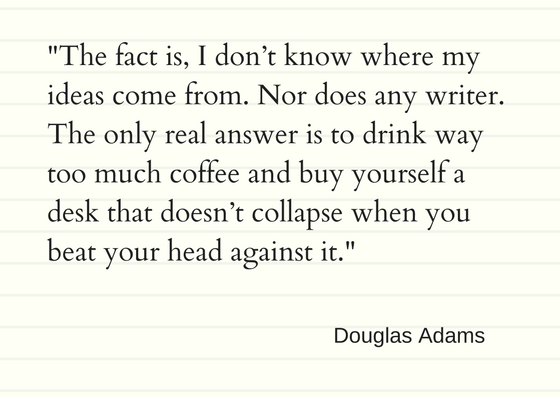
It was a frustrating day of writing like crazy. Thank god for coffee.

Sunday’s Theme Music

I worked with an officer while stationed at Shaw AFB, SC. He was a navigator who graduated college with a degree in Literature, and he wrote poetry on the side.

Music of the era set him off. He thought the lyrics were shallow and the liberties taken with grammar annoyed him. People used to sing in full, coherent sentences, telling a story, he would say, and the songs were often very poetic. He was my age, and it amused me that this upset him, because that’s not what popular music is about. It’s a reflection of the times and how language is used. It’s dynamic. Those were exactly some of the things that he mourned as going wrong.

I remember once we were getting ready to deploy to Egypt. Killing time as we had to do in those situations, we talked music, and he singled out this song, which had been released a few years before, as one that he particularly disliked – his exact words. His diatribe made me laugh.

Here is Eddy Grant with “Electric Avenue” from 1982.

Inflooftigate

Inflooftigate (catfinition) – the systematic and wary progressive process a cat or dog uses to explore or examine something.

In use: “Seeing the toy mouse on the floor, the cat began to inflooftigate. First, he stopped and stared. When the toy didn’t move or make a sound, he approached it a few steps. Stopping short, he leaned forward and avidly sniffed it. When it still didn’t register as something he knew or as a threat, he tapped it with a paw. That’s when the remote control was used to turn the mouse on. As the toy lit up and squeaked, the cat ended his inflooftigation by springing back in alarm.”

The Actors As God Dream

I was with my friend, Ron, sitting at a cafe table outside. Another friend of mine, Marge (who doesn’t know Ron, and lives across the country in Ohio), came up. She said, “Can you think of anyone who played God in movies?”

As Ron and I took in the question with a look at one another, Marge said, “I’ve tried, and I can’t think of anyone.”

I said, “Well, off the top of my head, I can think of Morgan Freeman, George Burns, Alanis Morrisette – remember? She was God in Dogma.”

Ron said, “Morgan Freeman played God?”

“Yes,” I said, “in that Jim Carrey thing. I think it was called Bruce Almighty or something. I’ve never seen the whole thing. I think I saw some of it in a hotel.”

“Oh, yeah,” Ron said.

I said, “Didn’t Whoopi play God in something, too?”

None of us were sure. Marge said, “Thank you.” As she did, Ron and I pulled out laptops to Google actors who played God in movies.

That was the dream, short, sharp, and clear. What’s not clear is what it meant and why I dreamed it. My guess is that it was some food generated neuron frenzy.

I never asked Marge why she asked the question.

Piece Work

I was thinking about my organic writing process, and how much of it is piece work.

Like many writers, I had a concept in the beginning. Then I developed a sketchy framework. Then, like many writers, I wrote to tell myself the story, to realize most of the facets, discover the plot, story and character arcs, and to find where I will begin and end. Today, I’m working on a climatic chapter, the penultimate moment. I’ve already written the end and denouement. Writing this series of scene that is this chapter means that the series’ beta version is done.

In true piece-work fashion, I’ll put together all these raw chunks of words and story until I can see the entirety. Then I’ll begin reading, editing, and revising, cutting and changing as necessary to find the right story (or stories) out of this mass of words. I’m reminded of a sculptor studying rock, marble, and wood, studying it to see what art is within the mass, waiting to come out.

From the beta will come the first draft. From the first draft will come a second draft, something that’s workable and complete. With the second draft, maybe I’ll have something to give to an editor. I’ll see. If I need to, there will be a third draft.

It’s been a long process for me to learn these things, that the first product isn’t the final product, that it won’t be perfect — that it’ll probably have substantial flaws — but whatever flaws are found doesn’t mean that I’ve failed. Writing is a journey and exploration. But it’s not just the story being explored; the novel isn’t the end-all of the journey. Most of the journey and exploration is about me, about learning how I think, what I imagine, and what I don’t know. When I write, more of myself and my attitude is revealed to me through the characters and novels than I ever realized would happen back when I first thought, “Hey, I think I’ll write a novel.” Part of this is learning, how do I cope with setbacks, disappointments, and frustrations? How do I found and maintain the pace and discipline to traverse the arcs and write a novel, or a series? How do I deal with going the wrong way?

I think that may be where many beginning writers struggle; they don’t realize how much of writing is about themselves as much as it is about the story they’re writing. It can be daunting, descending into our private depths to face the person within. It’s a test of resilience to face yourself and your shortcomings, and find ways to address them.

Time to write like crazy, at least one more time.


Blog at WordPress.com.

Up ↑