
Science fiction, fantasy, mystery and what-not
Ashland, southern Oregon. Sunday, October 4, 2026.
Supposed to be bright, sunny, and hot today, but clouds swamped three fourths of the sky, and sunshine struggled to be seen and felt. Never reached close to the 90 which was forecast, but it’s now 83 F.
Dreamed last night that I was in basic training. When I awoke and saw the date, I realized it was the anniversary of my first enlistment. October 4, 1974, I took my first oath. Twenty years later, I declared done.
I remember that first day. Rainy and overcast. Went in oh dark thirty. Was given a meal voucher for breakfast at a nearby local diner. Then had lunch at the same place with another voucher. We didn’t take off until late that afternoon.
That was my first time in an airplane, too. Flew from West Virginia, where I then lived, to San Antonio, Texas, via some other city.
It was a Friday, too. When we arrived at Lackland AFB, Texas, to begin basic training, we were informed there weren’t enough to make a full flight. We wouldn’t begin training until the following Tuesday, and spent the extended weekend in silence in our civies, waiting to begin.
Yes, welcome to the military. That’s how it was during my entire career: hurry up, then wait, then GO!
I spoke with Mom today. She called so I ended up chatting with her for an hour, just talking about life in the assisted living facility, Heritage Grove, Penn Hills. While I was speaking with her, my wife took a call on the home line and we learned that our friend, Larry, passed away at 3 AM this morning.
Larry was 96, and a military veteran. Obtaining a degree from Purdue via the GI Bill, he ended up as an engineer and an executive in the aerospace industry. After college, he lived and worked most of his life in the Los Angeles, California, area, moving up here to Ashland after retiring. He was married and adopted and raised two children and had two grandchildren. Although staunchly conservative and Republican, he was intelligent, trustworthy, and fun. I’ll miss him.
I read the NYT’s coverage of a 2026 Trump rally. They’re heavy with promise and rituals: attack the Democrats, maybe throw in a commie scare. Lie about multiple things. Donald Trump will use profanity — his fans love it when he uses profanity, because he’s telling it like it is, isn’t he? Trump sometimes claims prices are way down, which probably surprises anyone who regularly shops.
At many stops this year, Trump is begging people to support AI and data center construction. It’s the primary commercial construction now underway. He might claim the US already won against Iran, or he might threaten Iran with more bombing.
What is so sad is that after the many lies Donald Trump has made, and after all the promises that Donald Trump has broken, his brand of chaos, hatred, and bigotry still serve a portion of the Republican party.
Today’s music is by Incubus. The 2011 song, “Promises, Promises” did not come from reading the news. It came instead while listening to my mother talk about the inherent promises made — work hard, save your money, buy a house, raise a familiar — all that American dream debris, will bring you happy closure when you pass away. Mom relates that she and her gang of assisted living friends refer to their new home as jail — three hots and a cot.
I hope you live up to the promises you make, and that others fulfill the promises they make to you.
I also hope that promise and swear to Vote Blue in November, 2026.
Cheers
Donald Trump made headlines with a new steel manufacturing complex in Iowa.
In it is a tale about the Republican party.
In 2008, Essar Steel Minnesota planned to build a taconite mine, a direct-reduction-grade iron ore pellet plant, and a steel mill in Minnesota. The project suffered from repeated delays and over $1 billion in debt. In 2015, Essar withdrew its financial pledge, and the project collapsed into bankruptcy. From the bankruptcy emerged Mesabi Metallics.
Mesabi Metallics is Iowa’s new partner in the $15B steel mill complex.
Trump didn’t mention that Iowa could build this new steel plant because of windmills. Iowa is the top state in the nation for wind dependency, generating roughly 63% of its total electricity from wind power. Wind leads coal by far. A Republican governor began Iowa’s wind turbine electricity project waaayyyy back in 1983.
The project succeeded in part because Senator Chuck Grassley sponsored Wind Energy Incentives Act of 1992, which created the Production Tax Credit (PTC).

It’s hilarious in a not-funny way. Trump disparages wind energy. Donald Trump blames them for cancer, talks about how ugly they are, and bellows about how dangerous they are to birds. Yet, thanks to windmills, Donald Trump is in Iowa, trumpeting about a new manufacturing plant. Trump fights against the sort of incentives which Senator Grassley championed, the incentives which make Iowa’s new projects possible.
Trump’s hypocrisy and ignorance remain appalling.
On the other hand…
Because of all that flat farmland in Iowa, Iowa is currently at a critical energy crossroads. It ranks among the top five states per capita for data center density—with 4 massive centers under active construction and 17 more in planning in counties like Linn—meaning the Mesabi plant is landing right in the middle of a pre-existing technology boom.
Sounds good, doesn’t it? The problem is the climate, and the chance of flooding.
Your Trump Quote of the Day:
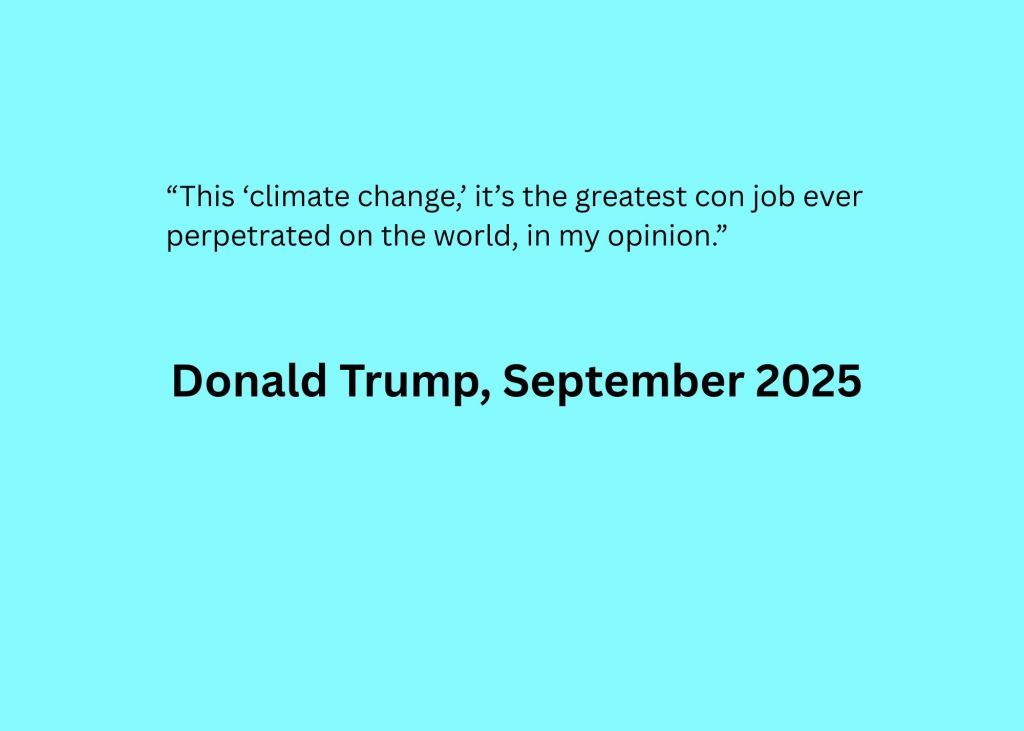
Donald Trump dismisses climate change as a con job. The new Iowa Mesabi Metallics plant sits close to the Mississippi River, which is needed as part of the plant’s supply chain. The iron pellets needed for the new steel production facility comes from Minnesota via barges on the Mississippi and railroad routes along river basins. The mining and iron pellets in Minnesota are part of that original, failed Essar Steel project that began in 2008.
Analysts cite a 15% chance that the area where the steel plant is being built will experience a major flood. That percentage might become worse, thanks to climate change and the extreme weather changes it causes, such as the super El Nino forecast for this winter.
The new steel plant is being built to survive a flood. The problem with a flood is that the plant would need to be shut down and restarted, a long and complicated process. Also, flooding will affect workers’ ability to reach the plant.
Flooding will also affect the power sources. Not the windmills, but the infrastructure needed to deliver the power.
Yet, Trump — and the GOP — are focused only on the construction and manufacturing aspects. Not the climate, weather, or other threats.
It’s funny, again, in a sad, I’m not laughing way. Back in 1983, Republicans had the vision to see these problems and forge productive viable paths forward.
Now, under Trump, they close their eyes, trying to pretend like they don’t exist.
Unfortunately, Iowans are pushing back against windmills. It again takes us to another crossoad of challenges and history. Blades have broken off and fallen in cornfields. There was also the Greenfield disaster, where a tornado hit and destroyed windmills.
Climate scientists are expecting more tornados in Iowa due to climate change. Fewer ‘tornado days’ are projected, but more tornado clusters are expected. Windmills falling apart rightly scare people. Their reaction is to build fewer windmills and even remove those which already exist. But to do that, they must shift energy production back to fossil fuels, which will accelerate climate change.
The Iowa steel and energy story is a microcosm of the global climate challenge we face. The hardest part of transitioning to clean energy isn’t the engineering or the math; it’s the political and human friction.
When Donald Trump attacks wind projects, he is speaking directly to the anxieties of older, core conservative voters who view rapid green mandates as costly and unreliable. Yet, those are now the Republicans pushing back against wind power.
It’s an interesting dichotomy. Part of that can be traced to how windmills changed from those early years into what they are now.
Part of the battle now can also be viewed as the difference between how the issue used to be framed — as a business initiative to improve costs — vice a political football to address climate change.
The good news is that young Republicans view the problem much differently than old Republicans. So, there might be hope in the future.
Once Donald Trump is gone.

