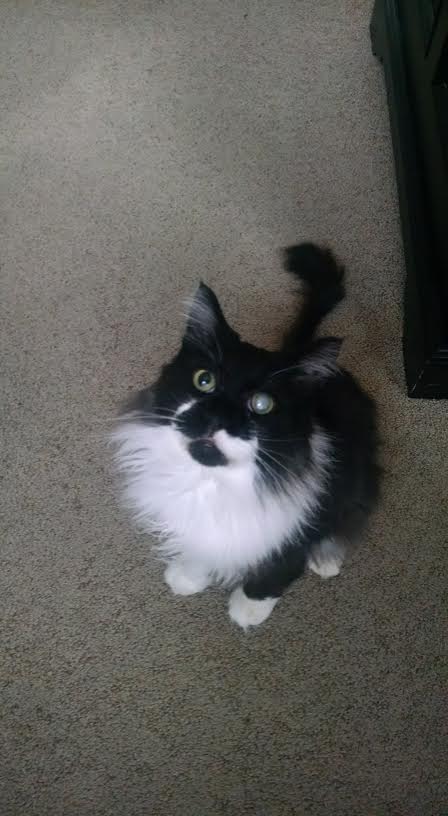
Poor Tucker. He loves kibble.
Kibble despises him.
Kibble is not a creature, but the hard cat food. Sadly, Tucker, a large black and white cat with an injured eye (who may have some Maine Coon in him) suffers from an auto-immune condition, gingivitis stomatitis. He came to us in this condition, someone’s pet lost on the streets, looking for food, shelter and affection. We stopped up because we’re suckers like that. He was not in good shape and it took almost a year for us to discover the terrible conditions of his gums and teeth. Bleeding, infections, bad breath, ulcers, inflammation, pain and sensitivity, he had it all.
We started him on medications and steroids to contain the problem. Our vet recommended we pull all his teeth. No, no, no, no, no, we replied, no. Instead, we sought methods for containing and reducing the problem. Through reading and testing, we found he can’t eat kibble, period. So all kibble was taken from him. He eats wet food only but not just any. I’ve found that those wet foods with carrageenan causes swelling, ulcers and inflammation in him so they’ve been taken out of his diet. This finding of mine is contrary to the pet food industry’s findings, that carrageenan doesn’t contribute to these issues, but since restricting him from them, he’s doing much better, so I’ll accept my findings over their findings. Then, after reading of others’ success with L-lysine, I initiated a daily practice of dosing him with L-lysine. Buying it in capsule form, I dilute it a little water and squirt 100 CCs into his mouth before his morning and evening meals.
These practices have worked well with him, and he’s not needed any shots in four months. A year ago, he was going every 30 t0 45 days.
Sadly, though, Tucker is a huge kibble fan. We also feed it to our other cats (we have one, but ‘take care of’ two others). So Tucker remains on a perpetual quest to get to the kibble and gobble it up. He’s also a fighter. Although amazingly sweet and docile with humans, when it comes to other cats, he wants to fight, not chase or hiss or yowl, but launch himself fangs and claws out and battle! So we segregate the four cats. The matter is more complicated as Boo Radley, the big black tailless stray, taken in to protect him from the frigid winter but now probably also our pet, fights with Meep, the ginger cat that isn’t allowed in his house. (We bring him in to feed and offer shelter from foul and cold weather.) Only Quinn, our black paw buddy, gets along with the others. It’s trying, to express the most minimal impact, to deal with the fights when Meep, Tucker or Boo encounter one another and unsheath their claws.
It all works in a way, but we need to find a way to end the fights. At least we’ve mitigated many of Tucker’s problems. Maybe someday we’ll find kibble that doesn’t cause him issues. Then he’ll be one purring kitty.
 Michael Seidel, writer